UK Bed Frame Size Chart, All Standard Dimensions
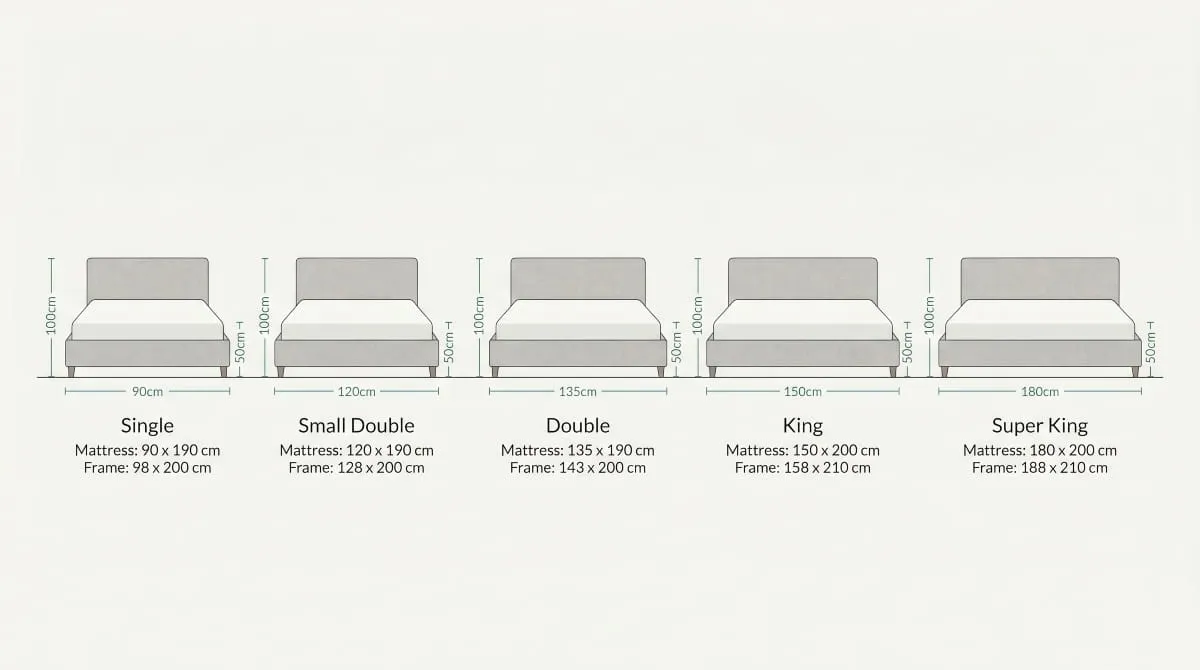
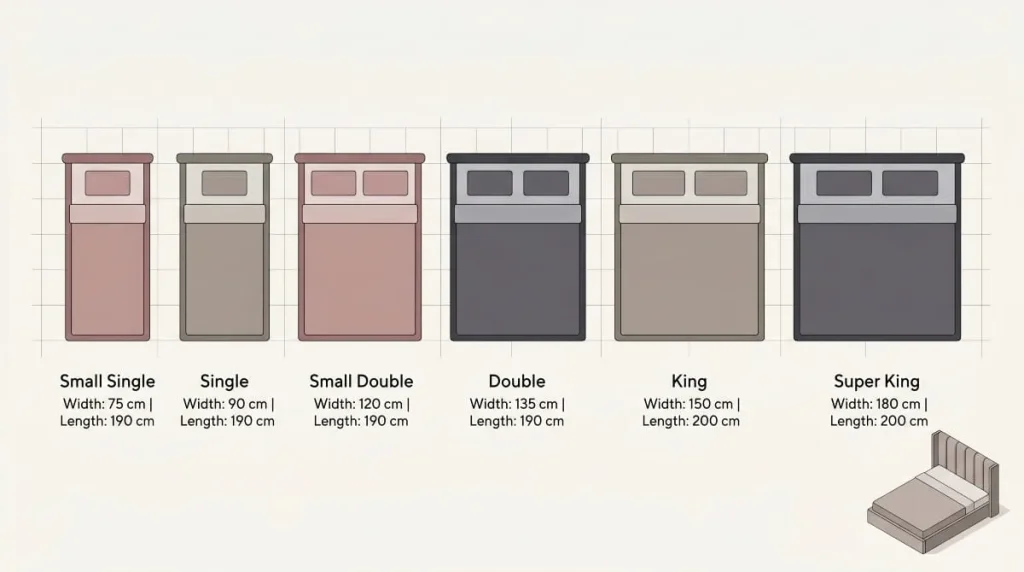
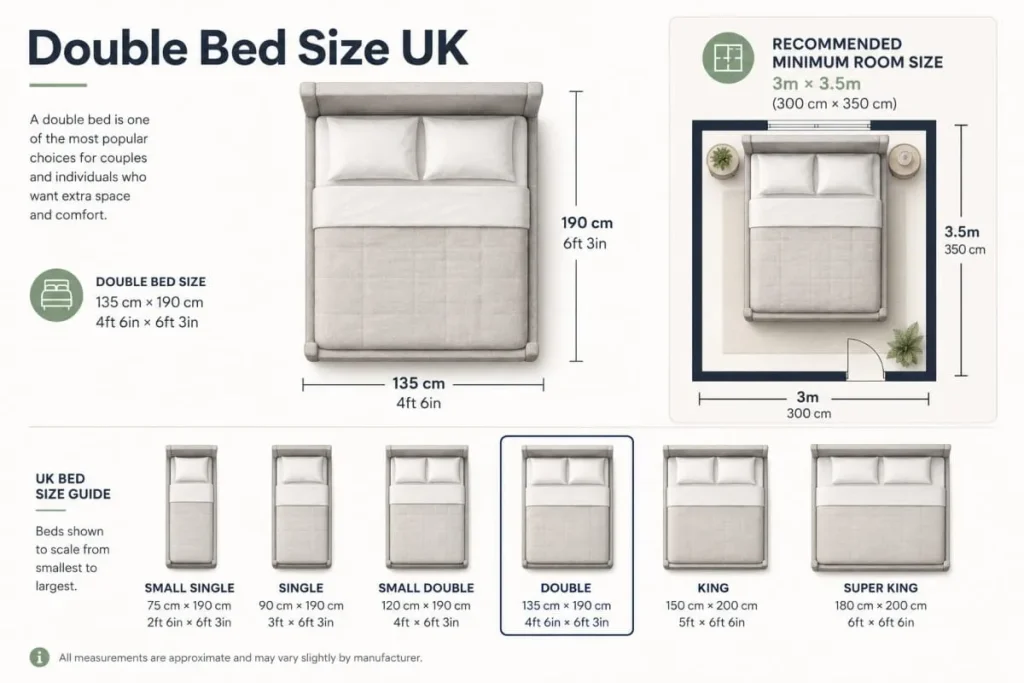
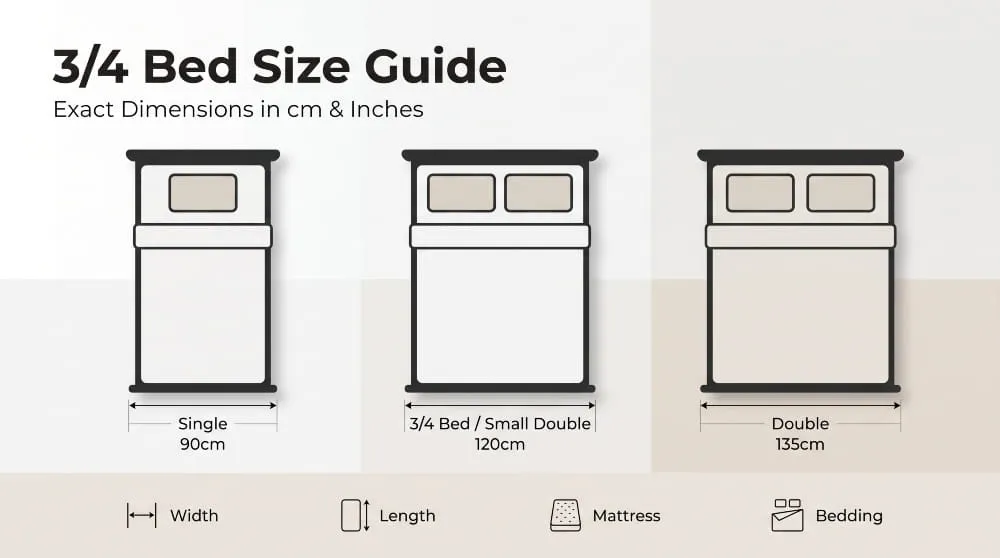
UK bed frames follow standardised mattress sizes, but the external frame dimensions vary depending on the design and construction. The table below gives you the mattress size, the typical external frame footprint, and the imperial equivalent for every standard UK size, so you’re working with the numbers that actually matter when measuring a room.
| Size | Mattress | External Frame (cm) | Frame (inches) | Relative Width |
|---|
| Single | 3ft
90 × 190 cm | 98–100 × 195–205 | 39 × 77–81″ | 90 cm |
| Small Double | 4ft
120 × 190 cm | 128–132 × 195–205 | 50–52 × 77–81″ | 120 cm |
| Double | 4ft 6in
135 × 190 cm | 143–148 × 195–208 | 56–58 × 77–82″ | 135 cm |
King
Most Popular | 5ft
150 × 200 cm | 158–165 × 205–215 | 62–65 × 81–85″ | 150 cm |
| Super King | 6ft
180 × 200 cm | 188–196 × 205–215 | 74–77 × 81–85″ | 180 cm |
Please Note: External frame dimensions are larger than the mattress size. Always measure your room using the external frame dimensions, not the mattress size.
Frame dimensions vary between manufacturers. Upholstered frames with deep-padded rails tend to sit at the wider end of the ranges above; divan and platform bases typically sit closer to the narrower end.
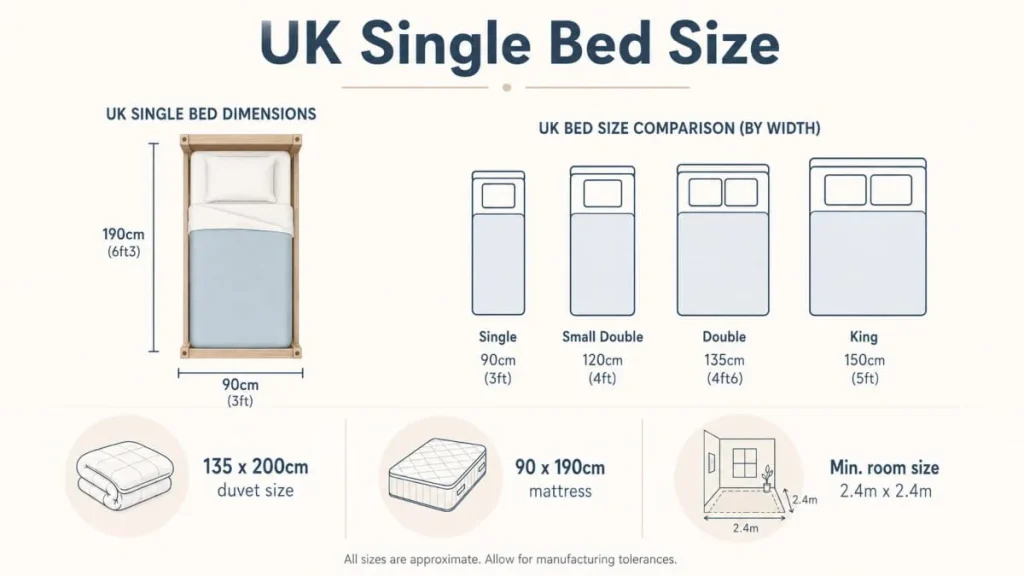
Single Bed Frame Dimensions (3ft)
A single bed frame holds a 90cm × 190cm mattress and typically measures between 98cm and 100cm wide externally, with a length of 195cm to 205cm depending on the headboard attachment and footboard design. In feet and inches, that puts the external footprint at roughly 3ft 3 in wide by 6ft 5 in to 6ft 9 in long. Single frames are the most compact option available and suit bedrooms from around 190cm wide, though a room of at least 240cm × 300cm gives you workable space around the bed on two sides.
Double Bed Frame Dimensions (4ft 6in)
A double bed frame, the most common size sold in the UK, holds a 135cm × 190cm mattress and measures approximately 143cm to 148cm wide externally, with a length of 195cm to 208cm. In imperial terms, that’s roughly 4ft 8in to 4ft 10in wide by 6ft 5in to 6ft 10in long. It’s a practical size for a single sleeper who wants room to move, or a couple in a smaller bedroom, but it is worth noting that a double mattress gives two people just 67.5cm of sleeping width each, less than a single bed.
King Size Bed Frame Dimensions (5ft)
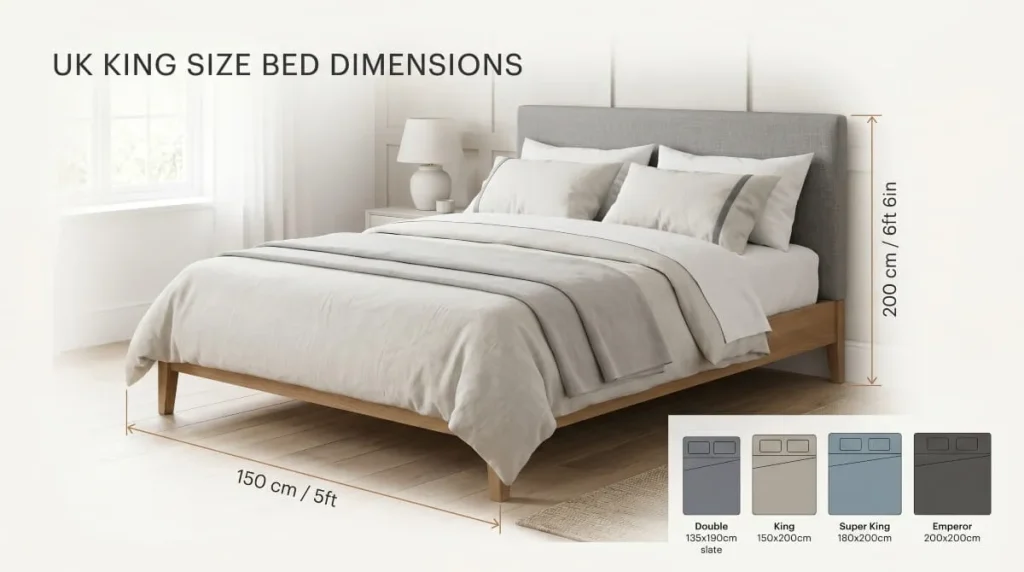
A king size bed frame holds a 150cm × 200cm mattress and has an external footprint of approximately 158cm to 165cm wide and 205cm to 215cm long, roughly 5ft 2in to 5ft 5in by 6ft 9in to 7ft. It’s the most popular upgrade from a double for couples, adding 15cm of mattress width while also gaining 10cm in length over a standard double mattress. For a room, you’re looking at a recommended minimum of around 300cm × 340cm to maintain comfortable clearance on both sides and at the foot of the bed.
Super King Size Bed Frame Dimensions (6ft)
A super king bed frame holds a 180cm × 200cm mattress and externally measures between 188cm and 196cm wide and 205cm to 215cm long, approximately 6ft 2in to 6ft 5in wide by 6ft 9in to 7ft long. It is the largest standard UK bed size and genuinely requires a room with space to match. A bedroom of at least 350cm × 360cm is the practical minimum; anything smaller and the super king tends to dominate rather than anchor the room. In the right space, though, it’s the most comfortable option available for two people.
How UK Sizes Compare to US Queen and California King
UK and US bed sizing use different standards, which matters if you’re importing a frame, buying a mattress internationally, or simply trying to make sense of size references across different websites.
A US Queen (153cm × 203cm) is the closest American equivalent to a UK King, and the two are nearly identical in mattress size. However, US queen frames are typically slightly narrower externally than their UK king counterparts due to construction differences. A US King (193cm × 203cm) sits between a UK super king in width and slightly exceeds it, so UK super king bedding will not fit a US king mattress correctly.
The California King (183cm × 213cm) is narrower than a US King but 10cm longer, closer to a UK super king in width but notably longer. It has no direct UK equivalent and is rarely stocked by UK manufacturers. If you’re shopping on a UK site, all size references will follow British standards unless explicitly stated otherwise.
King Size Bed Frame Dimensions, Full Breakdown
A king size bed frame in the UK has an external footprint of approximately 158cm to 165cm wide and 205cm to 215cm long, larger than the 150cm × 200cm mattress it holds, because the frame’s rails, base surround, and upholstery all add to the overall size. Here are all the measurements you need, across all formats.
King Size Frame Dimensions in cm
The mattress cavity of a king size frame measures 150cm × 200cm. The external width runs between 158cm and 165cm, and the external length between 205cm and 215cm. The variance comes down to construction: a fabric-upholstered frame with padded side rails will sit toward the wider end; a thinner-railed divan or platform base will sit closer to 158cm. Always ask the manufacturer for the external frame dimensions specifically, not the mattress size, before measuring your room.
King Size Frame Dimensions in Inches
In inches, a king size bed frame measures approximately 62 to 65 inches wide and 81 to 85 inches long. The mattress itself is 59 inches × 79 inches (150cm × 200cm). The frame adds roughly 3 to 6 inches in width and 2 to 6 inches in length, depending on the design. For room planning in imperial, budget for at least 68 inches of total width, including a 24-inch walkway on one side, and 90 inches of total length with clearance at the foot.
King Size Frame Dimensions in Feet and Metres
In feet, a king-size frame runs approximately 5ft 2in to 5ft 5in wide and 6ft 9in to 7ft long. In metres, that is 1.58m to 1.65m wide and 2.05m to 2.15m long. These are the numbers to use when cross-referencing a room’s floor plan, since most architectural drawings and estate agent floor plans use metres in the UK.
King Size Frame With Headboard, How Height Affects Space
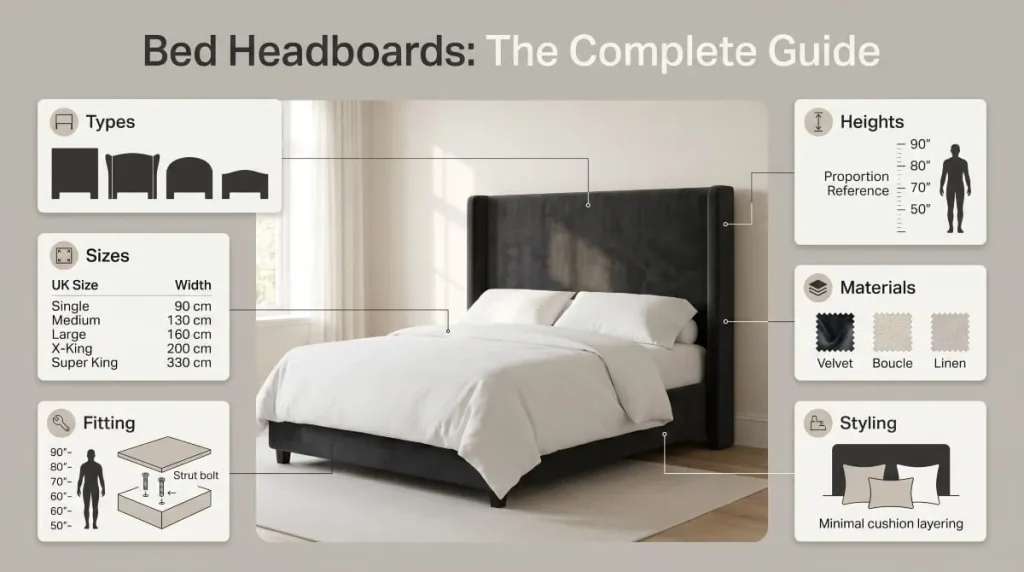
A headboard does not change the floor footprint of a king-size frame, but it does affect two things: wall clearance and visual proportion. Most king-size headboards range from 100cm (about 39 inches) to 150cm (about 59 inches) in height from the floor, with high-back and wingback styles reaching 130cm to 150cm or more. In a room with a ceiling height of 240cm, the UK standard for modern builds, a 140cm headboard will occupy more than half the wall height behind the bed, which reads as bold and considered in a large room, and overpowering in a smaller one. No additional floor space is required, but the bed should sit close enough to the wall for the headboard to be seen in full without a gap that looks unfinished, typically no more than 5cm to 10cm from the wall.
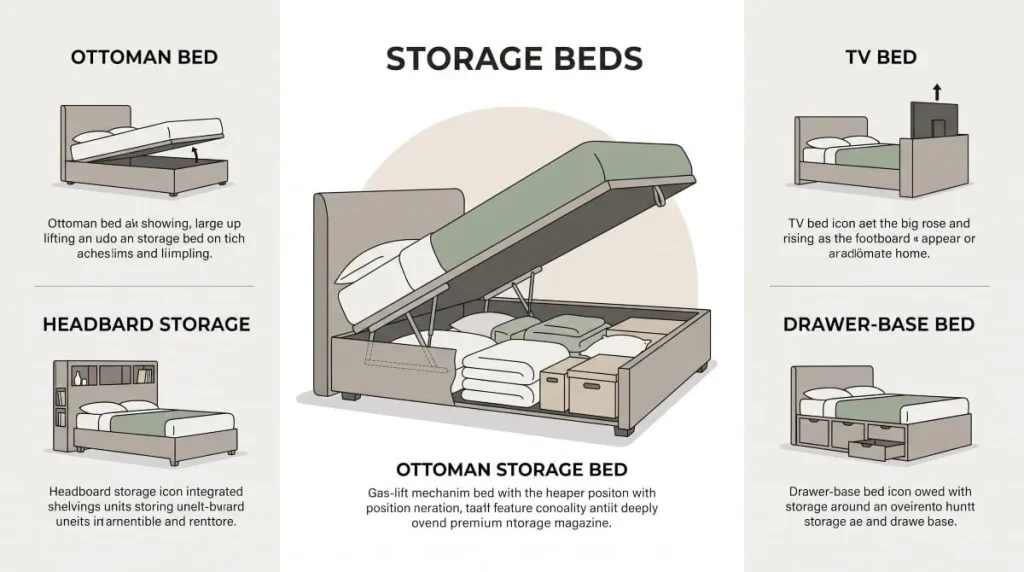
King Size Ottoman Storage Bed Frame: Does Storage Change the Footprint?
An ottoman king-size frame has the same external footprint as a standard king, approximately 158cm to 165cm wide and 205cm to 215cm long. The storage mechanism is contained within the base, so the floor plan remains unchanged. What does change is the operational clearance required: an end-lift ottoman opens from the foot of the bed and needs roughly 60cm to 80cm of unobstructed space at the foot to lift fully. A side-lift ottoman opens along one of its long edges and requires the same clearance on the chosen side. If your room is tight at the foot, a common issue in bedrooms where the bed faces a fitted wardrobe, a side-lift ottoman is the more practical configuration.
Queen Size Bed Frame Dimensions (US Sizes Explained)
The queen-size bed frame is an American and Australian standard; it doesn’t exist as a named size in the UK market. If you’ve seen “queen size” referenced on a UK furniture site, it almost always means a UK king (150cm × 200cm), which is the closest British equivalent. Here’s how the measurements actually compare.
Queen Frame Dimensions in cm and Inches
A US queen mattress measures 153cm × 203cm (60 × 80 inches). The external frame that holds it typically runs between 160cm and 168cm wide and 210cm to 220cm long, roughly 63 to 66 inches wide and 83 to 87 inches long. It is marginally wider and longer than a UK king-size frame, though the two are close enough that the difference rarely matters for room planning. Where it does matter is bedding: US queen sheets and mattress protectors will not fit a UK king mattress correctly, despite the sizes appearing almost identical on paper, because the depth and tuck measurements differ between manufacturing standards.
How a US Queen Compares to a UK King Size
The US queen (153cm × 203cm) and the UK king (150cm × 200cm) differ by just 3cm in width and 3cm in length, a difference that is essentially invisible in a room but meaningful for mattresses, bases, and bedding compatibility. A US queen mattress will not fit snugly into a UK king frame, and vice versa, because frames are engineered to the millimetre for their intended mattress size. If you’re buying a bed frame in the UK, shop by UK sizing: single, double, king, super king, and treat any queen size reference as a prompt to clarify with the retailer exactly which standard they’re using.
Bed Frame Dimensions by Type
The size of a bed frame isn’t determined solely by the mattress; the type of frame you choose affects the external footprint, floor clearance, and, in some cases, the amount of room you need to use it properly. Two king-size frames can have meaningfully different real-world dimensions depending on whether one is a slatted frame and the other is an ottoman. Here’s what to expect from each type.
Standard Slatted Bed Frame Dimensions
A slatted bed frame is the leanest of the standard options, so its external dimensions are closest to the mattress size. A king size slatted frame, for example, typically measures 158cm to 161cm wide and 205cm to 208cm long, toward the lower end of the 158cm to 165cm external range. The slats span the frame’s internal width and support the mattress directly, with no additional base bulk adding to the footprint. Floor clearance on a slatted frame is generally between 15cm and 30cm, depending on leg height, which is enough for under-bed storage boxes but not for built-in ottoman mechanisms.
Ottoman Bed Frame Dimensions, Floor Clearance and Lid Lift Space
An ottoman bed frame has the same external footprint as a slatted frame of the same size, but the storage mechanism is housed within the base rather than extending beyond it. What changes is the operational space required around the bed. An end-lift ottoman needs 60cm to 80cm of clear floor space at the foot of the bed to allow the base to open fully; a side-lift needs the same clearance along one long edge. Floor clearance on an ottoman is minimal, typically 5cm to 10cm, because the base sits close to the floor to maximise the internal storage volume. According to bed industry data, ottoman beds now account for a significant share of upholstered bed sales in the UK, driven largely by buyers in urban homes where built-in storage is limited.
Sleigh Bed Frame Dimensions, Why They Run Larger
Sleigh beds are consistently the largest-footprint option within any given mattress size, and the reason is structural. The curved or scrolled headboard and footboard that define the sleigh silhouette both extend beyond the mattress plane; the footboard, in particular, adds meaningful length to the overall frame. A king size sleigh frame typically measures 165cm to 170cm wide and 220cm to 230cm long, which puts it 15cm to 20cm longer than a standard slatted king frame in the same room. If you’re working with a bedroom that’s comfortably sized for a king but only just, a sleigh design may require stepping down to a smaller mattress to preserve adequate walkway clearance.
Floating/Platform Bed Frame Dimensions
A floating or platform bed frame is defined by its low profile and the visual illusion that the mattress appears to hover above the floor. Externally, the footprint is comparable to a standard slatted frame; a king platform frame will typically measure 160cm to 165cm wide and 208cm to 215cm long, but the height profile is dramatically lower. Most platform frames sit between 15cm and 25cm from the floor to the top of the base, compared to 35cm to 45cm for a standard legged frame. That low clearance means under-bed storage is impractical, and the reduced height can make getting in and out of bed harder for people with mobility concerns. In a room with high ceilings, a platform frame’s low stance amplifies the sense of space; in a room with standard ceiling height, the effect is more modest.
Divan Bed Frame Dimensions
A divan base sits flush to the floor with no legs, which means the external footprint matches the mattress size far more closely than a framed alternative. A king-size divan typically measures 150cm to 153cm wide and 200cm to 203cm long externally, making it the closest to the raw mattress dimensions of any bed type. What a divan lacks in visual presence, it compensates for in practicality: drawer divans offer accessible built-in storage without the lid-lift clearance requirement of an ottoman, and the solid base construction provides consistent mattress support across the full surface. Divan bases are almost always sold in two halves for king and super king sizes, which simplifies delivery through narrow hallways and up standard UK staircases.
How to Measure Your Room for a Bed Frame
Before you commit to a bed frame size, measure the room, not just the wall the bed will sit against. A surprising number of returns and reorders come down to one missed measurement: a frame that fits the floor plan but won’t get through the door, or a size that looked workable on paper but leaves no usable space around the bed. Ten minutes with a tape measure before you order will settle every question.
Step-by-Step Room Measuring Guide
Start with the room itself. Measure the floor’s full width and length at skirting board level, not at shoulder height, where the room may feel wider due to architectural features. Note any recesses, radiators, fitted wardrobes, or door swings that reduce usable floor space, because a bed placed in front of a radiator or blocking a wardrobe door creates daily friction that compounds quickly.
Next, mark out the bed’s external footprint on the floor using masking tape or an AR-measuring app. Include the headboard position against the wall and the foot of the bed toward the room. Stand in the space and walk around it. If you can’t move naturally on at least two sides, the size is too large for the room, regardless of what the numbers suggest on paper.
Finally, measure the height of any window sills, light switches, or plug sockets on the wall where the headboard will sit. A tall headboard, anything above 130cm from the floor, can obscure switches or conflict with low window sills on period properties, which is worth knowing before the frame arrives.
How Much Walkway Space Do You Need Around a Bed
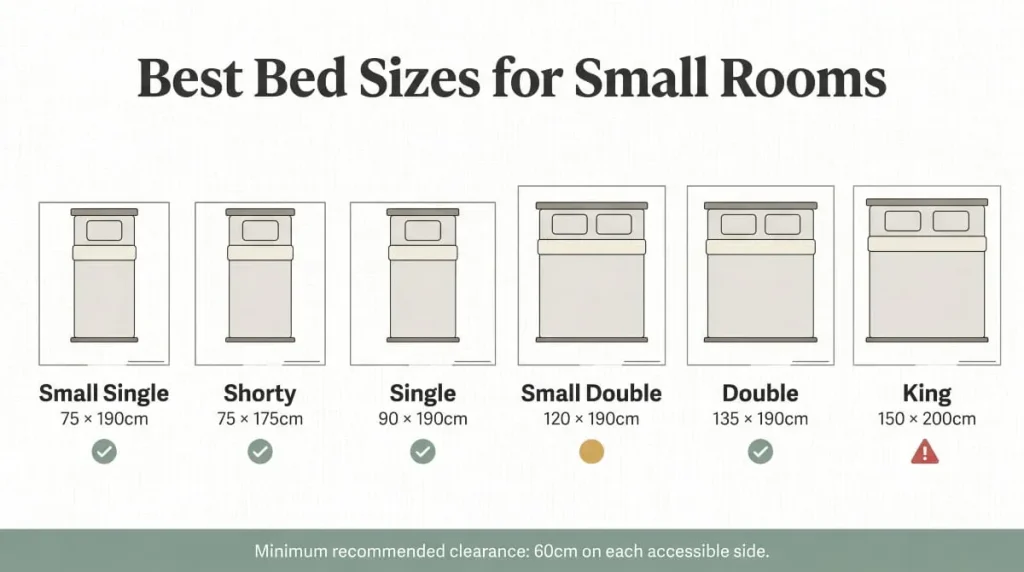
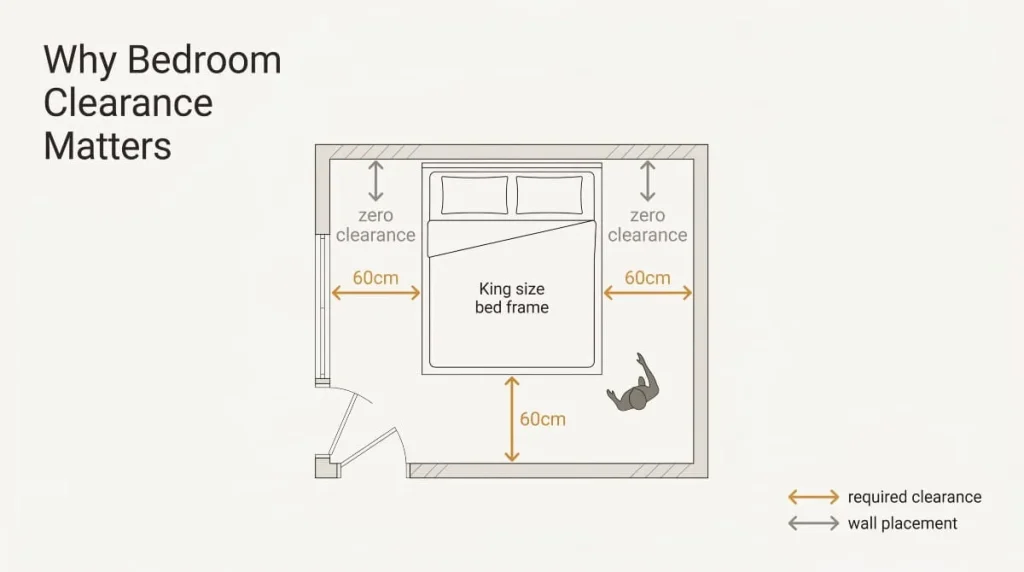
The widely used minimum is 60cm of clear walkway on each accessible side of the bed, enough to walk without turning sideways, open a bedside drawer, and make the bed comfortably. For a more generous feel, 75cm to 90cm is the standard recommended by most interior designers for a primary bedroom. At 90cm, you can dress and move freely, and the room reads as considered rather than full.
The foot of the bed is often the most constrained point, particularly in rectangular rooms where the bed faces a doorway or fitted wardrobe. A minimum of 90cm at the foot is the practical standard; less than that, and the room feels like a corridor. If an ottoman base is on your shortlist, add the lid-lift clearance requirement (60cm to 80cm) to any walkway you’re planning, since both are needed simultaneously.
Measuring for Delivery, Doorways, Stairwells, Landings
A bed frame that fits the room still has to get into the room, and this is where delivery measurements catch people out. Most UK bed frames are delivered flat-packed or in parts specifically to manage this. Still, some fully assembled or part-assembled frames, particularly large upholstered headboards and ottoman bases, require meaningful clearance to manoeuvre.
Measure the width and height of your front door, any internal doorways the frame will pass through, and the narrowest point on any staircase, including the handrail. The critical number for most deliveries is the diagonal clearance in a stairwell. A panel or headboard that’s 200cm long needs enough diagonal space to tilt through the turn. A standard UK staircase has a width of around 90cm, which is sufficient for most flat-pack components but tight for assembled sections.
King and super king divan bases are split into two halves as standard, which resolves most staircase problems. Ottoman gas lift mechanisms are usually delivered unattached and fitted on site. If you’re ordering a large upholstered frame and live in a flat above the ground floor or a period property with a narrow staircase, contact the retailer before ordering to confirm how the frame is delivered and whether an assembly service is available, it’s a straightforward question that prevents a difficult situation on delivery day.
Shop Style Beds Frames, Handcrafted in Yorkshire, Sized to Fit Your Room
Every bed frame in the Style Beds collection is handcrafted at our workshop in Dewsbury, West Yorkshire, and made to order in the size, fabric, and headboard height you choose. There are no generic imports, no flat-pack compromises, just a properly built upholstered frame, sized to the millimetre and delivered free to mainland UK in 3 to 5 working days.
Whether you’ve worked out that a king-size is right for your room or you’re still deciding between a double and a king, every frame is available across all standard UK sizes, single, double, king, and super king, in a choice of fabrics including Plush Velvet, Teddy Boucle, and Naples, with nine headboard heights from 50 inches to 90 inches. Hence, the proportions work for your ceiling and your room.
If storage is part of the brief, the ottoman range lifts on a gas mechanism and uses every centimetre of the base, no wasted cavity, no flimsy drawer runners. And if you’re not completely certain the frame is right once it arrives, the 30-night sleep trial means you’re not locked in.
Browse by size below, or use the headboard height guide above to narrow your choice before you click through.
→ Shop King Size Bed Frames → Shop Super King Bed Frames → Shop Double Bed Frames → Shop Ottoman Bed Frames
Frequently Asked Questions (FAQ’s)
Are bed frame dimensions the same as mattress dimensions?
No. Bed frame dimensions and mattress dimensions are different measurements, and confusing the two is the most common sizing mistake buyers make. A mattress size refers to the sleeping surface; a UK king mattress is 150cm × 200cm. The bed frame that holds it will measure larger externally, typically 158cm to 165cm wide and 205cm to 215cm long, because the rails, base surround, and upholstery all add to the overall footprint. Always ask for the external frame dimensions when measuring your room, not the mattress size the frame is built for.
What size room do I need for a king-size bed frame?
A king-size bed frame needs a room at least 300cm × 340cm to maintain a workable 60cm walkway on both sides and at the foot of the bed. For a more comfortable layout with 75cm of clearance on each side, the standard recommended for a primary bedroom, a room of 320cm × 360cm or larger is the practical target. If your bedroom falls below 300cm in either dimension, a double frame will give you a better-proportioned room without sacrificing much sleeping width.
Do all king-size mattresses fit a king-size frame?
All UK-standard king-size mattresses (150cm × 200cm) will fit any UK-standard king-size frame. The compatibility issue arises with non-UK mattresses. A US queen mattress (153cm × 203cm) is 3cm wider and longer than a UK king and will not sit correctly in a UK king frame. Similarly, a mattress bought from a European manufacturer may use slightly different dimensions even when labelled as “king.” If you’re replacing a mattress rather than buying new, measure the existing mattress before ordering a frame, rather than relying on the size label.
What’s the difference between a UK super king and a US California king?
A UK super king measures 180cm × 200cm (6ft × 6ft 6in). A US California king measures 183cm × 213cm, slightly wider and notably longer, at roughly 72 × 84 inches. The two are close enough in width that they’re sometimes conflated, but the California king’s additional 13cm in length makes a meaningful difference both in mattress fit and bedding compatibility. UK super king bedding will not fit a California king mattress correctly. The California king has no direct UK equivalent and is not a standard size stocked by UK bed manufacturers.
How much bigger is a king frame than a double?
A king-size frame is approximately 15cm to 20cm wider and 10cm to 15cm longer than a double frame. In practical terms, a double frame typically measures 143cm to 148cm wide and 195cm to 208cm long, while a king measures 158cm to 165cm wide and 205cm to 215cm long. The mattress difference is 15cm in width and 10cm in length, from 135cm × 190cm to 150cm × 200cm, giving each person in a couple an additional 7.5cm of sleeping space. That’s a modest number on paper but a meaningful difference in practice, which is why the king is consistently the most popular upgrade purchase for couples in the UK.
Do Ottoman frames take up more room than standard frames?
An ottoman frame has the same external floor footprint as a standard frame of the same size, and the storage is built into the base, not added around it. What an ottoman does require is operational clearance: an end-lift ottoman needs 60cm to 80cm of unobstructed space at the foot of the bed to open fully, and a side-lift needs the same clearance along one long edge. If that clearance already exists within your walkway space, an ottoman adds no meaningful room requirement beyond a standard frame. If your room is tight at the foot, common where a bed faces a fitted wardrobe, a side-lift configuration or a drawer divan is the more practical alternative.
































)
&description=&image=https://stylebeds.co.uk/wp-content/uploads/2026/05/Bed-Frame-Dimensions--1024x572.webp)