
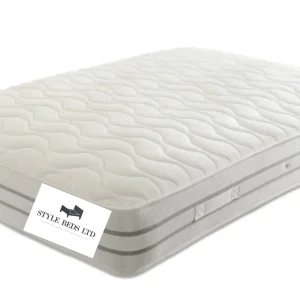
Gold Cashmere Mattress
Price range: £369.90 through £609.99
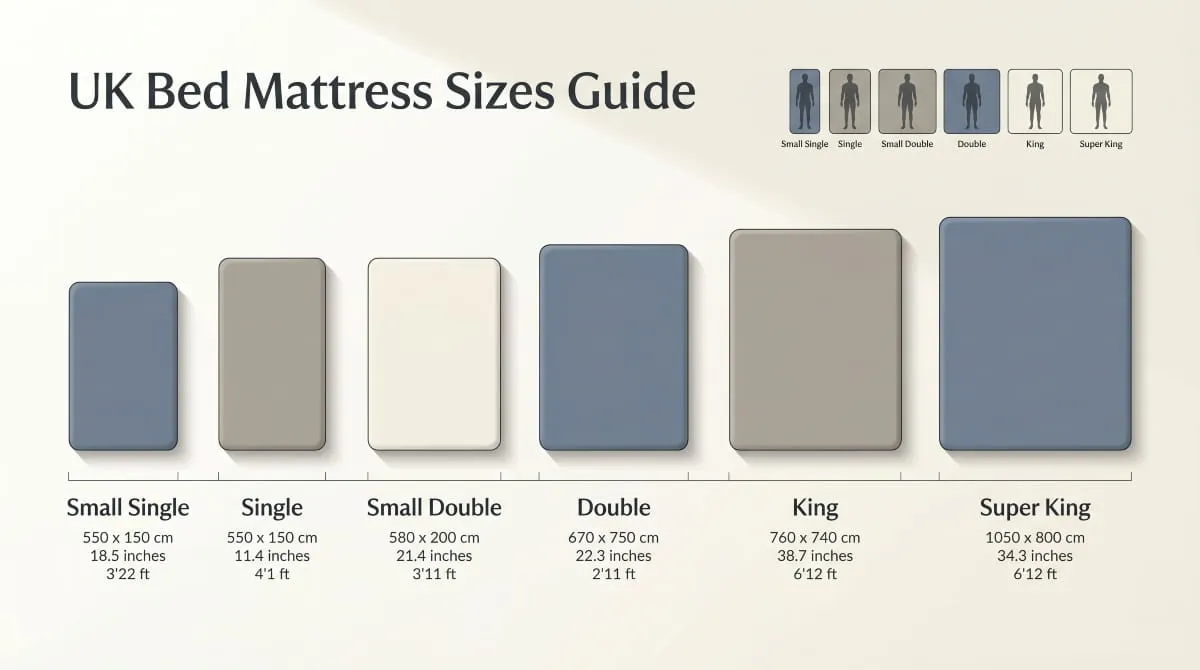
UK bed mattress sizes follow a standardised set of dimensions, from the 90 × 190 cm single up to the 180 × 200 cm super king, but choosing the right one means more than just knowing the numbers. Room size, sleeping habits, and bed frame type all shape the decision, and getting it wrong is an expensive mistake.
This guide covers every standard UK mattress size in centimetres, inches, and feet, with honest comparisons between sizes, minimum room size recommendations, and answers to the questions most buyers are still Googling at midnight before placing an order.
Whether you’re sizing up from a double, debating whether a king is worth the extra space, or trying to work out if two singles can replace a super king, it’s all here, clearly laid out and easy to reference.
What Are the Standard UK Bed Mattress Sizes?
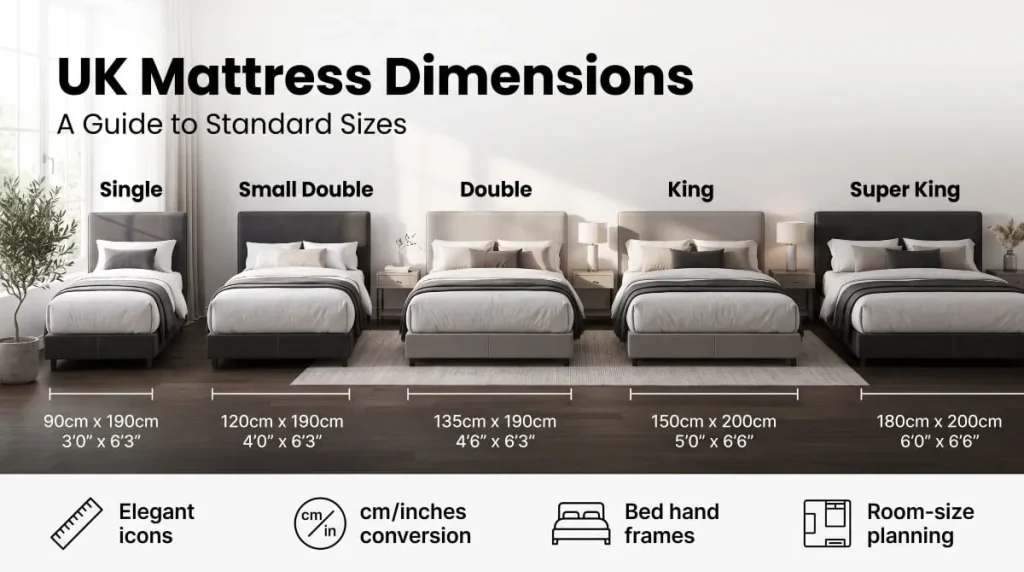
There are six standard UK bed mattress sizes: small single, single, small double, double, king, and super king. Each follows a set width and length measured in centimetres, with the length remaining consistent at 190–200 cm across most sizes, while the width varies.
UK Bed Size Chart, All Sizes at a Glance (cm, inches, feet)
A few things worth noting. The king and super king are the only two sizes whose lengths extend to 200 cm rather than 190 cm, a 10 cm difference that matters if you’re tall. The double is the most commonly purchased size in the UK, accounting for a significant share of all mattress sales, which is why it has the widest availability across price points, materials, and brands.
UK and US bed sizes share some of the same names but not the same dimensions, which catches many buyers out, particularly when ordering internationally or replacing a mattress on an imported bed frame.
A US king, for example, measures 193 × 203 cm, making it noticeably wider than a UK king at 150 × 200 cm. The US queen, a size that doesn’t formally exist in the UK market, sits at 153 × 203 cm, which is close to a UK king but not identical. A US full (or double) measures 137 × 190 cm, slightly wider than a UK double at 135 × 190 cm, but close enough that bedding often crosses over.
European sizing follows its own logic. A standard European double (often called a French double) typically measures 140 × 200 cm, wider than a UK double but shorter than a UK king. Continental beds frequently run 200 cm long as standard, which is why European mattresses can feel roomier lengthways than their UK equivalents in the same named size.
The practical rule: never assume that a size name transfers across markets. Always check the centimetre dimensions before buying, especially for mattress protectors, fitted sheets, or replacement mattresses for frames purchased abroad.
This is one of the most common sources of confusion in mattress shopping. A mattress is not designed to match the outer dimensions of a bed frame; it’s designed to fit inside it.
A UK king-size bed frame, for instance, will have an internal sleeping surface of 150 × 200 cm, but its external footprint, including the frame surround, headboard base, and any side rails, will be considerably larger. The exact external measurements vary by manufacturer and design, but buyers should expect to add 5–10 cm to each side when planning the room layout.
The same logic applies in reverse when choosing a mattress. The size you need is determined by the internal dimensions of the frame’s base, the slatted platform or divan top, not by the frame’s outer measurements. If you’re replacing a mattress without access to the original specs, measure the base directly rather than the frame exterior. A mattress that’s even a few centimetres too wide won’t sit correctly and can affect both comfort and the frame’s structural integrity over time.
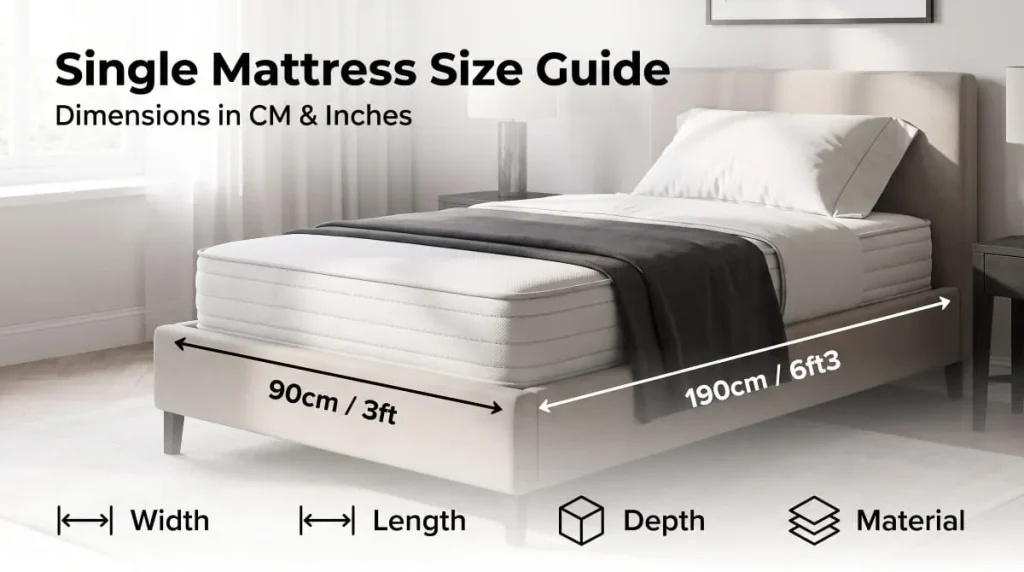
A standard single bed mattress measures 90 × 190 cm (35″ × 75″, or 3’0″ × 6’3″) and is the most widely used size for children’s bedrooms, guest rooms, and single sleepers in compact spaces. It’s a straightforward size with broad availability, but it isn’t the only single-width option, and for some buyers, the small single is worth considering first.
The single mattress measures 90 cm wide by 190 cm long, dimensions that have remained consistent across UK manufacturers for decades, making replacement straightforward and bedding easy to source. At just under a metre wide, it provides adequate sleeping space for one person but leaves little room for movement, which is why it tends to work better for children and teenagers than for adults who move around in their sleep.
For adults over 6 feet tall, the 190 cm length can become a limiting factor. Some manufacturers offer a 90 × 200 cm extended single, though this size isn’t universally stocked and can make fitted sheets harder to find. If height is a concern, it’s worth checking whether a king-size, which runs 200 cm long as standard, is a more practical long-term investment, even in a guest room context.
The small single measures 75 × 190 cm (30″ × 75″, or 2’6″ × 6’3″), 15 cm narrower than a standard single and designed primarily for shorty beds, bunk beds, and very compact children’s rooms where saving floor space is the priority.
That 15 cm difference is more significant than it sounds. It reduces the sleeping surface from a functional single width to something closer to a cot-style dimension, limiting its use to younger children or situations where space genuinely cannot accommodate a full single. Availability is also narrower; fewer mattress manufacturers stock the small single as a core size, so the choice of materials and firmness options tends to be more limited, and bedding can be harder to match.
The small single is a practical choice when the bed frame dictates it. Outside of that constraint, most buyers are better served by the standard single.
A single mattress makes sense in three clear situations: a child’s first proper bed, a dedicated guest room that sees occasional use, or a box room where floor space genuinely won’t accommodate anything wider. In each case, the size delivers exactly what’s needed without excess.
Where it falls short is for adult primary sleepers. At 90 cm wide, there’s enough room to sleep comfortably in one position, but not enough to turn freely or maintain a comfortable distance from the edge, which becomes noticeable quickly for anyone using it as their main bed night after night. Research into sleep quality consistently shows that a restricted sleeping surface increases nighttime disturbance, particularly for restless sleepers.
For a guest room that’s used more than a few times a year, or for a teenager moving into a larger bedroom, it’s worth considering whether a small double at 120 × 190 cm would serve better. The floor space difference is modest, 30 cm of width, but the usability difference for an adult sleeper is significant.
A small double bed mattress measures 120 × 190 cm (47″ × 75″, or 4’0″ × 6’3″), 30 cm wider than a standard single but 15 cm narrower than a full double. It occupies a practical middle ground that’s often overlooked, yet for single adults in smaller bedrooms it’s frequently the smartest size choice on the market.
At 120 cm wide and 190 cm long, the small double gives a single sleeper considerably more room to move than a standard single without demanding the floor space that a full double requires. The length stays consistent with the single at 190 cm, so it’s subject to the same caveat for taller sleepers; anyone over 6 feet may find the length tight over time.
It’s worth noting that the small double is sometimes listed by retailers under alternative names: “three-quarter bed” and “queen” are both used informally in the UK market, though neither is a precise industry term here. If you’re shopping across multiple retailers, the safest approach is to filter by centimetre dimensions (120 × 190 cm) rather than relying on the size label alone, as naming conventions aren’t always consistent.
Bedding availability has improved significantly for the small double in recent years, and most major UK linen brands now stock fitted sheets and duvet covers in this size as a standard line rather than a special order.
For a single adult using the bed as their primary sleeping space, the small double is almost always worth the upgrade. The 30 cm of additional width, roughly the span of a hand and forearm, translates into meaningfully more freedom of movement during sleep, which has a direct effect on sleep quality. You’re no longer sleeping close to the edge by default, and turning over doesn’t require conscious repositioning to stay on the mattress.
The floor space trade-off is modest. A small double adds 30 cm to the width of a single, which in practical terms means it fits comfortably in rooms that couldn’t accommodate a full double, typically bedrooms in the 2.5 to 3 metre width range, where a 135 cm double would feel cramped or obstruct a doorway or wardrobe.
The single remains the right choice in two specific scenarios: when a child’s age or room size genuinely dictates it, or when a bunk or cabin bed frame is fixed at single dimensions. Outside of those constraints, the small double delivers adult-appropriate sleeping space without the full footprint of a double, and at a price point that rarely sits far above its narrower counterpart.
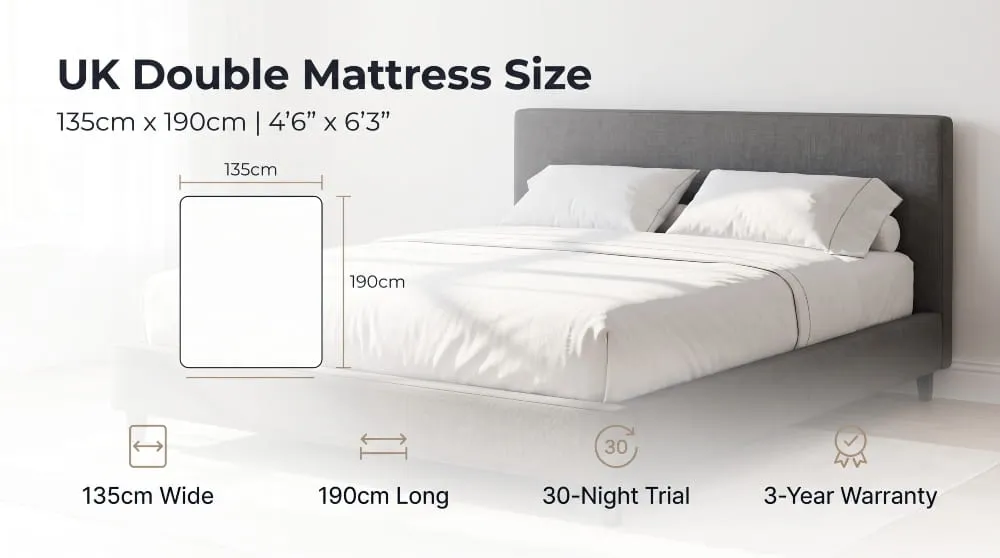
A standard double bed mattress measures 135 × 190 cm (53″ × 75″, or 4’6″ × 6’3″) and is the most purchased mattress size in the UK. It’s the default choice for couples in smaller bedrooms and for single adults who want a genuinely comfortable primary sleeping surface without stepping up to king-size dimensions.
At 135 cm wide and 190 cm long, the double mattress offers 45 cm more width than a standard single, enough of a difference to feel substantial when you’re lying down, but modest enough that the size fits into most standard UK bedrooms without dominating the room. The 190 cm length is shared with the single and small double, making it consistent across the lower half of the UK size range before the king and super king step up to 200 cm.
The 4’6″ width label is where the double gets its most common colloquial name in the UK; you’ll frequently see it listed as a “4’6 double” by retailers and manufacturers, which refers to the same 135 cm standard. This labelling is consistent enough across the market that it can be relied upon, unlike some of the looser naming conventions around small doubles and three-quarter beds.
Replacement bedding, mattress protectors, and double-size bed frames are the most widely stocked in the UK, which keeps prices competitive and gives buyers the broadest possible choice of materials and styles.
The generally recommended minimum bedroom size for a double bed is 2.75 metres wide by 3 metres long, allowing the frame to fit with clearance on either side for access. In practice, many UK bedrooms house a double in rooms slightly smaller than this, particularly in older terraced houses and flats where the second bedroom may fall just below that threshold.
A useful planning rule: allow at least 60–70 cm of clearance on the side you most commonly get out from, and a minimum of 90 cm at the foot of the bed if a wardrobe or chest of drawers sits opposite. Rooms that can’t meet those clearances with a double frame will likely feel noticeably cramped in daily use, regardless of how the bed looks in the space on paper.
For context, a double mattress and frame typically adds around 145–155 cm to a room’s width once the frame surround is accounted for, so measuring the room rather than relying on size names is always the more reliable starting point.
The double is 15 cm wider than the small double, 135 cm versus 120 cm, and that difference lands differently depending on who’s using the bed.
For a single sleeper, the gap between a small double and a double is noticeable but not transformative. Either size gives one person adequate room to sleep and move freely, and in a bedroom where space is genuinely limited, the small double is a sensible concession that still delivers a comfortable night’s sleep.
For two people sharing, however, the small double presents a real constraint. At 120 cm wide, two adults have roughly 60 cm each, less than the width of a standard single mattress per person. It’s workable for couples who sleep close together and don’t move much, but for most pairs, it results in disrupted sleep over time. The double at 135 cm isn’t generous for two people by any measure, but it crosses the threshold into functional shared sleeping that the small double doesn’t quite manage.
The decision point is straightforward: if the bed is for one person, let room size and budget guide the choice between the two. If it’s for two, the double is the minimum worth considering, with a king-size the more comfortable long-term investment, wherever the room allows it.
Price range: £369.90 through £609.99


Price range: £329.99 through £659.99
Price range: £319.99 through £459.99

Price range: £469.99 through £739.99

Price range: £459.99 through £659.99

Price range: £359.99 through £509.99
Price range: £199.99 through £469.99
Price range: £389.99 through £729.99
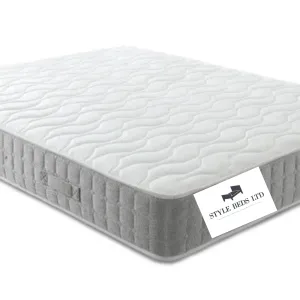
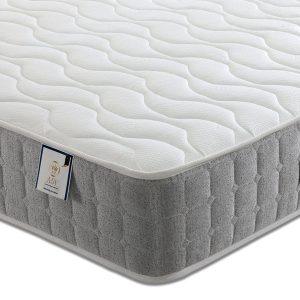
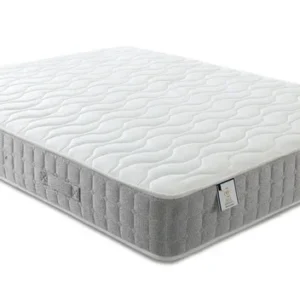
Price range: £319.99 through £459.99
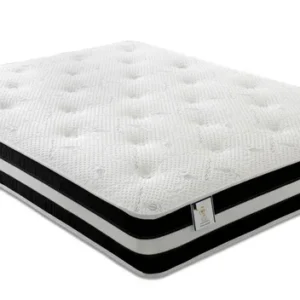
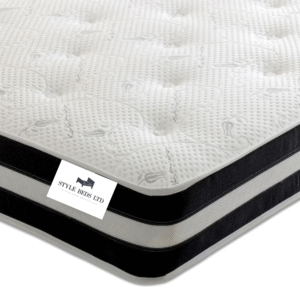
Price range: £339.99 through £509.99
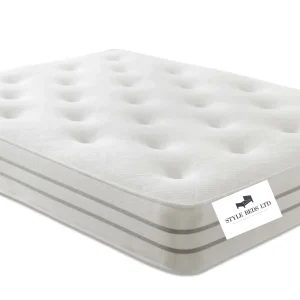
Price range: £459.99 through £639.99
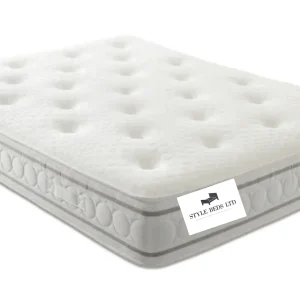
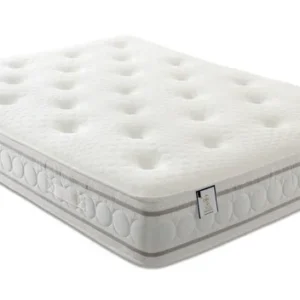
Price range: £549.99 through £799.99
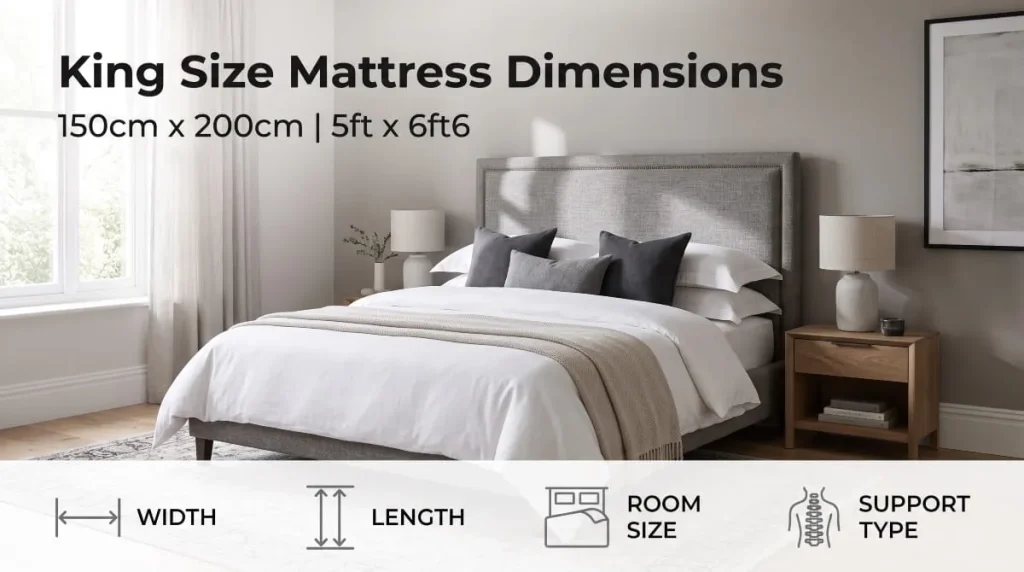
A king-size bed mattress measures 150 × 200 cm (59″ × 79″, or 5’0″ × 6’6″) and is the most popular upgrade choice for couples in the UK. It offers more space than a double in both width and length, meaningfully, and sits at a size that most standard UK bedrooms can accommodate without requiring significant furniture rearrangement.
At 150 cm wide and 200 cm long, the king-size mattress is 15 cm wider and 10 cm longer than a standard double. The width increase is the headline figure; it gives each person sharing the bed roughly 75 cm of sleeping space, compared to just under 68 cm on a double. The length extension to 200 cm is equally important for taller sleepers. Anyone over 5’11” who has spent time in a 190 cm bed will notice the difference immediately.
The king is also referred to as a 5ft bed across much of the UK retail market, a label consistent enough to be reliable when cross-referencing between retailers. Frame external dimensions will vary by manufacturer, but as a planning guide, a king-size bed frame typically occupies around 160–165 cm in width and 210–215 cm in length once the surround is factored in, figures worth having before measuring a room.
On paper, the difference between a king and a double is 15 cm of width and 10 cm of length. In practice, the impact is considerably larger than those numbers suggest, particularly for two people sharing.
On a double, each person has approximately 67.5 cm of width. On a king, that rises to 75 cm per person, roughly the same as a standard single mattress each. That shift from “sharing a bed” to “each having their own single-equivalent space” is what makes the king-size feel like a genuine upgrade rather than a marginal one. A survey by the Sleep Council found that couples who share a double report significantly higher rates of sleep disturbance from a partner’s movement than those sleeping on a king, with the width differential cited as the primary factor.
For single sleepers, the king offers a noticeably more generous surface and the extended 200 cm length, making it the practical choice for taller adults who find the 190 cm double length restrictive.
The floor space requirement is the main constraint. A king-size bed needs a room of at least 3 metres wide by 3.5 metres long to sit comfortably, with adequate clearance on the sides and at the foot. Below that threshold, the room tends to feel dominated by the bed rather than furnished by it.
This is one of the most searched questions in the UK bed size space, and the answer is: not with standard single mattresses. Two standard singles placed side by side would measure 180 cm wide, the same width as a super king, not a king. A king-size frame at 150 cm wide is designed for a single 150 cm mattress; attempting to fit two 90 cm singles would leave the mattresses overhanging the frame on both sides.
What works on a king-size frame is two 75 cm mattresses placed side by side, a setup sometimes called a split king. This size isn’t widely stocked in the UK, so it typically requires a custom or specialist order. Still, it’s a practical solution for couples with significantly different firmness preferences who want individual comfort without moving to a super king. The gap between the two mattresses, even with a mattress topper bridging them, remains the main drawback of this arrangement in day-to-day use.
For couples who simply want more movement independence, a zip-and-link mattress is the more practical UK-market solution: two separate mattresses that connect seamlessly, available from several UK manufacturers in king and super king sizes.
A king-size ottoman or storage bed uses the space beneath the mattress platform for concealed storage, accessed by lifting the base. The mattress itself sits on top of the platform in the same way as a standard bed, at the same 150 × 200 cm dimensions, so storage functionality does not affect the mattress size you need.
What it can affect is mattress weight and flexibility. Ottoman bases use a gas-lift mechanism to raise the platform, and a very heavy mattress, dense memory foam or a thick pocket-sprung model can place additional strain on that mechanism over time. Most UK Ottoman bed manufacturers specify a maximum mattress weight or depth in their product guidelines, typically 25–30 kg and up to 30 cm, though this varies by frame. It’s worth checking those specifications before selecting a mattress, particularly if you’re drawn to a thicker, heavier model.
Beyond that consideration, the mattress choice for a king-size storage bed follows the same logic as for any other king-size frame: size first, then material, firmness, and depth based on personal preference and the frame manufacturer’s guidance.
A super king-size bed mattress measures 180 × 200 cm (71″ × 79″, or 6’0″ × 6’6″) and is the largest standard mattress size available in the UK market. It gives two people sharing the bed 90 cm of width each, the equivalent of a full single mattress per person, making it the closest thing to genuinely undisturbed shared sleep that a standard UK size can deliver.
At 180 cm wide and 200 cm long, the super king shares its length with the king size at 200 cm but adds a significant 30 cm of additional width. That width, 6 feet across, is what defines the super king’s appeal, and it’s a dimension that requires deliberate room planning rather than casual consideration.
A super king bed frame typically measures 190–195 cm wide and 210–215 cm long, once the frame surround is accounted for. The recommended minimum bedroom size is 4 metres wide by 4 metres long, though many buyers make it work in rooms slightly smaller by accepting tighter clearance on one or both sides. Below 3.5 metres of room width, the super king tends to overwhelm the space, affecting both the functionality and the feel of the room.
Bedding availability at the super king size is excellent across the UK market, with most major retailers stocking fitted sheets, duvets, and mattress protectors as standard lines. Prices at this size sit higher than king equivalents, but the premium is rarely dramatic.
The super king adds 30 cm of width over a king, taking each person’s share from 75 cm to 90 cm. That extra 15 cm per person is the difference between king-size comfort and each sleeper having their own, uncompromised space. For couples in which one or both partners are restless sleepers, it’s a significant improvement in nightly sleep quality.
Whether it’s worth it comes down to two factors: room size and budget. The super king demands a meaningfully larger bedroom than the king; the jump from a 3-metre minimum width to a 4-metre minimum is not a minor planning adjustment. In a room that’s on the cusp, a super king can make the space feel like it exists solely to house the bed, with little room for the rest of the furniture a bedroom typically needs.
On budget, the super king commands a premium at every point: the frame, mattress, and bedding all cost more at 180 cm than at 150 cm. For buyers with the room and the budget, it’s the single most impactful upgrade available within the standard UK size range. For those stretching on either dimension, a king in a room that breathes will generally deliver a better overall result than a super king in a room that doesn’t.
This is the one size where two standard single mattresses do add up correctly. Two singles at 90 cm wide placed side by side produce exactly 180 cm, the precise width of a super king. The length of a standard single at 190 cm, however, falls 10 cm short of the super king’s 200 cm, which means standard singles won’t sit flush with a super king frame designed for a 200 cm length.
The practical solution used by many couples is a zip-and-link super king: two 90 × 200 cm mattresses, sometimes called extended singles or Euro singles, designed specifically to connect and form a seamless 180 × 200 cm sleeping surface. This format is widely available from UK mattress manufacturers and offers the significant advantage of allowing each partner to choose a different firmness level while sharing the same bed. It’s particularly popular among couples where one prefers a firm mattress and the other a softer feel, a compromise that a single unified mattress simply can’t deliver.
The main consideration with any split arrangement is the join. A well-made zip-and-link system minimises the central ridge, but it rarely disappears entirely. A quality mattress topper placed over both mattresses is the standard fix, and for most couples, it renders the joint undetectable in normal sleep.
Beyond the six standard UK sizes, a handful of non-standard mattress dimensions exist for specific bed types, older frames, and buyers who need something outside the mainstream range. The three most commonly searched are the three-quarter, the emperor, and the shorty, each serving a distinct purpose and each requiring a degree of planning that standard sizes don’t.
A three-quarter bed mattress typically measures 120 × 190 cm, which makes it dimensionally identical to the UK small double. The name persists largely for historical reasons: “three-quarter” was the common term for this width in older British homes, particularly Victorian and Edwardian properties, where beds of this size were standard in secondary bedrooms. The small double is simply the modern retail name for the same footprint.
Where the distinction matters is with genuinely antique bed frames. Older three-quarter frames were not always manufactured to modern, precise standards, and a bed described as a three-quarter may have an internal sleeping surface that is slightly narrower or shorter than today’s 120 × 190 cm small double specification. If you’re replacing a mattress in an antique or inherited frame, measure the base directly rather than assuming the small double dimension will be an exact fit. A difference of even 3–5 cm can affect how the mattress sits and performs over time. Custom sizing, available from many UK mattress manufacturers, is worth considering if the frame falls outside standard dimensions.
The emperor is the largest bed size available in the UK, measuring 200 × 200 cm, a perfect square that is 20 cm wider than a super king and 20 cm longer. It falls entirely outside the standard UK size range, so most mainstream retailers do not stock it and require specialist sourcing for both the frame and the mattress.
At 200 cm wide, the emperor gives two people sharing the bed a full metre of width each, a level of sleeping space that has no equivalent in the standard range. It’s a size that appeals primarily to buyers in larger master bedrooms who want maximum space without compromise, and it carries a corresponding price premium across frame, mattress, and bespoke bedding, all of which need to be ordered to size.
The requirements for an emperor’s room are significant. With a frame surround, an emperor bed typically occupies around 210–215 cm in both width and length, demanding a bedroom of at least 4.5 metres in each direction to sit with reasonable clearance. For most UK homes, this rules it out entirely, but in a large main bedroom, it represents a genuinely different class of sleeping space.
A shorty bed mattress measures 75 × 175 cm, narrower and shorter than a standard single at 90 × 190 cm, and is designed specifically for shorter bed frames used in rooms where standard length won’t fit. The most common applications are under-stair bedrooms, compact box rooms with sloped ceilings, and certain cabin and bunk bed configurations where height or depth clearance is the limiting factor rather than width.
The shorty is a niche size by any measure, and availability reflects that. Mainstream mattress retailers rarely stock it, and buyers typically need to go directly to specialist manufacturers or custom mattress suppliers. Bedding at this size is similarly limited, with bespoke or made-to-measure linen the most reliable route rather than searching standard retail ranges.
If a shorty is being considered purely because a standard single seems long for a small room, it’s worth pausing before committing. A 190 cm mattress in a room with limited floor space doesn’t require 190 cm of clear floor; the bed can sit against a wall with the head end in a corner, and the room’s usable space is measured from the foot of the frame outward. In most cases, creative furniture placement makes a standard single workable in rooms that initially appear too small for it, avoiding the availability constraints that come with the shorty size.
Choosing the right mattress size comes down to three variables: who’s sleeping in it, how much room the bedroom can realistically give up, and how long you expect the bed to serve its purpose. The chart below gives a clear reference point, with the sections that follow translating those numbers into practical guidance for the most common buying situations.
For two people sharing, the double is the practical minimum, and the king is the comfortable standard. On a double, each person has approximately 67.5 cm of sleeping width, which is functional but narrow enough that one restless sleeper will reliably disturb the other. It works best for couples in smaller bedrooms where a king simply won’t fit, or early in a shared living situation where budget is the primary constraint.
The king size is where shared sleep genuinely becomes comfortable for most couples. At 75 cm per person, each sleeper has the equivalent of a standard single mattress width, which is enough to turn, shift position, and move without consistently encroaching on the other person’s space. For couples where one or both partners are light sleepers, the king is less a luxury and more a practical investment in sleep quality, and by extension, in how functional the following day feels.
The super king takes that comfort further, giving each person 90 cm of uninterrupted width. For couples with significantly different sleep schedules, temperature preferences, or firmness requirements, the super king, particularly in a zip-and-link configuration, is the most effective solution within the standard UK size range.
A single adult using a bed as their primary sleeping surface should treat the small double as the starting point, not the single. The additional 30 cm of width over a standard single transforms the sleeping experience for one person; there’s room to move, to sleep diagonally on warmer nights, and to avoid the edge-awareness that a standard single creates when used regularly by an adult.
The double is the natural step up for single sleepers who have the room for it, delivering a generous surface that never feels restrictive and offering the broadest availability of mattress types and price points in the UK market. For taller adults, anyone over 5’11”, the king’s 200 cm length becomes relevant regardless of whether the bed is shared, as the 190 cm length of the double and below can become a genuine comfort issue over the years of daily use.
The single itself remains the right choice for guest rooms that see occasional use, children, and teenagers in rooms where floor space is genuinely limited. For a primary adult bed, it’s an unnecessary compromise in most situations.
In a small bedroom, the most common mistake is choosing a bed size based on what physically fits rather than what fits comfortably. A king-size frame that technically slots into a room but leaves 20 cm of clearance on one side is not a king-size bedroom; it’s a storage problem waiting to happen, and it makes the room feel smaller every day.
The general principle: choose the largest size that leaves at least 60 cm of clearance on the primary exit side of the bed and 90 cm at the foot, where possible. In rooms below 2.8 metres wide, a double tends to be the practical ceiling. Between 2.8 and 3.2 metres, a double sits comfortably, and a king becomes worth measuring carefully. Above 3.2 metres, a king should be the default consideration for couples, with the super king coming into play above 4 metres.
For single adults in smaller bedrooms, the small double consistently outperforms the single on sleep quality while adding only 30 cm to the room’s width requirement, a trade-off that works in almost every standard UK box room or second bedroom.
If you’re working from a measurement rather than a size name, this section is the fastest way to confirm what UK bed size you actually need. Every standard UK mattress, plus the odd cm dimensions that regularly turn up in searches and on imported or European frames, is covered below.
There are six standard UK mattress sizes, and each is defined by a fixed cm measurement rather than a range. If your mattress or frame matches one of the rows below, you’re dealing with a standard UK size and replacement should be straightforward.
A quick way to check yourself against a listing: if the cm figures on the box or product page match a row above exactly, you’re set. If they’re close but not identical, for example 150 × 190 cm rather than 150 × 200 cm, don’t round up. The sections below cover exactly why that gap exists and what it means for your purchase.
Every UK mattress size up to and including the double shares the same 190 cm length. King and super king are the only two sizes that step up to 200 cm, a 10 cm increase that only applies from king size upward.
This is the single most common source of “wrong size” confusion in cm searches. A mattress listed as 150 × 190 cm is not a UK king; a genuine king is always 150 × 200 cm. The 190 cm version is either a mislabelled listing, a non-UK size, or a mattress designed for a different market. If you’re replacing a king-size mattress and the old one measures 190 cm long rather than 200 cm, it’s worth double-checking the frame’s actual internal length before ordering a standard king, since older or imported frames don’t always follow current UK conventions.
The 200 cm length exists for a practical reason: it’s the point in the UK range built to comfortably accommodate taller sleepers, roughly six feet and above, without their feet reaching the end of the mattress. If you’re under that height, the extra 10 cm won’t be noticeable night to night, but it’s the reason king and super king mattresses cost more to manufacture than a double at the same width.
Two mismatches account for most of the confusion in this space, and neither one is a standard UK size.
140 × 200 cm is a European (often called French) double, not a UK size. It’s wider than a UK double (135 cm) but shorter than a UK king would need to be at that length. If you’ve found a mattress or frame listed at 140 × 200 cm, it’s built to Continental sizing, not UK sizing, and won’t be a drop-in replacement for either a UK double or a UK king. The same applies to the closely related 135 × 190 cm search: that figure is the exact UK double, so if a listing shows 135 × 190 cm, you can treat it as standard.
150 × 190 cm is the other frequent mix-up, and it’s effectively a UK king with the wrong length. A genuine UK king is always 150 × 200 cm. A 150 × 190 cm mattress is either an error in a listing, a size specific to a non-UK frame, or, occasionally, a custom or older product. It’s not a size worth ordering by assumption; confirm the actual internal length of the frame before buying.
The practical rule for either mix-up: match both numbers, width and length, against the standard chart above. A match on one figure but not the other means it isn’t a standard UK size, whatever the listing calls it.
A cluster of cm searches, 80 × 200, 90 × 200, 100 × 200, 160 × 200, and 200 × 150, show up regularly in UK searches but don’t correspond to any standard UK size. Almost all of them trace back to European or Scandinavian sizing conventions, where the 200 cm length is standard across nearly every width, unlike the UK system, where 200 cm applies only from king size upward.
The pattern across all of these is that European retailers list length first in some contexts and use 200 cm as a near-universal length regardless of width, while the UK system keeps 190 cm as the default and only steps up to king size. If you’re buying a mattress for a frame that was purchased from a European retailer, or inherited from a property with Continental furniture, measure the frame’s internal base directly rather than assuming a UK standard size will fit.
If none of the above matches what you’re seeing, or you simply don’t know your current mattress size, measuring the frame directly is the only reliable method.
Measure the internal dimensions of the base, the sleeping surface itself, not the frame’s outer edges, headboard, or side rails. Run a tape measure from one inner edge straight across to the opposite inner edge for the width, then repeat along the length. These two figures, compared against the standard chart at the top of this section, will tell you exactly which UK size you need, or confirm that the frame follows non-UK sizing and requires a made-to-measure mattress.
A mattress that’s a few centimeters out in either dimension won’t sit correctly. Too wide, and it will bow up against the frame’s inner edges; too narrow, and it will shift during use. If your measurements fall between two standard UK sizes, or your frame follows European conventions, contact our team, and we can advise on the right fit or a custom size for your frame.
These figures represent practical minimums, room dimensions that allow the bed to function without the room feeling consumed by it. They account for the frame surround, which adds approximately 10–15 cm to each mattress dimension, and for the clearances needed to move around the bed comfortably in daily use.
Rooms that meet these minimums, but only just, where the bed fits, but a wardrobe, chest of drawers, or dressing table also needs to share the space, should be assessed with all furniture in mind, not the bed in isolation. A king-size bed in a 3.2 metre wide room leaves little room for anything else along that wall, which is a practical consideration that floor plan sketches make immediately clear and mental arithmetic rarely does.
The cost of a king-size bed and mattress in the UK typically ranges from around £400 at the budget end to well over £3,000 for premium frames paired with high-specification mattresses. Where you land within that range depends on frame construction, mattress type, and whether you’re buying the two together as a set or sourcing them separately, a distinction that affects both price and quality control more than most buyers expect.
A double bed frame in the UK ranges from approximately £200 for a basic metal or simple fabric frame up to £800–£1,200 for a well-constructed upholstered frame with a solid foundation. Paired with a mid-range mattress, pocket sprung or memory foam in the £300–£500 bracket, a complete double bed setup typically lands between £500 and £1,500 for most buyers shopping the mainstream market.
At the lower end, the compromises tend to show in the mattress rather than the frame. A £150 mattress on a £250 frame is a setup that works in the short term but rarely holds up well past the 2- to 3-year mark, particularly for regular use. The mattress is where the majority of the budget should sit if a trade-off has to be made; a quality mattress on a modest frame will outperform a budget mattress on an expensive one in terms of sleep quality and longevity every time.
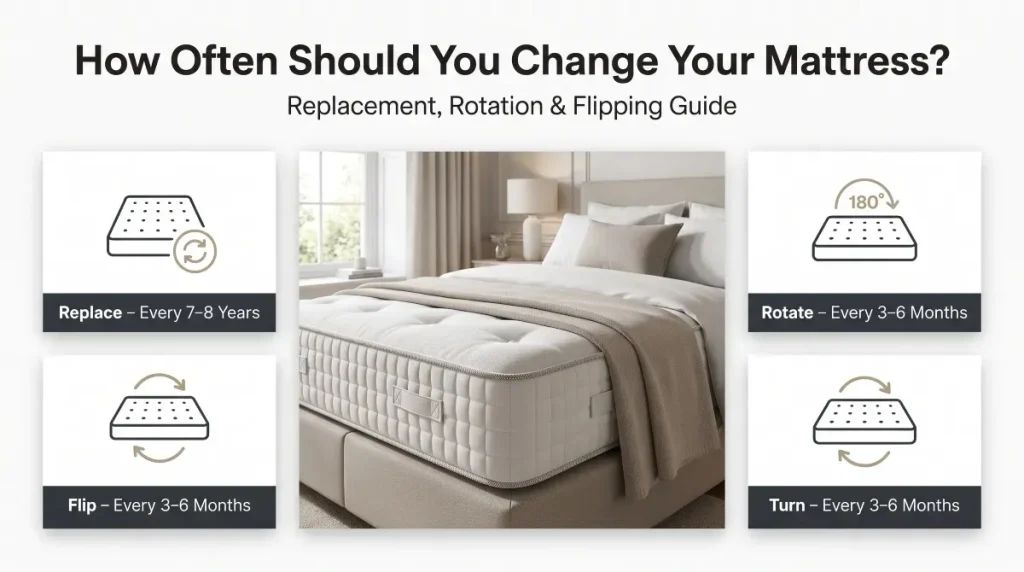
For context, the Sleep Council recommends replacing a mattress every seven years on average, which makes the per-year cost of a better mattress considerably lower than the upfront price suggests.
A king-size bed frame alone, without a mattress, typically ranges from £300 for an entry-level option to £1,500 or more for a premium upholstered or storage frame from a specialist manufacturer. The widespread reflects differences in construction quality, fabric, headboard design, and base type, with ottoman and gas-lift storage frames commanding a consistent premium over standard slatted bases across all price points.
King-size mattresses in the UK span a similarly broad range. A serviceable open-coil or basic memory foam mattress starts at around £200–£300, while pocket-sprung models from established UK manufacturers sit comfortably in the £400–£800 bracket. Luxury options, natural fillings, hand-tufted construction, and higher spring counts can reach £1,500 to £3,000 for the mattress alone.
For most buyers purchasing a complete king-size bed and mattress together, a realistic mid-market budget is £800–£1,800. Below £600 as a combined spend, meaningful compromises in either frame construction or mattress quality are almost inevitable at king size. Above £2,000, buyers are typically accessing genuinely better materials and construction rather than simply paying for brand positioning, though due diligence on what’s inside the mattress remains worthwhile at any price.
The super king commands a premium over king pricing at every level of the market, frames, mattresses, and bedding all cost more at 180 cm than at 150 cm, reflecting the additional materials involved and the smaller production volumes at this size. As a rule of thumb, buyers should expect to add 20–35% to the equivalent king-size price when moving up to super king.
A super king bed frame typically starts at around £400–£500 for a basic upholstered model and rises to £2,000 or beyond for a premium storage or ottoman frame from a specialist manufacturer. Super king mattresses range from approximately £300–£400 for entry-level options to £1,000–£4,000 for high-specification pocket-sprung or natural-fill models.
A realistic combined budget for a quality super king bed and mattress sits between £1,200 and £2,500 for most buyers in the mainstream market. For buyers considering a zip-and-link configuration with two separate mattresses to allow individual firmness preferences, factor in that two individual mattresses will typically cost more than a single unified super king, even at equivalent specifications, due to the additional materials and manufacturing involved.
Most UK bed frames are sold without a mattress as standard; the frame and mattress are typically listed and priced separately, with a mattress-included bundle offered as an optional upgrade rather than the default purchase. This is the case across the majority of UK bed retailers, from high street chains to specialist manufacturers.
Where “bed and mattress” bundles are offered, they generally fall into two categories. The first is a genuine package deal, a frame paired with a specific compatible mattress at a combined price that represents a modest saving over buying separately. The second, more common in the budget end of the market, is a frame listed at an attractive headline price, with a basic mattress added to make the listing appear more complete, even though the mattress itself would not be a standalone purchase; most informed buyers would choose.
The practical advice is to evaluate the frame and mattress independently before committing to a bundle. If the included mattress meets your requirements on its own merits, construction, firmness, materials, and warranty, then the bundle pricing is worth taking. If the mattress is simply the cheapest available option dressed up as a convenience, buying the frame alone and sourcing the mattress separately will almost always produce a better long-term result for a comparable or only marginally higher spend.
A standard double bed mattress in the UK measures 135 × 190 cm, equivalent to 53″ × 75″ or 4’6″ × 6’3″. This dimension is consistent across the vast majority of UK manufacturers and retailers, making it the most reliably standardised size in the domestic market. You may see it listed as a “4’6 double” in some retail contexts, which refers to the same 135 cm width.
A UK king-size bed mattress measures 150 × 200 cm. The width of 150 cm and the length of 200 cm are consistent with UK market standards, and the size is also commonly referred to as a 5ft bed in retail listings. It is 15 cm wider and 10 cm longer than a standard double, with the additional length making it the first size in the UK range to extend beyond the 190 cm that singles, small doubles, and doubles all share.
No. A double mattress at 135 cm wide is 15 cm narrower than the 150 cm internal base of a king-size frame. Placing a double mattress on a king-size base would leave a gap on one or both sides, allowing the mattress to shift during use and creating an uneven sleeping surface. A king-size frame requires a king-size mattress; the dimensions are not interchangeable, and the difference is too significant to bridge with a topper or pad.
No. A super king mattress at 180 cm wide is 30 cm wider than a king-size frame’s 150 cm internal base. It would overhang on both sides and would not be supported evenly across its full surface, affecting both comfort and the mattress’s structural integrity over time. If you’re upgrading from a king to a super king, both the frame and the mattress need to change; the two sizes are not compatible.
The difference is significant. A UK king measures 150 × 200 cm, while a US king measures 193 × 203 cm, making the US version 43 cm wider and 3 cm longer. They share a name but are effectively different sizes, and a US king mattress will not fit a UK king frame. The discrepancy catches buyers out most often when purchasing frames or bedding internationally, or when replacing a mattress on a bed frame that was imported from the United States. Always verify dimensions in centimetres before buying across markets.
A 4ft 6 bed requires a standard double mattress measuring 135 × 190 cm. The “4ft 6″ label refers to the bed’s width in feet and inches; 4 feet 6 inches converts to approximately 137 cm, which is the nominal width from which the 135 cm mattress standard is derived. The small discrepancy between 137 cm and 135 cm accounts for the frame surround: the internal sleeping surface is 135 cm, while the external frame width sits closer to the 4’6” label. A double mattress is the correct and only standard size for this frame.
Yes. A 5ft bed is the standard retail label for a UK king-size bed, referring to its 150 cm width, which converts to approximately 4’11”, rounded to 5ft in common usage. The terms are interchangeable across the UK market, and a 5ft bed frame requires a standard king-size mattress measuring 150 × 200 cm. If you see a bed listed as “5ft king size”, it is the same size as one listed simply as “king”. The label is a width description rather than a separate size category.
Measure the internal dimensions of the base, not the outer frame. Place a tape measure inside the frame from one inner edge to the opposite inner edge for the width, then repeat along the length. These two figures are what your mattress needs to match. Do not measure the frame’s external footprint, as this includes the surround, side rails, and any decorative elements that sit outside the sleeping surface.
If the internal measurements fall between standard sizes, which can happen with older, imported, or custom frames, note the exact centimetre figures and contact a specialist mattress manufacturer before ordering. A mattress that is even 3–5 cm too wide will not sit correctly in the frame, and one that is too narrow will shift during use. Standard UK sizes are consistent enough that most frames will correspond exactly to one of them, but confirming with a tape measure takes two minutes and eliminates the most common and costly mattress-buying mistake.

)
&description=&image=https://stylebeds.co.uk/wp-content/uploads/2026/05/UK-Mattress-Sizes-1024x572.webp)