)
&description=&image=https://stylebeds.co.uk/wp-content/uploads/2026/06/Beds-for-Small-Rooms--1024x572.webp)
Bed Frame Dimensions Every UK Size Explained (cm, inches & feet)
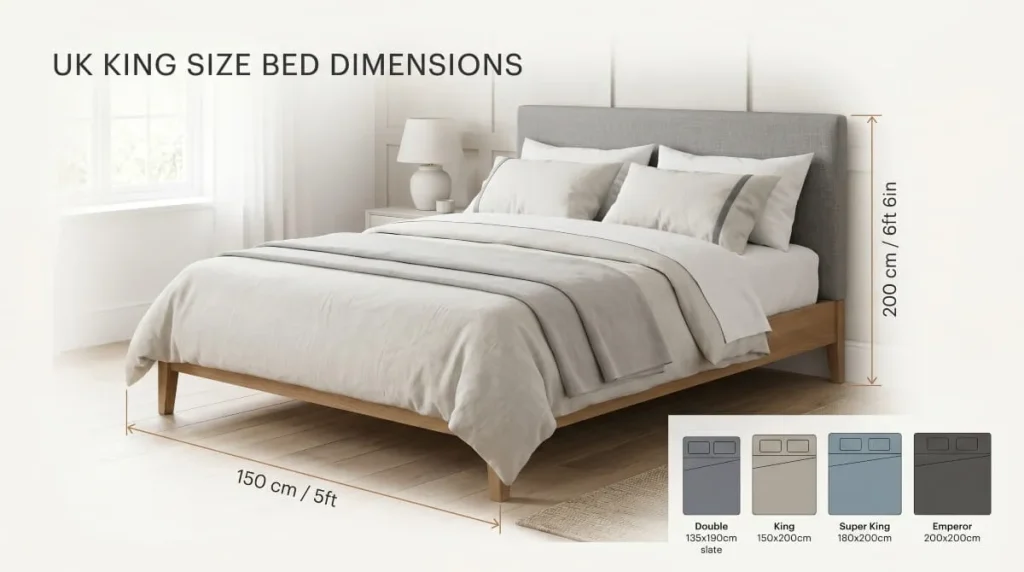
A king size bed frame in the UK measures 150cm wide by 200cm long (5ft × 6ft 6in), that’s the frame’s external footprint, not just…
The best beds for small rooms combine the right size with smart storage and a low-profile frame, and knowing which of those three levers to pull first saves you from a bedroom that feels permanently cramped. This guide covers every bed type, size, and layout idea worth considering, so you can shop with confidence rather than guesswork.
Most small room mistakes happen before a single piece of furniture arrives. The bed is chosen first because it has to be; it dominates the floor plan, but it’s rarely chosen with the room’s full geometry in mind. A bed that’s even 6 inches too wide can eliminate a usable walkway on one side, push a wardrobe into an awkward corner, and make the entire room feel like a corridor.
The right bed doesn’t just fit; it fits. It leaves the room functioning.
According to NHBC data, the average UK bedroom in a new-build home is just 2.15m × 2.75m, smaller than most people realise when they’re standing in a showroom. That gap between perceived space and actual space is exactly where bed-buying decisions go wrong.
It’s not always about the mattress footprint. A tall, heavily upholstered headboard on a high-profile frame can eat vertical space and make low ceilings feel lower. Dark fabric can anchor the eye downward. Ornate side panels on a wide divan can make a 4ft 6in small double feel more like a 5ft king. The bed’s height, colour, and frame silhouette all contribute to how large or small a room feels in use.
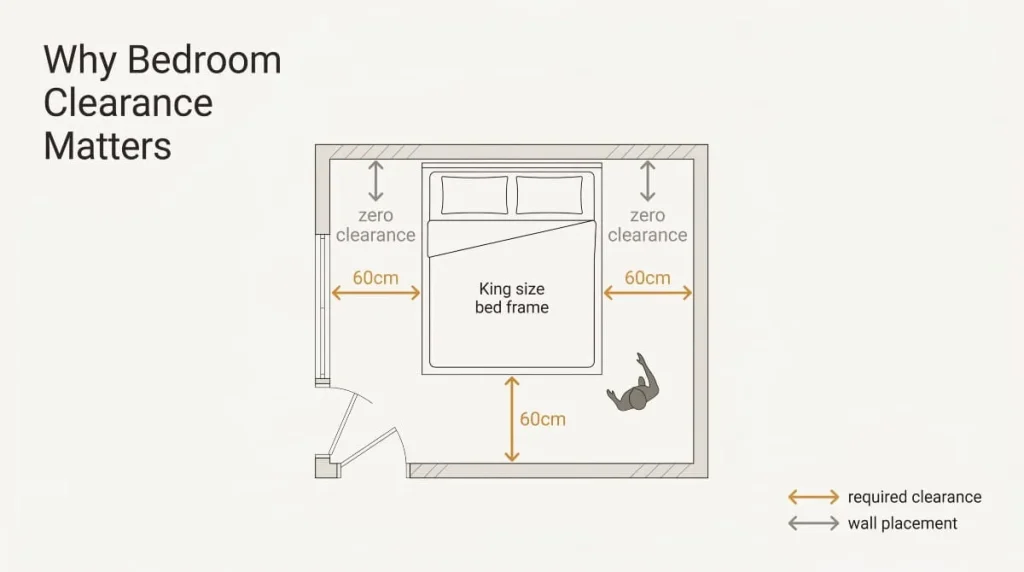
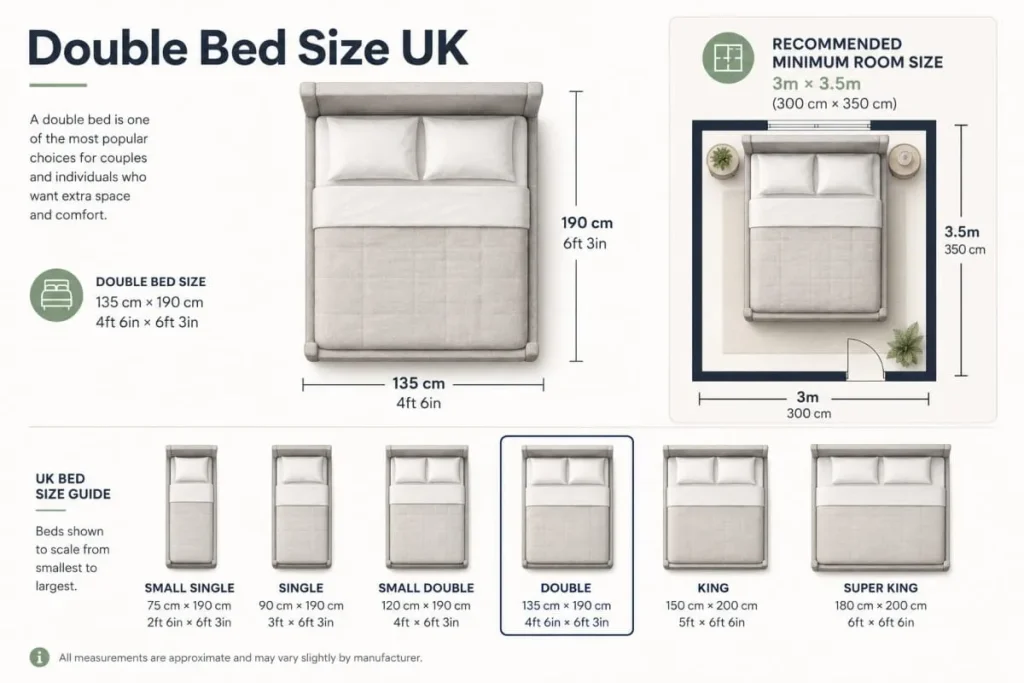
A practical starting point: once the bed is placed, you want a minimum of 60–70cm of clear walkway on at least one long side, and enough clearance at the foot to open a door or drawer without contortion. In a box room, this often means a single or small double is the realistic ceiling. In a modestly sized double bedroom, say 3m × 3.5m, a standard double works comfortably, and a king becomes possible with careful placement.
Measure twice. Then measure again with tape on the floor where the bed will actually sit.
Lower beds create an illusion of height by leaving more wall visible above the frame. They work well in rooms with standard or low ceilings, and they suit minimalist or Scandi-influenced interiors. Higher frames, particularly high sleepers, are the exact opposite: sacrificing the low-profile look to unlock the floor space beneath for a desk, shelving, or storage.
Neither is universally better. The right answer depends on whether your priority is making the ceiling feel higher, or making the floor feel larger.
UK bed sizes follow a reasonably consistent standard, but “fits in the room” and “works in the room” are two different things. Here’s what each size actually delivers in a small room context.
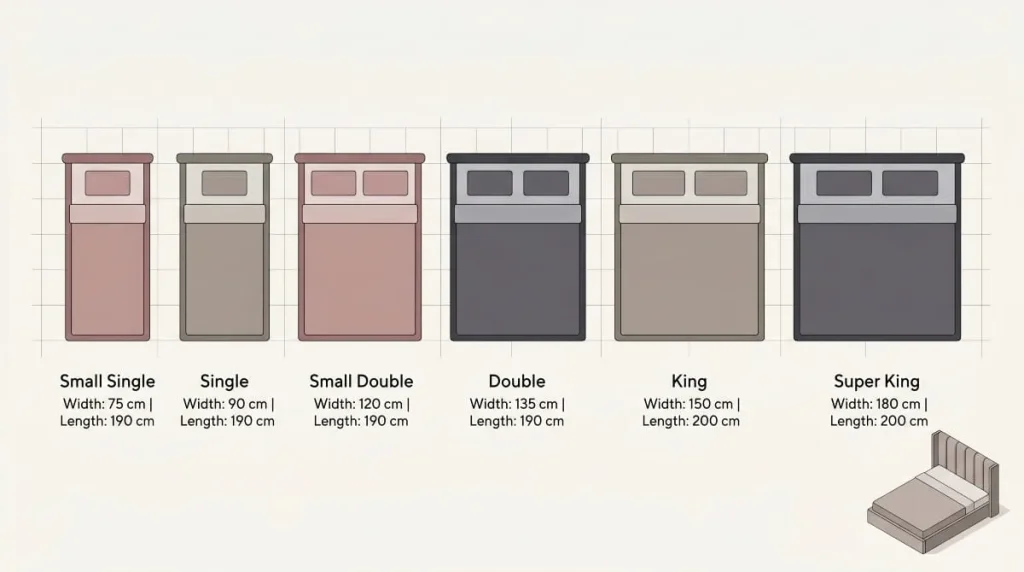
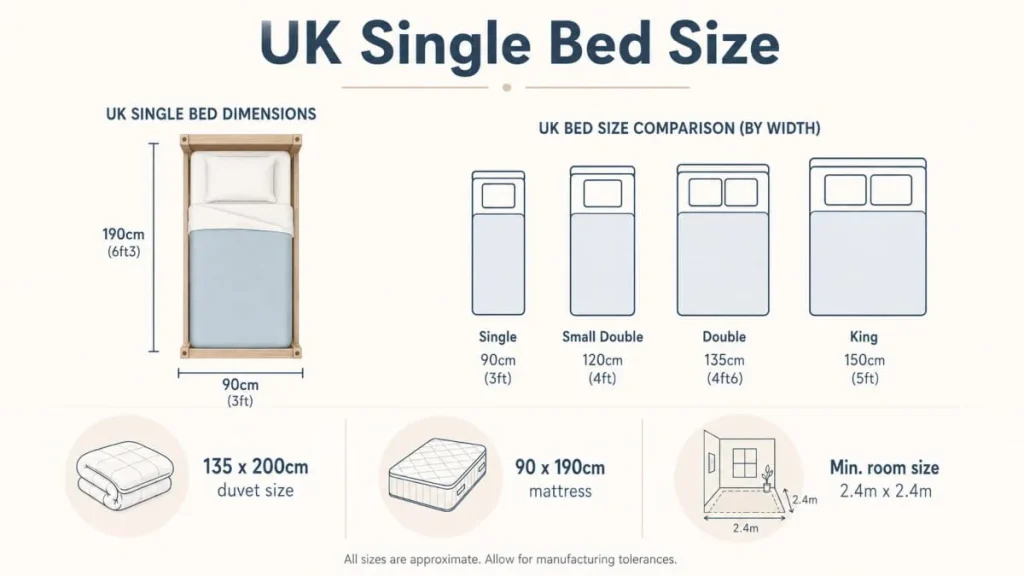
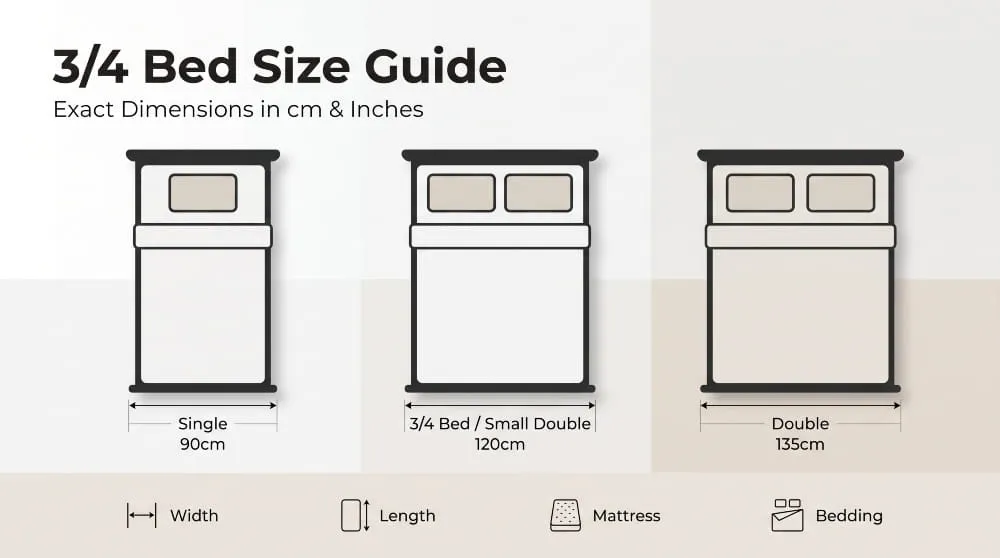
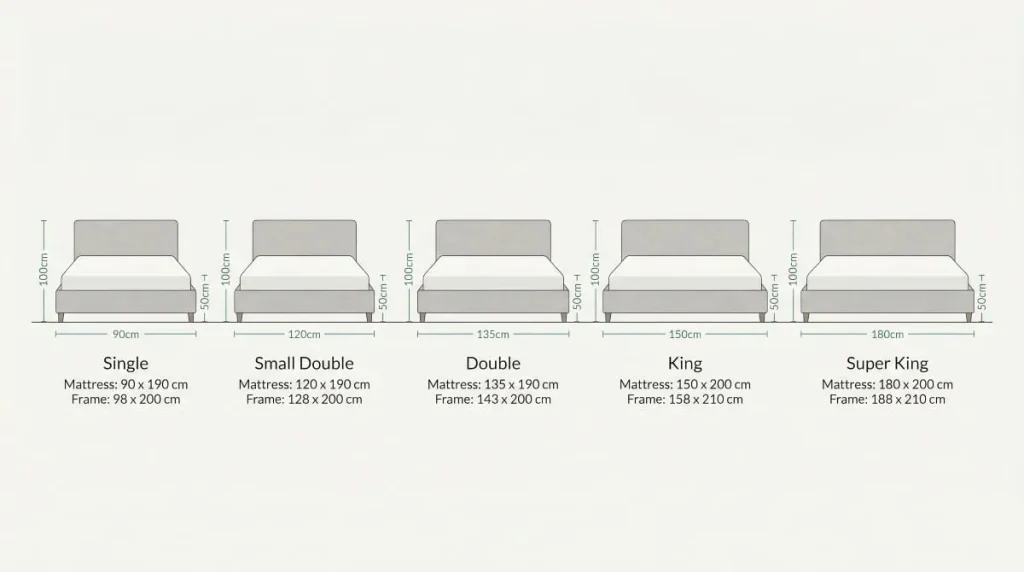
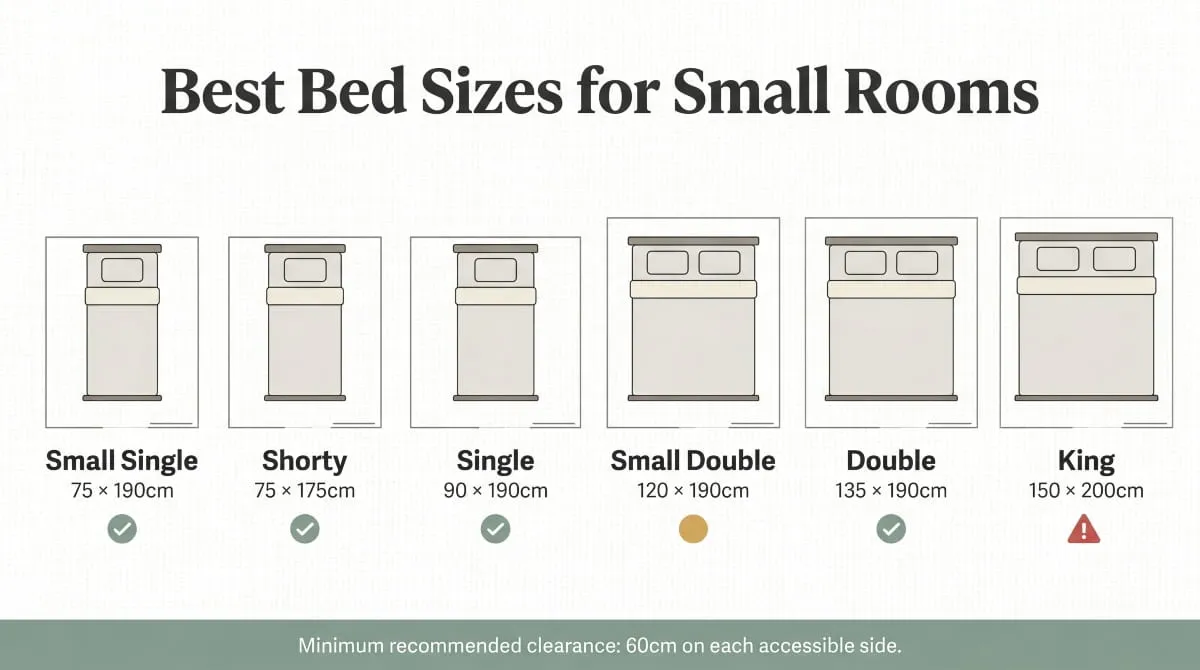
A UK single measures 90cm × 190cm. It’s the default choice for box rooms, children’s rooms, and compact guest bedrooms, and for good reason, it leaves enough floor space around it to function as a full bedroom rather than just a sleeping area.
For adults, a single can feel narrow but remains perfectly functional for solo sleepers who prioritise space over sprawl. Pair it with an ottoman base, and you eliminate the need for a separate chest of drawers.
At 75cm × 190cm, the small single is the narrowest standard option in the UK. It’s primarily used in children’s rooms, very tight box rooms, or where a second bed needs to fit alongside a single without the room becoming impassable. For most adults, it’s a compromise on comfort, but for a dedicated guest room that’s rarely used, it can be the difference between the room working and not working at all.
The small double (120cm × 190cm) is arguably the best bed size for small rooms where a solo adult wants more sleeping width without committing to a full double footprint. It’s 15cm narrower than a standard double; that margin is often exactly the difference between a room that flows and one that doesn’t.
It’s particularly well-suited to teenage bedrooms, compact master bedrooms in flats, and single-occupancy rooms where the sleeper simply wants more space than a standard single offers.
A standard double (135cm × 190cm) fits comfortably in most rooms described as a “double bedroom”, but many UK homes label rooms as doubles that are functionally small. As a rough guide, a double bed works in a room of approximately 3m × 3m or larger, provided storage is handled elsewhere (or under the bed).
In a room smaller than that, the walkway on each side becomes impractical. If you’re set on a double in a tight space, a storage ottoman double eliminates the need for bedside furniture and opens up the visual field considerably.
A UK king measures 150cm × 200cm. In most small rooms, a king is genuinely pushing the boundaries, but it’s not impossible if the room is prioritised around the bed. That means wall-mounted lighting instead of bedside tables, fitted wardrobes rather than freestanding furniture, and a low-profile frame to avoid a top-heavy feel.
King-size beds for small rooms work best when placed against the longest wall, with the headboard centred, leaving walking room on both sides, even if the room is tighter than ideal.
Standard UK bed lengths run to 190–200cm. Shorty beds (typically 175cm) exist specifically for rooms where even that length creates a problem, usually narrow box rooms where the bed runs parallel to the door swing, or rooms with a chimney breast or radiator that limits where the foot of the bed can sit. They’re niche, but in the right room they’re the difference between a workable layout and a blocked door.
The size of the bed determines whether it fits. The type determines whether the room works. These are different problems, and solving both is what separates a small room that feels considered from one that feels compromised.
If you take one thing from this guide, make it this: in a small room, a storage bed isn’t a luxury; it’s a space strategy. Every drawer or lift-up compartment built into the bed base is a chest of drawers, blanket box, or underbed storage unit you don’t need to find floor space for.
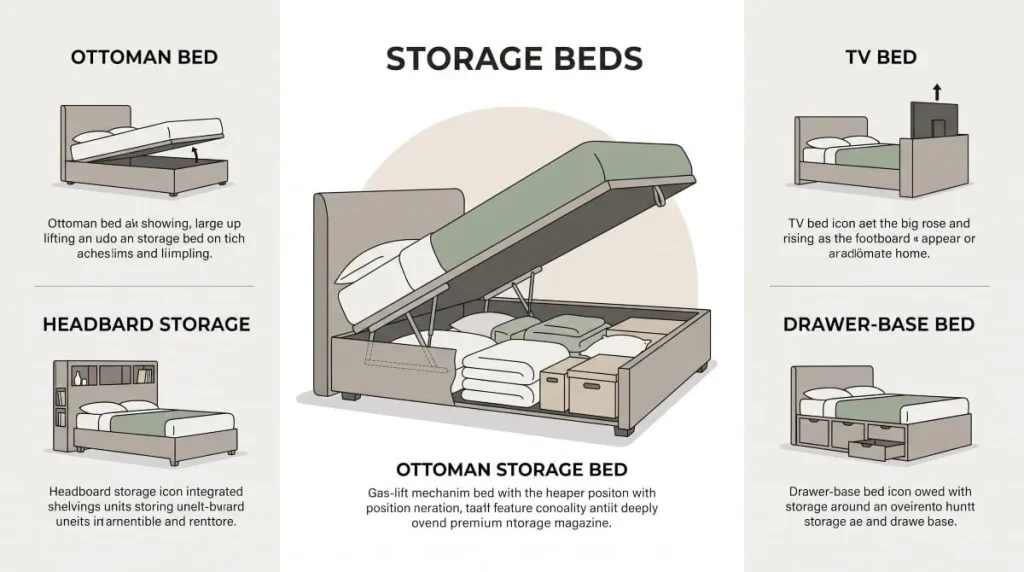
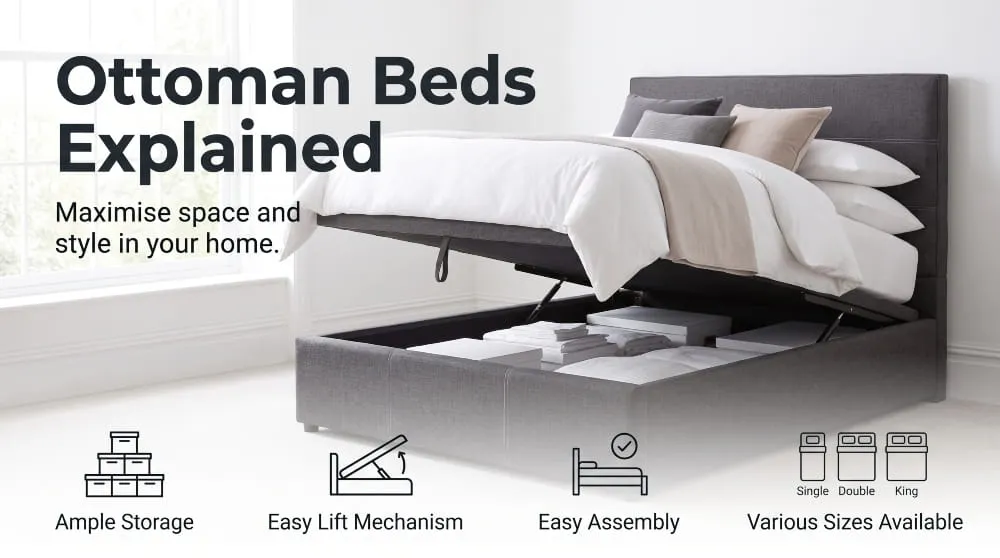
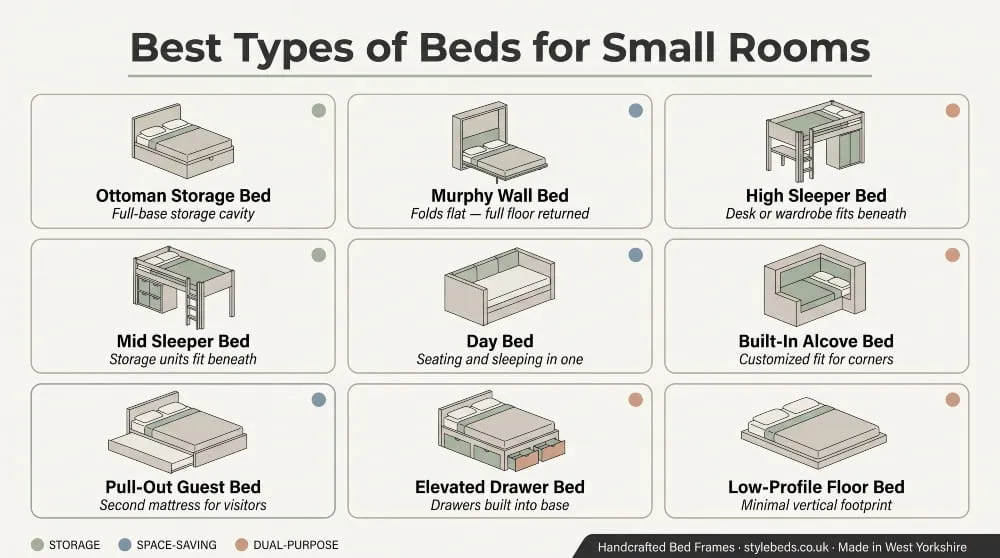
Storage beds come in two main configurations. Drawer beds sit on legs with two or four built-in drawers running along the sides; useful but limited in capacity, they still require clearance to open. Ottoman beds are the more powerful option: the entire mattress platform lifts on gas pistons to reveal a deep, unobstructed storage cavity the full size of the bed. For small rooms, the ottoman mechanism consistently outperforms drawers.
An ottoman bed with an end-opening or side-opening lift gives you the storage equivalent of a large chest without using a single centimetre of additional floor space. The cavity is typically 25–30cm deep across the full mattress footprint, enough for duvets, seasonal clothing, suitcases, and everything else that usually migrates under the bed in unsatisfying plastic boxes.
In a small room where floor space is the scarcest resource, this is one of the most rational furniture choices available. Style Beds’ ottoman divan range pairs this functionality with handcrafted upholstered frames in over 40 fabric options, so the practical choice doesn’t have to look like one.
Murphy beds (also called wall beds or pull-down beds) fold flat against the wall when not in use, returning the full floor area to the room during the day. They’re the most dramatic space-saving option available. In very small rooms, studio flats, home offices that double as guest rooms, or rooms under 2.5m in one direction, they can be the only configuration that makes the space genuinely liveable.
The trade-off is installation complexity and cost. A built-in Murphy bed requires wall fixings, a housing unit, and typically some carpentry work. For permanent bedrooms where someone sleeps every night, a well-chosen ottoman storage bed will usually deliver more value. For occasional-use rooms, the pull-down option is worth serious consideration.
A high sleeper raises the sleeping platform to approximately 140–160cm off the floor, leaving the space beneath fully usable. In children’s and teenage rooms this typically means a desk, wardrobe, or seating area underneath, effectively creating two zones within a single room footprint.
For adults, high sleepers are less common but not impractical, particularly in rooms with good ceiling height (at least 240cm is recommended to avoid the sleeping area feeling claustrophobic). They work best in rooms where the priority is reclaiming floor space for work or storage rather than creating a visual impression of openness.
Mid sleepers raise the bed to roughly 90–120cm, high enough to fit storage, a small desk, or a play area underneath, but low enough that climbing in and out is straightforward for children. For younger children who aren’t ready for a full high sleeper, or for rooms without the ceiling height to support one, the mid sleeper is a practical intermediate.
A day bed functions as a sofa during the day and a single bed at night, making it particularly well suited to guest rooms, home offices with a spare sleeping requirement, or teenage rooms where floor space doubles as social space. Most day beds fit a standard single mattress and sit at sofa height with a back panel on one long side.
The limitation is clear: a day bed is a single. If the room’s occupant needs a full-width sleeping surface every night, a day bed is a compromise. If the room is primarily a living or working space that occasionally needs to sleep a guest, it’s one of the most efficient solutions available.
A built-in bed, custom-made to fit a specific alcove, recess, or awkward corner, can unlock space that off-the-shelf furniture simply cannot reach. An alcove beside a chimney breast, a sloped ceiling section, or a room with an unusual width can all be made workable with a bespoke frame built to the exact dimensions available.
The upfront cost is higher than a standard bed, but the gain in usable space and the reduction in visual clutter often justify it, particularly in a room that will be used daily for years.
Floor beds (mattress directly on the floor or on a very low platform) emphasise openness and ceiling height, making a room feel taller and less enclosed. They suit minimalist interiors and work well in rooms with low ceilings where any frame height would feel oppressive.
Elevated beds, high-profile frames with significant clearance beneath, can incorporate drawers or simply create an airy underbed space. Still, they suit rooms with higher ceilings where the additional visual height doesn’t compress the space.
L-shaped bed configurations, typically a standard single paired with a perpendicular trundle or secondary sleeping surface, are designed for shared children’s rooms where two sleeping areas need to coexist without two separate beds running parallel and consuming the full width of a narrow room. They’re niche, but in the right room they’re genuinely clever.
Corner beds for adults, where the headboard sits diagonally in a corner, rarely work as well in practice as they appear on mood boards. They typically waste the triangle of space behind the headboard and create awkward clearance geometry on both sides.
A pull-out guest bed, either a trundle that slides from beneath a day bed or a sofa bed with a fold-out mechanism, solves the occasional-guest problem without permanently dedicating floor space to a second sleeping surface. For rooms that serve a dual purpose most of the time and a guest bedroom occasionally, this is often the most pragmatic answer.
Sofa beds vary enormously in sleeping comfort. If the room will be used as a guest room more than a few times a year, it’s worth investing in a quality mechanism and a proper mattress depth rather than treating it as a secondary consideration.
Storage and sleeping in one frame is the foundational upgrade for any small bedroom. But not all storage beds are built the same, and the differences matter considerably when floor space is already limited.
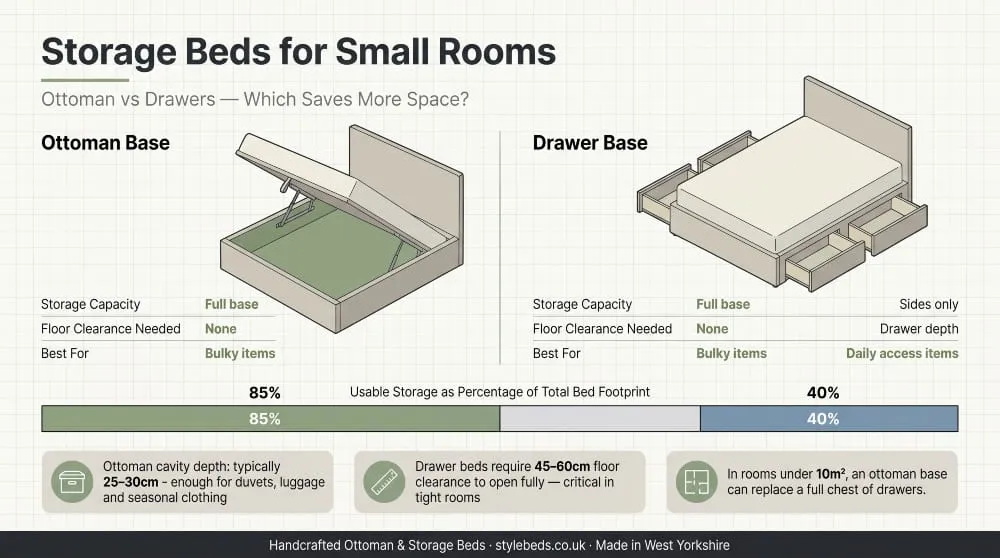
Drawer beds offer accessible, well-organised storage that’s easy to use daily, ideal for clothing, bedding, and items you reach for regularly. The drawbacks are clearance (you need floor space to pull the drawers open) and capacity (four drawers still leave the centre of the bed underutilised).
Ottoman beds sacrifice the compartmentalised organisation of drawers for sheer volume. The full base opens as one continuous space, which is less suited to neatly sorted daily use but significantly better for bulkier items, spare duvets, out-of-season clothing, suitcases, or anything that would otherwise require a separate storage solution. In a very small room where every square metre counts, the ottoman’s superior capacity-to-footprint ratio usually wins.
A single ottoman or drawer bed is the most space-efficient configuration for box rooms and children’s bedrooms. At 90cm wide, even a fully featured single ottoman leaves meaningful floor clearance on both sides while eliminating the need for under-bed boxes, a separate blanket chest, or additional shelving.
For children’s rooms specifically, a single storage bed also reduces the daily entropy of a small space; fewer places for clutter to accumulate means the room functions better without constant reorganisation.
A double ottoman bed in a small double bedroom effectively replaces a large chest of drawers or a significant portion of wardrobe space. The storage gain is substantial enough that some small bedroom layouts become viable specifically because a storage base removes the need for additional freestanding furniture.
For couples sharing a small double bedroom, a king-size ottoman with the largest available cavity is often the single most impactful furniture decision they can make, not just for storage, but for how spacious the room feels once the surrounding furniture is removed or reduced.
Beyond mechanism type, look for gas-lift quality (the pistons should hold the mattress platform securely without slamming), base depth (deeper cavities are significantly more useful), and fabric durability on the frame exterior. In a small room, the bed is the most visible piece of furniture from every angle; a well-upholstered frame in a considered colour contributes meaningfully to the room’s overall polish.
The best bed for a small room isn’t just about size or type; it’s about who’s sleeping in it, how often, and what else the room needs to do.
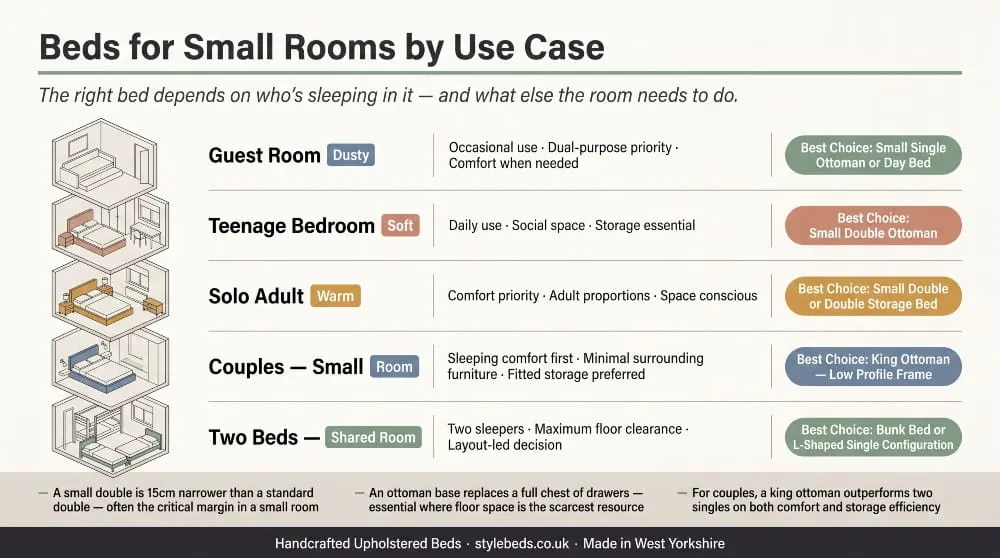
The primary tension in a small guest room lies between comfort when the room is in use and practicality when it isn’t. A permanent single bed takes up floor space year-round in a room that might host guests a handful of times a year. A pull-out sofa bed or day bed addresses this but often compromises on sleeping comfort.
The most satisfying middle ground for rooms that host guests more than occasionally is a small single or small double ottoman, a proper, comfortable bed that earns its floor space by eliminating storage furniture the room would otherwise need.
Teenage bedrooms ask more of a bed than almost any other room. The bed needs to be comfortable for sleeping, presentable as a social space, functional for studying nearby, and ideally large enough that a 16-year-old doesn’t feel they’re still sleeping in a child’s room. A small double with an upholstered headboard thread that balances well, adult-feeling proportions without overwhelming a modestly sized room.
Storage is equally important. Teenagers accumulate belongings faster than most adults, and a room that runs out of storage space quickly becomes a room that’s always in disarray. An ottoman base handles the overflow invisibly.
Adults sleeping in small rooms, whether in a flat, a converted space, or a single-occupancy second bedroom, often resist the single on principle, even when the room would suit it perfectly. The small double resolves this psychologically as much as practically: it reads as an adult bed, it sleeps one person comfortably, and it leaves enough room around it for the space to feel like a bedroom rather than a sleeping cupboard.
For adults who share a small room, a standard double is the practical minimum. A king in a small room is achievable, but it requires accepting that the bed will be the room, with everything else arranged around it rather than alongside it.
Fitting two sleeping surfaces into one small room is one of the harder layout problems in residential furniture. The workable solutions depend on who’s sharing and what compromise is acceptable.
For children sharing a room, bunk beds remain the most space-efficient answer; a single bed’s footprint supports two sleeping areas. For siblings who prefer their own space at floor level, L-shaped configurations or two singles placed head-to-head along one wall (with a shared bedside table between them) can work in rooms of approximately 3m × 3.5m or larger.
For couples in a very small room, a king ottoman on a low-profile frame, pushed against one wall if necessary, is usually preferable to the false economy of two singles pushed together, which creates an uncomfortable central gap and doubles the perimeter furniture requirement.
Where the bed sits in the room is as important as which bed you choose. The same frame in two different positions can make the same room feel either workable or impossible.
The most common and effective placement for a double bed in a small room is centred against the longest uninterrupted wall, with the headboard flush to the wall. This maximises the clearance at the foot of the bed and leaves space on both sides; even if that space is only 60cm, it’s navigable.
Avoid placing a double diagonally in a corner. It looks dramatic in larger rooms but wastes a significant triangle of space behind the headboard in smaller ones.
A king in a small room almost always needs to go against the longest wall. Unlike a double, there’s rarely enough clearance to centre a king with meaningful space on both sides, so one side typically sits closer to the wall than is ideal. Wall-mounted reading lights replace bedside tables, and access is primarily on one side.
This isn’t a failure of design; it’s an honest accommodation of the geometry. A king that’s slightly awkward to access from one side is still more comfortable than a double, and for couples, that trade-off is often worth it.
In very small rooms, particularly children’s box rooms, placing the bed into a corner or alcove and building storage above and around it creates a cabin-like sleeping nook that actually uses the awkward geometry productively. Low-profile shelving above a single pushed into a corner, a curtain to create definition, and lighting built into the shelf creates a space that feels intentional rather than constrained.
For adults, an alcove bed in a recess beside a chimney breast can be made elegant with the right upholstered frame and built-in cabinetry flanking it on both sides.
Yes, within reason. A bed frame that sits 30–35cm off the floor leaves more wall visible above the mattress line, which draws the eye upward and makes the ceiling feel higher. This effect is most pronounced in rooms with low ceilings or plain, uncluttered walls.
The trade-off is under-bed storage. A very low frame with minimal clearance beneath it is difficult to clean under and impossible to use for storage. If storage is a priority, a low-profile ottoman frame gives you both, the clean visual line of a lower profile and the full storage cavity underneath.
An upholstered frame, fabric-covered headboard and base, is often assumed to be bulkier than a metal or wooden slatted frame, but the opposite is frequently true. A well-proportioned upholstered frame in a mid-tone or light fabric creates a soft, unified visual that reads as less dominant than a harder-edged wooden frame. The fabric’s colour and texture absorb rather than reflect the room’s light, reducing the piece’s visual weight.
Style Beds’ handcrafted upholstered frames are available in over 40 fabrics including Plush Velvet, Teddy Boucle, and Naples, allowing the frame to be matched to the room’s existing palette rather than dictating it. In a small room where every visual choice carries more weight, that flexibility matters.
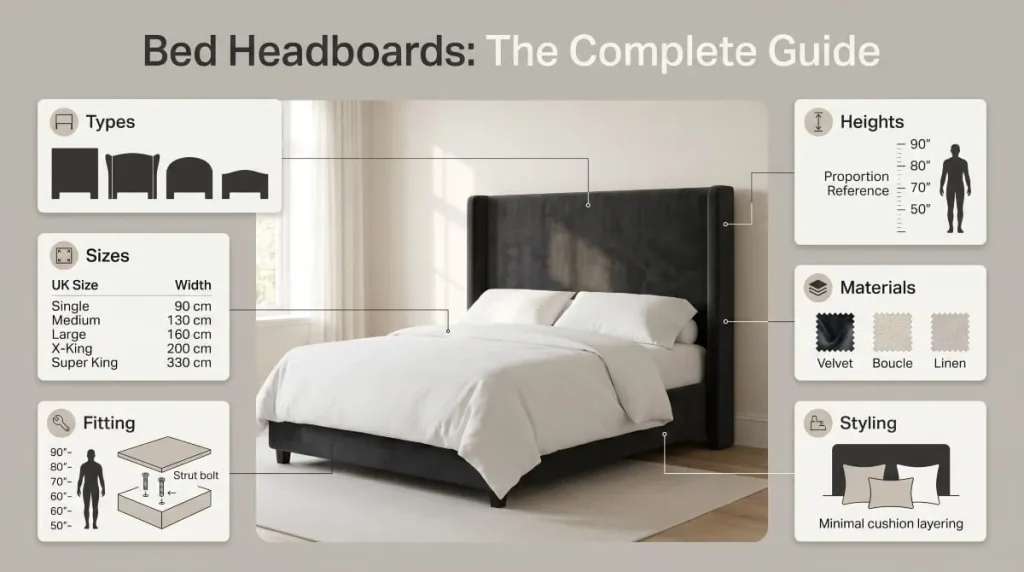
The design features that work best in small rooms share common traits: clean lines, minimal ornamentation, integrated or hidden storage, and a headboard height proportionate to the ceiling. Panelled headboards in particular add architectural interest without the visual bulk of heavily padded or deeply buttoned alternatives.
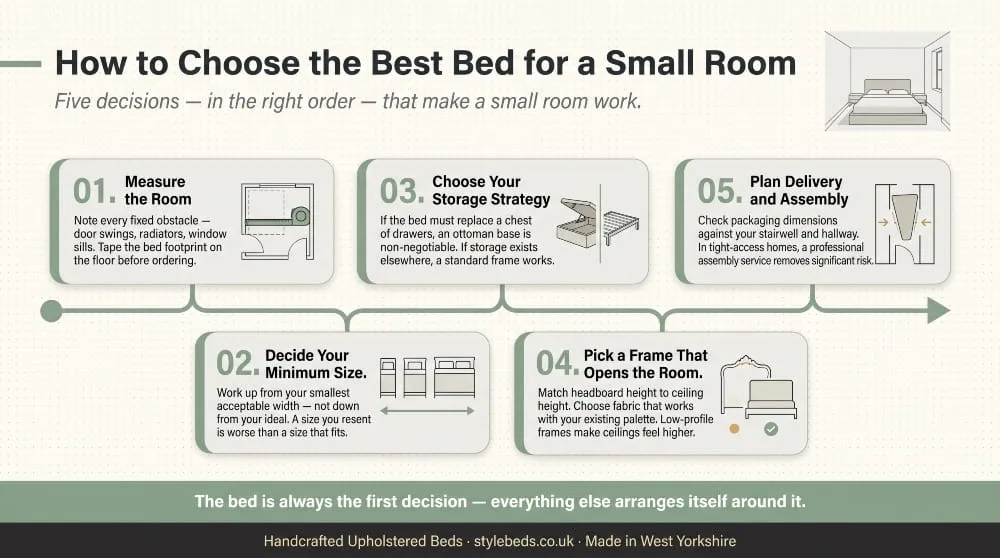
Measure the room’s full length and width, then note every fixed obstacle: door swings, window sills, radiators, built-in wardrobes. Tape the bed’s footprint on the floor before ordering anything. Check that the door opens freely and that there’s at least 60cm of clearance on the side of the bed you’ll access daily.
Work backwards from your minimum comfortable sleeping width, not downwards from your ideal. If you genuinely need a double, find a way to make a double work: storage solutions, furniture reduction, clever placement, rather than settling for a single and resenting it. If the room truly can’t accommodate a double with workable clearance, a small double is an honest and comfortable alternative.
Decide how much storage the bed needs to replace. If the room can accommodate a wardrobe and a chest of drawers alongside the bed, a standard divan or slatted frame is fine. If the bed is competing for floor space with those pieces, an ottoman base should be non-negotiable.
Choose a headboard height proportionate to the ceiling (taller headboards suit rooms with more ceiling height), a fabric that works with the room’s existing colour palette, and a profile that matches the visual tone you want: low and minimal, or upholstered and considered. In a small room, the bed isn’t background furniture. It will always be the first thing you see.
Small rooms often come with narrow corridors, tight stairwells, and awkward landings. Check the dimensions of the headboard and base in their delivery packaging; some large headboards require more manoeuvrability than the access to a small room allows. Style Beds offers an assembly service, which in a small room with difficult access is worth factoring into the decision from the outset.
Browse Style Beds’ full range of upholstered bed frames, ottoman divans, and storage beds, all handcrafted in Dewsbury, West Yorkshire, with free UK delivery and a 3-year frame warranty.
For a very small or box room, a single or small double ottoman bed is the most practical choice. The ottoman storage base maximises every centimetre of the frame, and the compact footprint leaves enough floor space for the room to function as more than a sleeping area.
Yes, in most rooms described as a small double bedroom, roughly 3m × 3m or larger. The key is clearance: at least 60cm of walkway on one side, and enough room at the foot for the door to open freely. A storage base eliminates the need for additional furniture and keeps the floor space around the bed clear.
A king can work in a small room if it’s placed against the longest wall, bedside tables are replaced with wall-mounted alternatives, and the surrounding furniture is minimal or fitted. It requires accepting tighter clearance on one side, but for couples who prioritise sleeping comfort above all else, the trade-off is often worthwhile.
A low-profile frame in a light or mid-tone fabric, placed against the main wall with clear floor space around it, will make a small room feel as open as possible. Removing bulky bedside tables and using wall-mounted lighting significantly reinforce the effect.
Consistently, yes. The storage capacity of a well-made ottoman base replaces furniture that would otherwise consume the floor space the small room cannot afford to lose. For rooms where storage is genuinely limited, an ottoman bed pays for any price premium within the first year of use.
A single ottoman or a shorty bed (if the room length is the constraint) with a low-profile upholstered frame. If the box room needs to function as a guest room and a daytime space, a day bed or pull-out configuration is worth considering.
A shorty bed is a bed frame and mattress combination built to a shorter-than-standard length, typically 175cm rather than the standard 190–200cm. They’re designed for rooms where the full standard length creates a layout problem, usually due to a door swing, radiator, or a structural feature near the foot of the bed. Most adults under 5’9″ sleep on them comfortably.
A UK box room is typically defined as a room measuring less than 2.15m × 2.75m. A single (90cm × 190cm) fits in almost all box rooms with workable clearance. A small double (120cm × 190cm) fits in many but requires careful measurement. A standard double (135cm × 190cm) is possible in a box room only if the room is towards the larger end of the definition and other furniture is minimal.