

Bed Frame Dimensions Every UK Size Explained (cm, inches & feet)
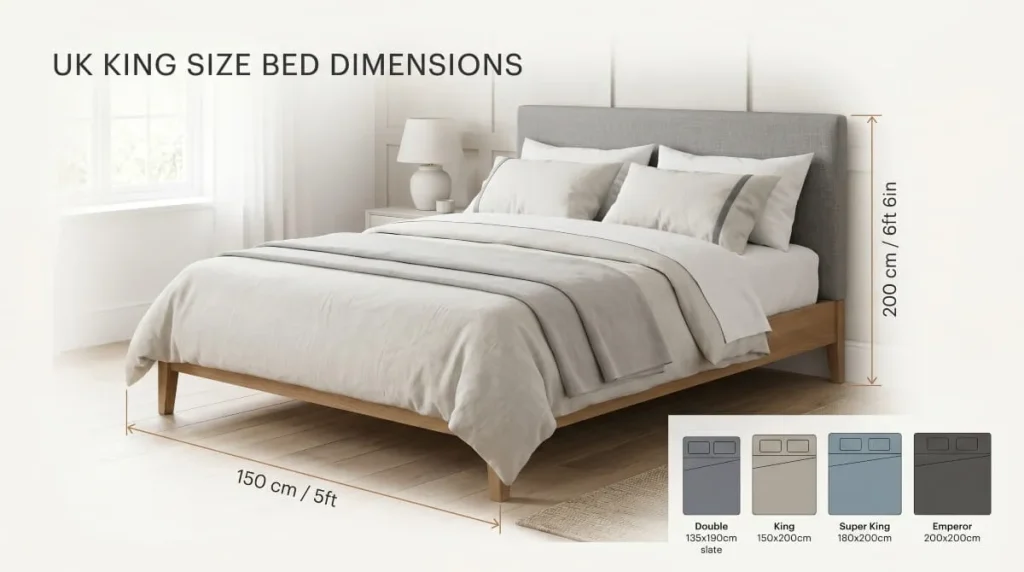
A king size bed frame in the UK measures 150cm wide by 200cm long (5ft × 6ft 6in), that’s the frame’s external footprint, not just…
Knowing your bed frame sizes and measurements before you buy is the difference between a bedroom that breathes and one that barely closes its door. In the UK, bed frames follow a standardised sizing system. Still, the exact dimensions vary by frame style, and the gap between a mattress size and its corresponding frame is something most buyers discover only after delivery.
This guide covers every standard UK bed frame size from single through to super king, with precise measurements in centimetres, inches, and feet. You’ll also find guidance on measuring your room correctly, how frame dimensions relate to mattress dimensions, and how to avoid the most common sizing mistakes. Whether you’re furnishing a compact spare room or choosing a statement king-size frame for a main bedroom, the numbers here give you a reliable foundation before you commit.
A mattress and its bed frame are not the same size. Frames are built slightly larger than the mattress they hold, typically adding 2–5 cm to each dimension, and that difference compounds when you factor in a headboard, footboard, or ottoman base. According to the Sleep Council, nearly one in five UK adults says their bedroom furniture doesn’t fit their room as well as they expected. Getting the measurements right before purchase isn’t a formality; it’s the step that protects the whole decision.
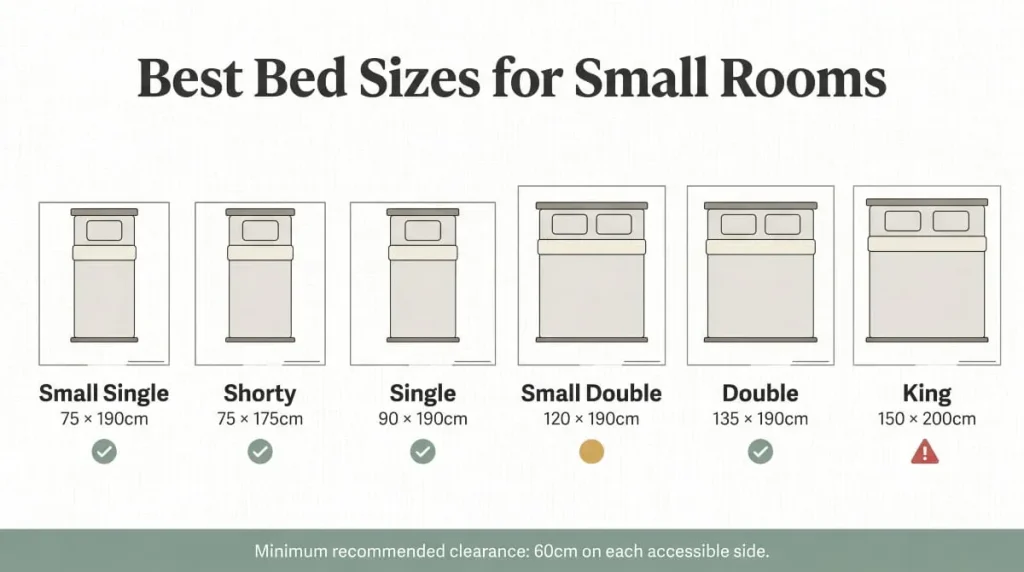
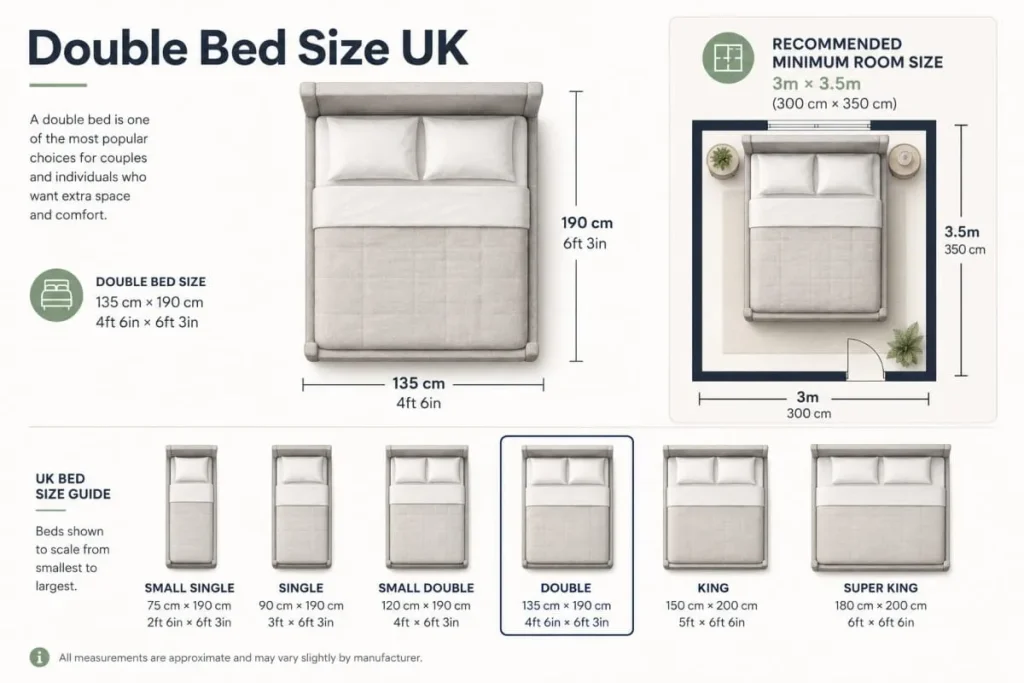
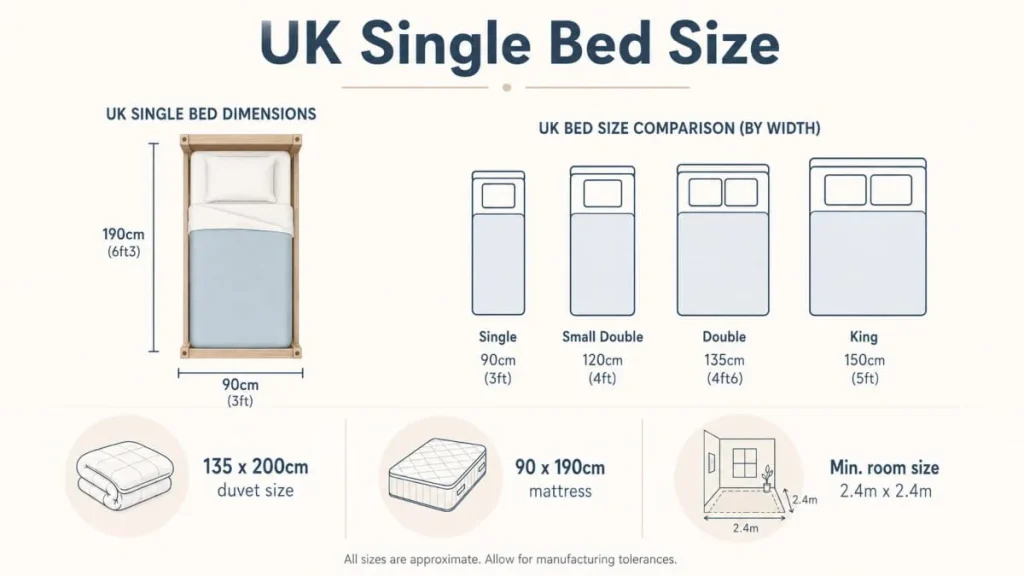
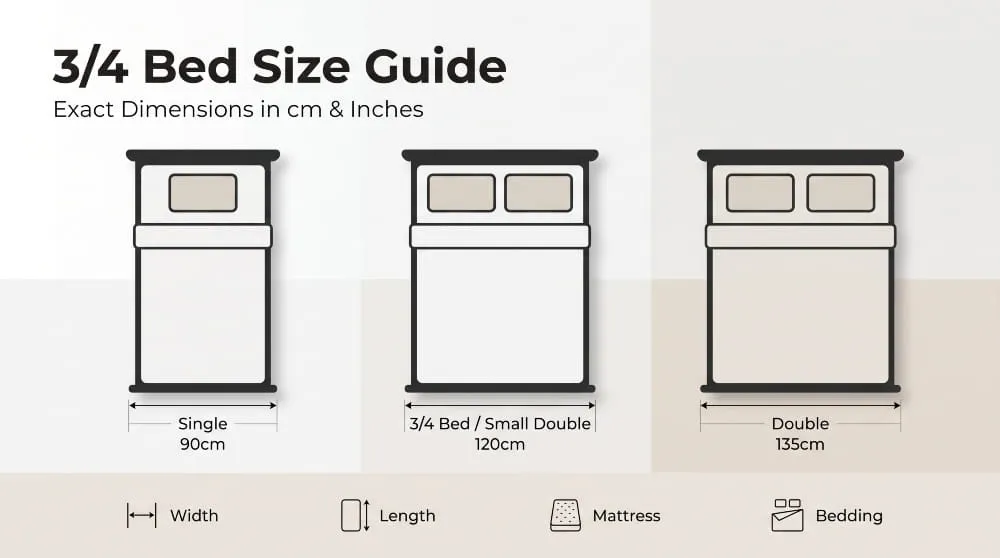
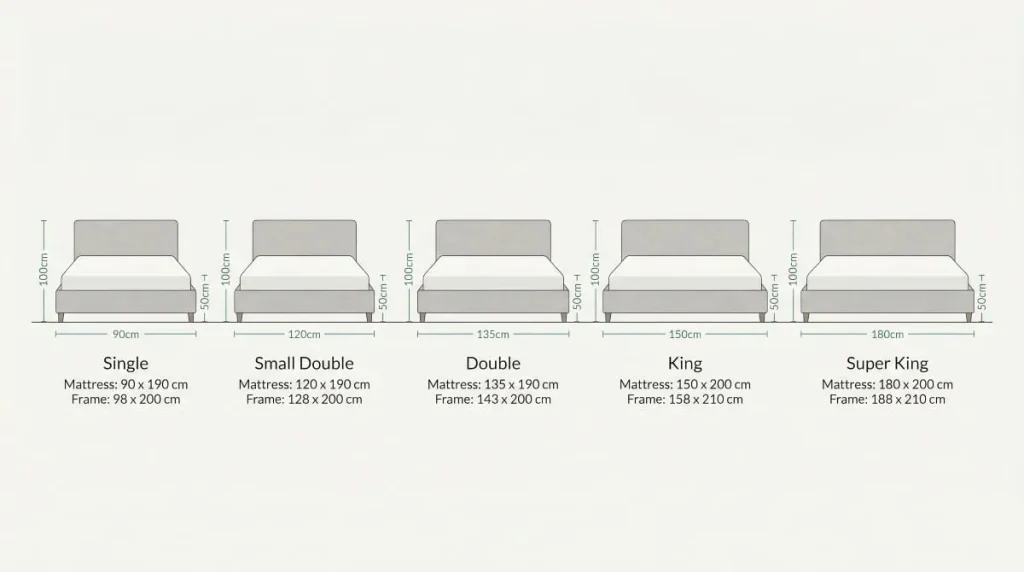
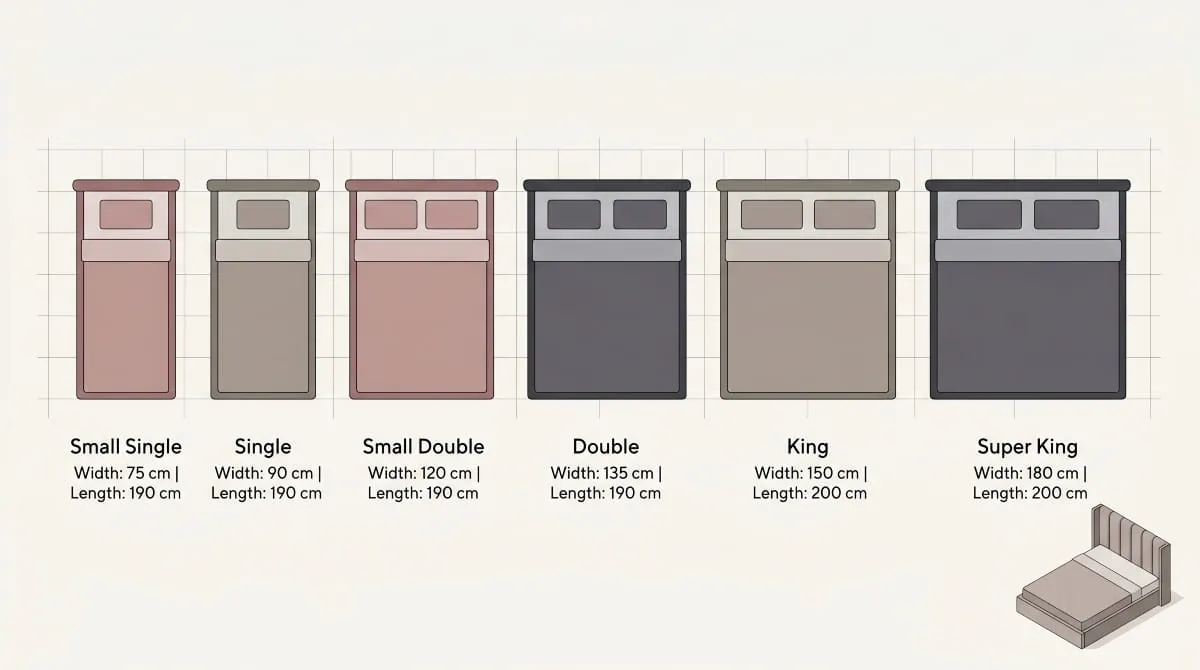
The UK uses a consistent bed-sizing system, and every standard bed frame is built to accommodate a specific mattress size. There are six sizes in common use: small single, single, small double, double, king, and super king. Each one has an agreed width and length, making it straightforward to match a frame to a mattress, provided you understand what the quoted dimensions actually refer to.
The table below shows the standard UK mattress dimensions that each frame is designed to hold, alongside the typical exterior frame footprint you should plan your room around. Interior dimensions match the mattress size; exterior dimensions vary by manufacturer but typically add 5–8 cm on each side.
King and super king frames run longer than their smaller counterparts, 200 cm versus the standard 190 cm, so room planning for these sizes deserves particular care.
When a manufacturer lists a bed frame as “king size,” they mean it’s designed to hold a 150 × 200 cm mattress, but the frame itself will be larger. The exterior frame footprint includes the thickness of the side rails, the base structure, and, in upholstered frames, the fabric and padding wrapped around the outer edge. This typically adds 5–10 cm to the width and 5–12 cm to the length, depending on the design.
This distinction matters most when you’re working in a tight room. A double mattress is 135 cm wide, but a double bed frame will occupy closer to 145–150 cm of floor space. If you’re measuring a gap between two walls or around existing furniture, always plan around the exterior frame measurement, not the mattress size.
There are two measurements every buyer should know before purchasing a bed frame. The interior dimension is the sleeping surface, the space the mattress sits within, which should match your mattress size precisely. The exterior dimension is the full outer footprint of the frame, including all structural and decorative elements.
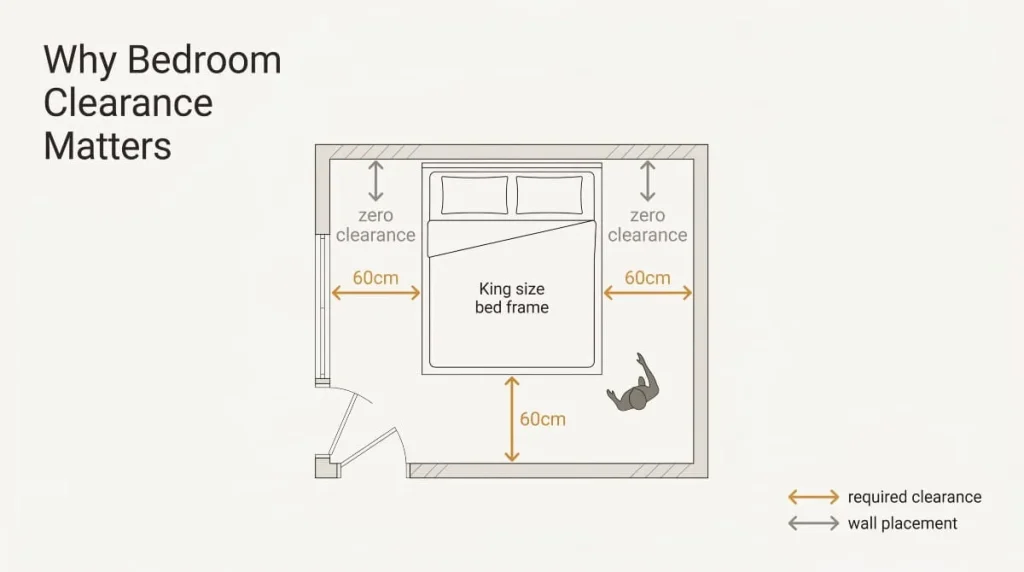
For room planning, the exterior dimensions are the only ones that matter. Measure the width and length of the frame’s outer edge, then add a minimum of 60 cm on each accessible side for comfortable movement. The NHS recommends at least this clearance around bedroom furniture for safe navigation. For headboard height, measure from the floor to the top of the headboard, especially if you’re working with low ceilings, a sloped attic, or positioning the frame beneath a window.
Measuring a bed frame correctly takes less than 10 minutes, but skipping this step is one of the most common and avoidable reasons for a failed delivery. Whether you’re replacing an existing frame or furnishing a room from scratch, the process follows the same four steps: gather the right tools, understand what each dimension means, measure your room, and confirm your clearance space.
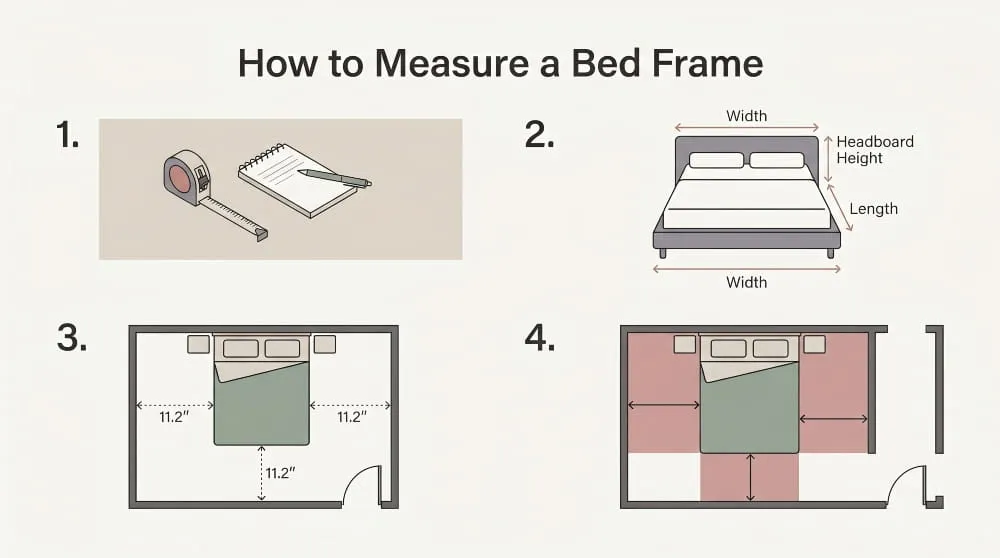
You need three things: a steel tape measure of at least 3 metres, a pencil, and a notepad or phone to record your figures. A laser distance measurer is useful for larger rooms, but not essential. Fabric tape measures, the kind used in dressmaking, are not suitable, as they flex and introduce error over longer distances. Always measure twice and record in centimetres for accuracy, converting to inches or feet only if you’re cross-referencing with a manufacturer’s listing that uses imperial units.
A bed frame has three key dimensions, each serving a different purpose in your planning.
Width is the measurement across the short side of the frame, the dimension most people mean when they say “bed size.” A king-size frame is 150 cm wide at the mattress interior, with an exterior width of approximately 160–165 cm, depending on the design.
Length is measured from the head end to the foot end of the frame along its longest axis. Most UK frames run 190–195 cm in length for single through to small double sizes, and 200–210 cm for king and super king. Always measure the exterior length, including any footboard.
Height has two components: the floor-to-top-of-mattress height, which determines how easy it is to get in and out of the bed, and the headboard height, measured from the floor to the very top of the headboard. Headboard height is easy to overlook and catches buyers off guard in rooms with low ceilings, dormer windows, or picture rails. Standard headboard heights on upholstered frames range from around 100 cm to over 150 cm, a meaningful difference in a room with a 220 cm ceiling.
Start by measuring the full length and width of the room at floor level, noting the position of every door, window, radiator, and built-in fixture. Doors are particularly important; measure the swing arc, not just the frame opening, and confirm the bed won’t obstruct it when fully open.
Next, measure the specific wall the bed will sit against. In most bedrooms, this is the longest uninterrupted wall, but alcoves, chimney breasts, and power sockets all reduce the usable space. Note the ceiling height, too, if you’re considering a tall upholstered headboard. Once you have these figures, sketch a rough floor plan to scale, even a basic one, before comparing against the exterior frame dimensions of any bed you’re considering. Research from NHBC Foundation suggests that in UK homes built since 2000, the average double bedroom measures just 11.5 m², making precise planning more important than most buyers expect.
Clearance space is the floor area you leave free around the bed frame for daily movement, and it directly impacts how livable the room feels. The minimum recommended clearance on any side of the bed that you access regularly is 60 cm, roughly the width of a person standing side-on. For the primary side where you make the bed and move around most, 75–90 cm is more comfortable.
At the foot of the bed, 90 cm is a practical minimum if a wardrobe or chest of drawers sits opposite. If the foot of the bed faces a door, check that the door can open fully without touching the frame; this is the measurement most often missed in room planning. On a wall side where access is not required, clearance can be reduced to 30–40 cm without any functional penalty.
A full-size bed frame is designed to hold a mattress measuring 135 × 190 cm, which in the UK is simply called a double. The term “full size” is predominantly American. Still, it appears frequently enough in UK search results and product listings that it’s worth understanding exactly what it refers to and how it maps to the sizes you’ll find on the British market.
A full-size bed frame measures approximately 54 inches wide by 75 inches long at the mattress interior. The exterior frame footprint, the figure you should use for room planning, typically runs to 57–60 inches wide and 78–80 inches long, depending on the thickness of the frame’s side rails and any upholstered edging. For reference, that’s just under 5 feet wide and just over 6 feet long as a floor footprint, before accounting for headboard projection or ottoman base depth.
In centimetres, a full-size bed frame holds a 135 × 190 cm mattress. The exterior frame dimensions generally fall between 143–150 cm wide and 197–205 cm long. If the frame includes a substantial upholstered headboard, common on fabric bed frames, add the headboard depth to the length measurement if it projects beyond the frame’s rear rail, which some designs do by 5–10 cm. Always request the exterior dimensions from the retailer before purchasing, as product pages frequently list only the mattress size.
In practical terms, yes: a full-size bed and a UK double bed are the same thing. Both are designed around a 135 cm-wide by 190 cm-long sleeping surface. The difference is purely linguistic: “full size” is the standard American term, while “double” is the term used throughout the UK, Ireland, and most of Europe.
The confusion arises because US sizing uses four terms, twin, full, queen, and king, that don’t map neatly onto the UK system of single, double, king, and super king. A US queen, for instance, is 153 × 203 cm, which sits between a UK double and a UK king with no direct British equivalent. If you’re importing a frame or buying from a US-based retailer, always verify the exact centimetre dimensions rather than relying on the size name alone.
A full-size, or double, bed frame is the most widely purchased size in the UK, and for good reason. At 135 cm wide, it provides a couple with a workable sleeping surface without dominating a moderately sized room, and it suits single sleepers who want more space than a standard 90 cm single offers. It’s the natural starting point for first-time buyers, those furnishing a guest room, and anyone upgrading from a single without committing to the larger floor footprint of a king.
Where a double works less well is in rooms below roughly 10 m², where the exterior frame footprint can leave inadequate clearance on both sides, and for couples who both sleep hot or move frequently during the night, in which case a king-size frame, at 150 cm wide, offers a meaningfully more comfortable sleeping width per person.
A double bed frame is the UK’s most popular bed size, designed to hold a mattress measuring 135 cm wide by 190 cm long. It strikes the balance most buyers are looking for, generous enough for two people, compact enough to fit comfortably in the majority of UK bedrooms without consuming the entire floor plan.
The interior of a double bed frame, the space the mattress sits within, measures 135 × 190 cm, or 54 × 75 inches. The exterior frame footprint, which is what you need for room planning, typically measures between 143–150 cm wide and 197–205 cm long, depending on frame construction and whether the design is upholstered.
Upholstered double frames, particularly those with deep-padded side rails and a substantial headboard, sit toward the larger end of that exterior range. A fabric-wrapped frame with a 55-inch or taller headboard will also add meaningful visual height to the room, a consideration in bedrooms with ceilings below 240 cm or in rooms where the bed sits beneath a window.
In feet, a double frame occupies roughly 4’9″ to 5’0″ in width and 6’6″ to 6’9″ in length as a floor footprint. Doubled-checked against the room’s usable wall width, minus sockets, radiators, and door swings, this figure determines whether a double frame genuinely fits or merely technically clears the walls.
There are no meaningful physical differences between a UK double and a US full-size bed. Both are built around the same 135 × 190 cm sleeping surface, and a double mattress will fit a full-size frame and vice versa. The distinction is entirely terminological; “double” is the British standard, “full” is the American equivalent, and the two terms describe the same size.
Where confusion occasionally arises is in product listings from international retailers or marketplaces, where “full” may appear as a size option alongside “queen” and “king” using US dimensions. A US queen measures 153 × 203 cm, which is noticeably wider and longer than a UK double, so a mattress bought for UK double dimensions will not fit a US queen frame without a visible gap. When buying across markets, always confirm dimensions in centimetres before purchasing either the frame or the mattress.
A king-size bed frame is built to hold a mattress measuring 150 cm wide by 200 cm long, which is wider and longer than a double, and is the most popular upgrade choice for couples in the UK. It’s a size that delivers a noticeable improvement in sleeping comfort without the room demands of a super king, making it the default choice for master bedrooms in most UK homes.
The interior of a king-size bed frame measures 150 × 200 cm, or 59 × 79 inches, or approximately 5’0″ × 6’6″ in feet. The exterior frame footprint, the figure that determines how much floor space the bed actually occupies, typically runs to 160–165 cm wide and 210–215 cm long, depending on frame design and whether the construction is upholstered.
In inches, that exterior footprint measures roughly 63–65 inches wide by 83–85 inches long. In feet, plan for approximately 5’4″ × 7’0″ of floor space as a working minimum. Upholstered king-size frames with deep-padded rails will sit toward the upper end of these ranges, so always request the manufacturer’s stated exterior dimensions rather than calculating solely from the mattress size.
A UK king-size and a US king-size are not the same, and the difference is significant enough to cause a genuine compatibility problem if you’re buying across markets. A UK king measures 150 × 200 cm. A US king, sometimes called a standard king or eastern king, measures 193 × 203 cm, making it considerably wider than its British equivalent and closer in width to a UK super king.
There is also a US western king, known as the California king, which measures 183 × 213 cm, longer and narrower than the US standard king, and again incompatible with UK mattress dimensions. If you’re purchasing a frame from a US retailer or a marketplace that lists sizes in American terms, a UK king-size mattress will not fit a US king-size frame. Always verify in centimetres before committing to either piece.
A king-size bed frame requires a minimum floor footprint of approximately 160 × 210 cm, and that figure should be treated as the absolute minimum, the space the frame occupies before any clearance is added. For a comfortable, functional bedroom layout, plan for at least 75 cm of clearance on each side of the bed that you access regularly, and a minimum of 90 cm at the foot if furniture sits opposite.
Working those clearances around a standard king frame produces a recommended room width of at least 310–320 cm and a recommended room length of at least 340–360 cm for a workable layout. Research from the Royal Institute of British Architects suggests the average UK main bedroom measures around 340 × 340 cm, meaning a king-size frame fits, but leaves little margin for oversized furniture on both sides simultaneously.
A king-size frame is the right choice when the main bedroom can comfortably accommodate the footprint without reducing the room to a corridor around the bed. The practical test is simple: mark out a 160 × 215 cm area on the floor with tape, add your clearance zones, and assess what remains. If you retain at least 75 cm on both accessible sides and 90 cm at the foot, the room works.
Beyond dimensions, a king-size is worth the upgrade for couples who regularly share a bed; each person gains roughly 75 cm of sleeping width, compared to 67 cm on a double. For single sleepers, the additional width is generous but rarely necessary unless the room size comfortably accommodates it without compromise. Where budget and room size allow, a king-size upholstered frame also tends to anchor a main bedroom more effectively than a double, giving the space the proportional weight it needs to feel considered rather than underfurnished.
A super king-size bed frame is the largest standard bed size available in the UK, built to hold a mattress measuring 180 cm wide by 200 cm long. It’s a genuinely expansive sleeping surface, 30 cm wider than a king, and it commands a room in a way no smaller size can match. For couples who prioritise sleep space above all else, or for larger master bedrooms that need a frame with real presence, the super king is the natural endpoint.
The interior of a super king bed frame measures 180 × 200 cm (71 × 79 inches). The exterior frame footprint, the measurement you need for room planning, typically falls between 190–196 cm wide and 210–215 cm long, depending on the frame construction and the depth of any upholstered edging or padded side rails.
In feet, a super king frame measures approximately 6’3″ to 6’6″ wide and 7’0″ to 7’2″ long, with a floor footprint. That particular width is the figure most buyers underestimate. At nearly two metres across, a super king frame is wider than most people are tall, and the frame’s visual scale in a room that’s too small for it is immediately apparent. Measure carefully, and plan around the exterior dimension, not the mattress size.
They are not the same, and the difference matters if you’re buying a mattress separately or sourcing a frame from outside the UK. A UK super king measures 180 × 200 cm, a wide, relatively standard-length sleeping surface. A California king, which is an American size, measures 183 × 213 cm, marginally wider but significantly longer, at 13 cm more in length than a super king.
UK retailers rarely stock the California king as a standard size, and UK super king mattresses will not fit a California king frame without a visible length gap. The two sizes are close enough to confuse but different enough to create a real compatibility problem. If a product listing uses the term “California king” without specifying centimetre dimensions, treat it as a different size entirely and verify before purchasing.
The minimum recommended room size for a super king bed frame is approximately 400 × 400 cm, assuming a straightforward layout with the bed centred against one wall. Working from an exterior frame footprint of roughly 193 × 213 cm, and applying the standard clearance recommendations of 75 cm on each accessible side and 90 cm at the foot, the usable room width needs to be at least 343 cm, and that’s before accounting for bedside tables, wardrobes, or any other furniture.
In practice, a super king sits most comfortably in a main bedroom of 420 cm or wider. Below that threshold, the clearances start to compress, and the room begins to feel dominated by the bed rather than anchored by it. If your room falls short but you’re set on a super king, prioritise clearance on the primary access side and accept a reduced margin on the wall side, 30–40 cm against a wall is acceptable where no access is needed. What you shouldn’t compromise is the foot-of-bed clearance, particularly if a door or wardrobe sits directly opposite.
The table below brings together all standard UK bed frame sizes, covering interior mattress dimensions, typical exterior frame footprints, and the minimum room size needed to accommodate each frame with practical clearance on all sides. Use the exterior frame column, not the mattress column, as your planning figure.
Exterior frame dimensions are approximate and vary by manufacturer, frame style, and whether the construction is upholstered. Fabric bed frames with deep-padded side rails typically add 5–8 cm to each exterior dimension beyond the mattress size; platform and metal frames generally add less. The minimum room sizes above apply standard clearance guidelines of 75 cm on accessible sides and 90 cm at the foot of the bed, and assume no additional furniture beyond the frame itself.
Two sizing jumps are worth noting specifically. The step from double to king adds 15 cm of sleeping width and 10 cm of length, a meaningful gain in comfort that only adds around 17 cm to the exterior frame width, making it achievable in most UK master bedrooms above 300 cm wide. The step from king to super king adds 30 cm of width, which has a more significant impact on room planning and typically requires a dedicated main bedroom with a narrower dimension of at least 400 cm to remain functional.
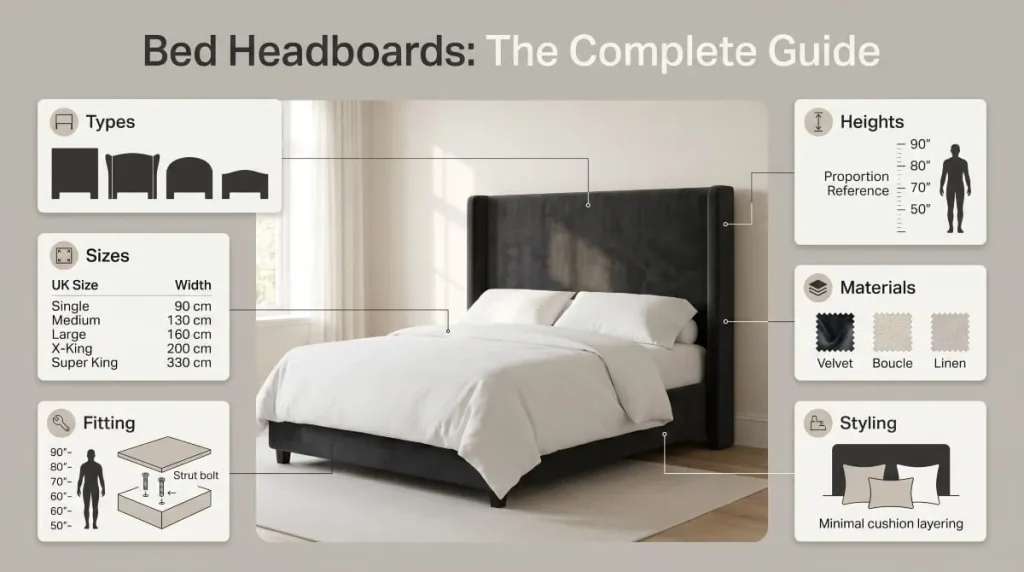
Headboard height is the dimension most consistently overlooked in bed frame planning, yet it has a direct impact on both the practical fit of the frame in a room and the way the bedroom looks and feels. A frame that clears every floor-level measurement perfectly can still create problems if the headboard height hasn’t been checked against ceiling height, window sill position, or picture rail placement.
Headboard heights in the UK are measured from the floor to the top of the headboard, not from the top of the mattress. This distinction matters because the floor-to-mattress-top height, typically 45–55 cm on a standard divan or slatted base, means a headboard that appears modest in a product image can still clear 130–140 cm from the floor once the base is accounted for.
Standard headboard heights on UK upholstered bed frames generally range from around 100 cm to 150 cm floor-to-top, though statement and high-back designs can reach 160 cm or beyond. On Style Beds frames, headboard options range from 50 inches (127 cm) to 90 inches (229 cm), measured from the top of the base, giving buyers a wide range of proportions to suit the ceiling height and the room’s aesthetic.
As a general rule, a headboard that reaches approximately two-thirds of the wall height between the top of the mattress and the ceiling creates the most balanced proportion. In a room with a standard 240 cm ceiling and a mattress sitting at 50 cm from the floor, the ideal headboard top is roughly 180–190 cm from the floor, a figure comfortably within the range of most high-back upholstered designs.
A tall headboard does more than add visual drama; it fundamentally changes how a room reads. In a bedroom with adequate ceiling height, a high-back upholstered headboard draws the eye upward, makes the ceiling feel higher, and gives the bed the weight and presence of a focal point rather than simply a piece of functional furniture. Interior designers consistently cite the bed as the single most important anchor in a bedroom, and headboard height is the primary lever that controls how effectively it anchors the space.
The practical considerations run in both directions. In rooms with high ceilings, 260 cm and above, a low or mid-height headboard can look underwhelming, leaving an expanse of blank wall above the bed that feels unresolved. Conversely, in rooms with standard or low ceilings, a headboard that approaches or exceeds ceiling height creates a cramped, top-heavy effect that works against the room rather than for it. Rooms with sloped ceilings, dormer windows, or roof lights directly above the bed position require particular care. In these cases, measure the ceiling height at the point where the headboard top will sit, not at the centre of the room, where ceiling height is typically greatest.
Beyond ceiling clearance, a tall headboard also affects the amount of natural light. A frame positioned beneath or adjacent to a window should be checked to confirm the headboard won’t block the window opening, obstruct ventilation, or cast the sleeping area into shadow during daylight hours. This detail rarely appears in planning guides but consistently matters once the frame is in place.
With the measurements confirmed and your room dimensions in hand, the next step is finding a frame that fits the space and suits the way you want the bedroom to look and feel. The size is the foundation, but the fabric, headboard height, and construction quality are what make a bed frame worth living with for years rather than months.
At Style Beds, every frame is handcrafted in our Dewsbury workshop in West Yorkshire and delivered free to mainland UK addresses in 3–5 working days. Each comes with a three-year warranty and a 30-night risk-free trial, so if the frame doesn’t work in your room the way you expected, you’re not committed to keeping it.
If you’re still deciding on size, the three most popular starting points are below.
Double Bed Frames are the UK’s most versatile size. At 135 × 190 cm, a double frame works in most UK bedrooms and suits both couples and single sleepers who want a generous sleeping surface without a large floor footprint.
King-Size Bed Frames: The most popular upgrade. At 150 × 200 cm, a king gives couples a meaningfully wider sleeping surface and anchors a main bedroom with the kind of presence a double rarely achieves.
Super King Bed Frames, The statement choice. At 180 × 200 cm, a super king is built for larger master bedrooms where space isn’t a constraint and sleep comfort is the priority. Available in Plush Velvet, Teddy Boucle, and Naples fabric across a full range of headboard heights.
Every size is available in your choice of fabric and headboard height, with no compromise on the handcrafted construction that goes into every frame we make. Built in Yorkshire. Delivered across the UK.
A UK king-size bed frame holds a mattress measuring 150 × 200 cm (59 × 79 inches). The exterior frame footprint, the figure to use for room planning, typically runs to approximately 160–165 cm wide and 210–215 cm long, depending on the frame construction.
A full-size bed frame is the American term for what the UK calls a double, designed to hold a mattress measuring 135 × 190 cm (54 × 75 inches). The exterior frame footprint is typically 143–150 cm wide and 197–205 cm long.
Measure the exterior frame dimensions, not the mattress size, and mark them out on the floor using tape. Then add a minimum of 75 cm of clearance on each accessible side and 90 cm at the foot of the bed to confirm the room can comfortably accommodate the frame.
Bed frame width and length measurements do not include the headboard, but headboard height is measured from the floor to the top of the headboard. Always check headboard height separately against your ceiling height, particularly in rooms with sloped ceilings or windows positioned above the bed.
UK and US bed sizes share the same names but not the same dimensions. A US king measures 193 × 203 cm, significantly wider than a UK king at 150 × 200 cm, and a US full at 135 × 190 cm is the closest equivalent to a UK double, though minor variations exist between markets.
A standard UK double mattress measuring 135 × 190 cm fits a double bed frame, also known as a full-size frame in American sizing. No other frame size is compatible without leaving a visible gap or creating a misfit between the mattress and the frame’s interior dimensions.