

Bed Frame Dimensions Every UK Size Explained (cm, inches & feet)
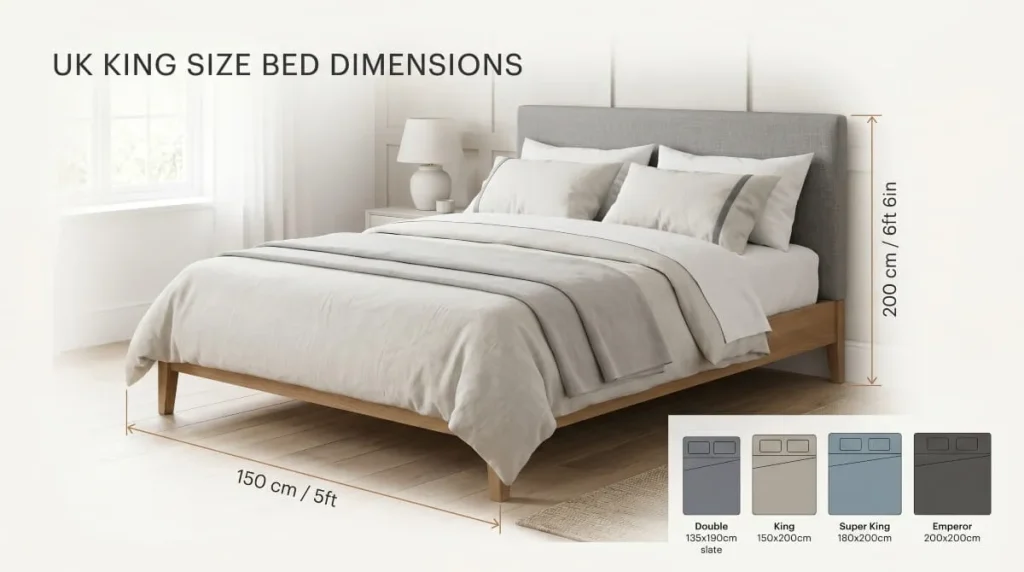
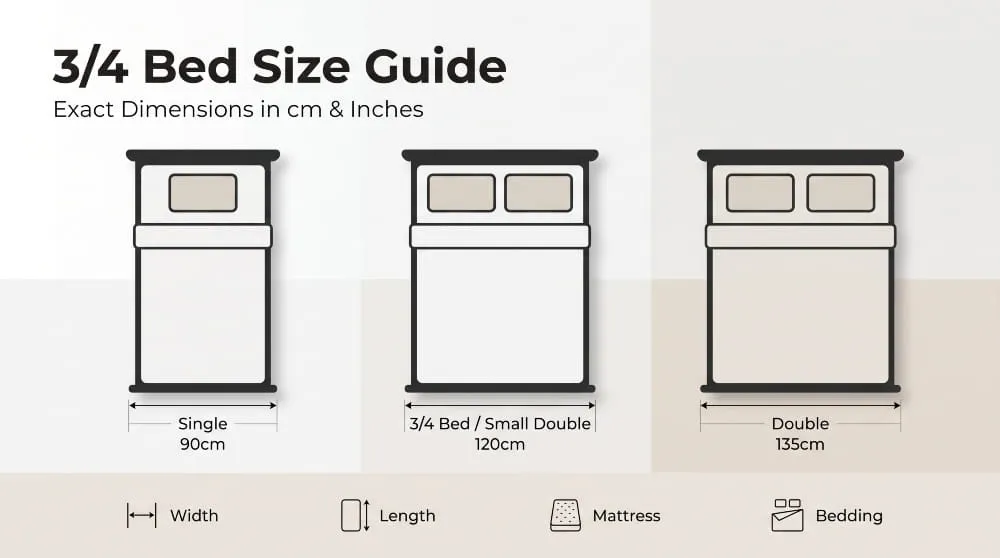
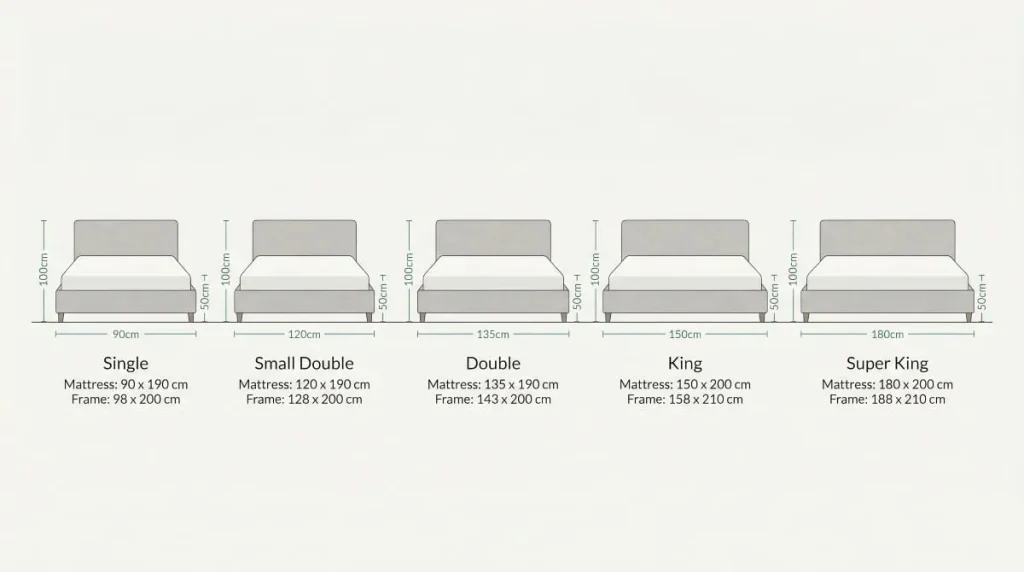
A king size bed frame in the UK measures 150cm wide by 200cm long (5ft × 6ft 6in), that’s the frame’s external footprint, not just…
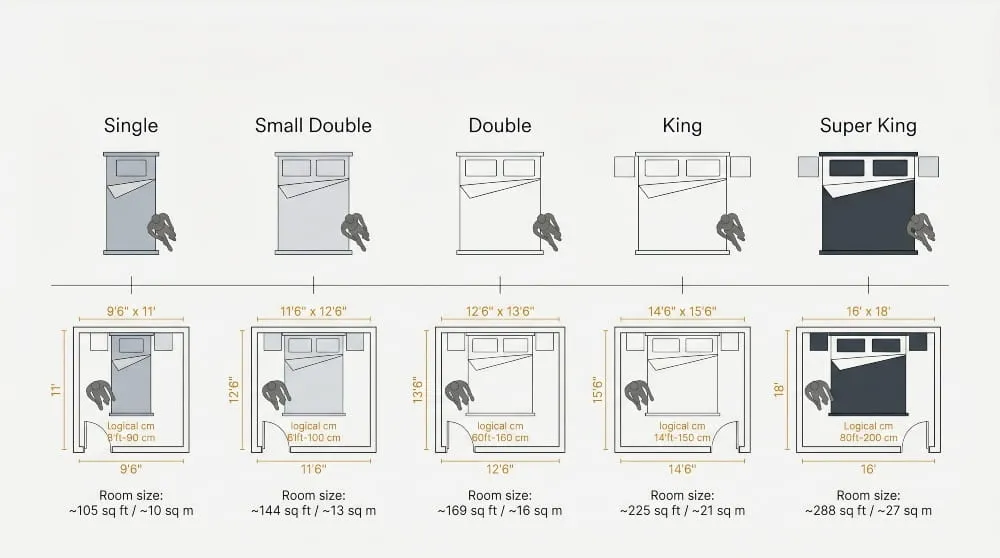
Choosing the right bed size for your room comes down to one rule: your bed should never take up more than 60% of your bedroom’s total floor space. Get that balance right, and the room feels open, functional, and well-proportioned. Get it wrong, and even the most expensive bed will make your bedroom feel like a storage unit.
The most common mistake people make is measuring the bed without measuring the room. A king-size bed is 150cm wide and 200cm long. That sounds manageable until you’re left with 40cm of clearance on either side and a door that barely swings open. Bedroom size determines everything: which sizes are physically possible, which are comfortable to live with, and which will leave you regretting the purchase six weeks in.
This guide gives you the framework to match any room to the right bed size, with specific room dimensions, minimum clearance rules, and practical fit advice for every scenario from a tight 10×10 box room to a generous 14×14 main bedroom.
Most people shop for a bed by style or budget. Room size is an afterthought, and that’s exactly why so many bedrooms end up feeling cramped, awkward, and harder to live in than they should be. The bed is the largest single piece of furniture in any bedroom, which means it sets the spatial tone for everything else. Choose the wrong size, and no amount of clever decorating will fix it.
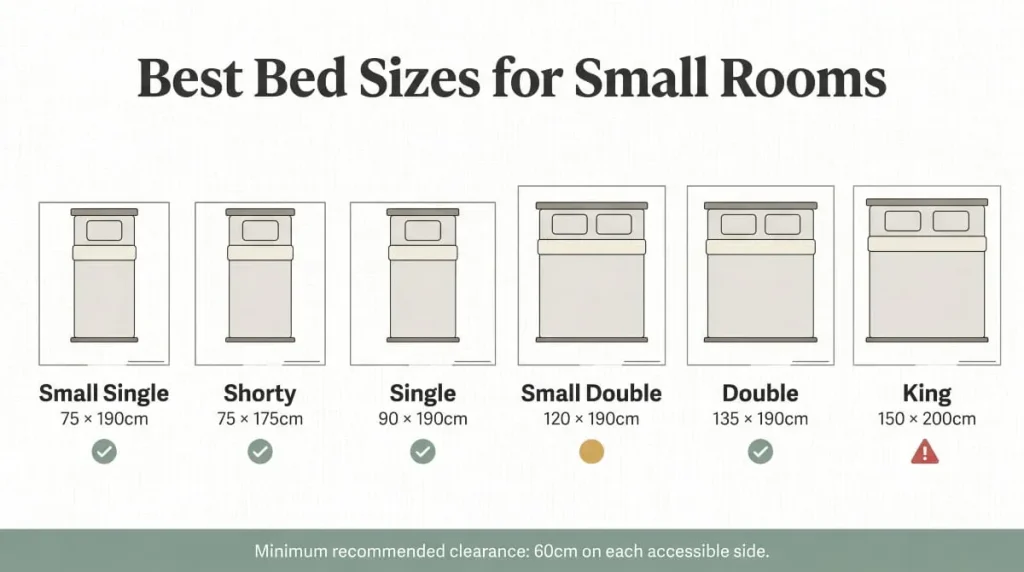
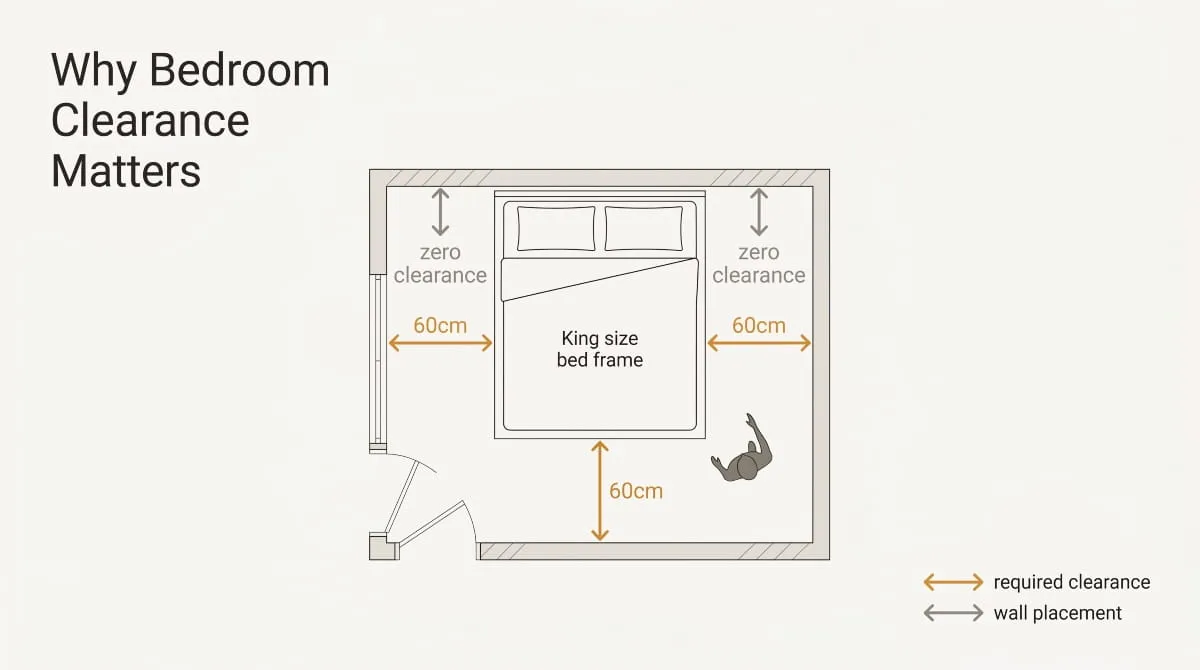
The 60cm clearance rule is the single most useful guideline in bedroom planning: leave at least 60 centimetres of clear floor space on every side of the bed you’ll regularly walk past. That’s roughly the width of your shoulders, the minimum comfortable passage for a person moving through a room without turning sideways or sucking in.
This isn’t an arbitrary design standard. It comes from ergonomics research into how people move through domestic spaces, and it’s the benchmark used by interior architects and bedroom planners across the UK and Europe. On the sides of the bed that sit against a wall or in a corner, clearance can drop to zero. But on any side where you walk, dress, make the bed, or open a wardrobe, 60cm is the floor, not the target.
In practical terms, this rule alone eliminates much of the wishful thinking. A king-size bed in a 10×10 room leaves roughly 35cm of clearance on each long side after accounting for the bed frame. That’s tighter than a standard doorway. The room isn’t broken; the bed is just the wrong size for it.
An oversized bed in a small room creates problems that compound over time. The immediate effect is visual: the room looks swallowed, disproportionate, unfinished. But the functional consequences are worse. Wardrobe doors that can’t fully open. Curtains: you have to reach across the bed to draw them. A bedside table that only fits on one side. Getting dressed becomes a performance. Changing the bed linen becomes a workout.
There’s also a sleep quality dimension that often goes unmentioned. Research from the Sleep Council UK found that a poor bedroom environment, including feeling physically constrained in the space, is a contributing factor in disrupted sleep. A room that feels cluttered or tight raises baseline stress levels, which works directly against the conditions your body needs to wind down. The right bed size isn’t just about space. It affects how the room functions as a sleeping environment.
Going too small creates different but equally real problems. A single bed in a room that could comfortably hold a double leaves the space feeling sparse and under-used, with an imbalance between the bed and the surrounding furniture that’s difficult to resolve with accessories alone.
Measure the room at its usable dimensions, not its maximum dimensions. That means accounting for any alcoves, chimney breasts, radiators, or built-in wardrobes before you start comparing bed sizes. A room that reads as 12×12 on a floor plan might have a 60cm chimney breast on one wall, effectively reducing the usable width to under 11 feet, enough to change which bed size is practical.
The process is straightforward. Measure the length and width of the room wall to wall, then subtract any fixed obstructions. Mark on a rough sketch where the door swings, where the window sits, and which walls have radiators. This tells you not just how big the room is, but where the bed can actually go, and that’s the measurement that matters.
Once you have the usable floor area mapped, apply the 60cm clearance rule to your shortlisted bed sizes. If the numbers work with comfortable clearance on all walking sides, the size fits. If you’re shaving it close, go down a size; you’ll notice the space every day, and you won’t notice the extra 15cm of bed after the first week.
The table below provides the definitive reference for matching bed sizes to room sizes, covering every standard UK bed size from single to super King, with both the minimum room size required for it to work physically and the recommended room size where it will genuinely feel comfortable.
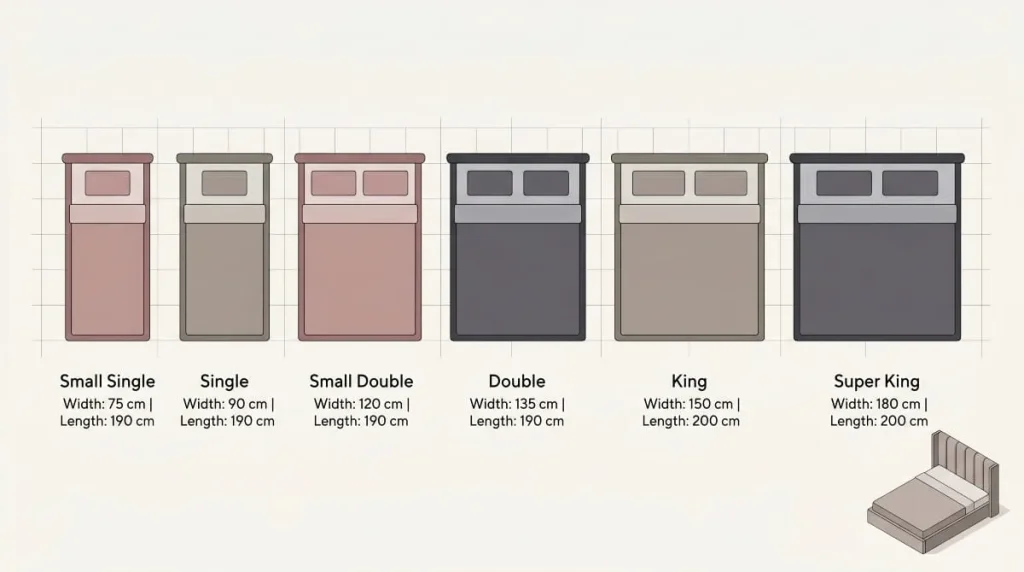
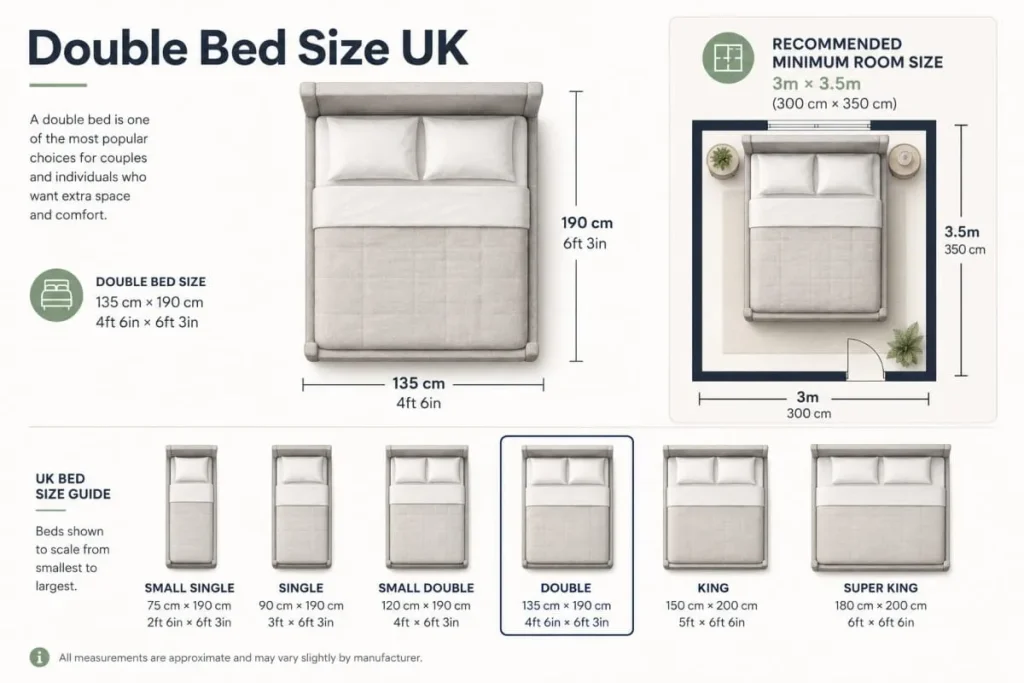
Each row represents a standard UK bed size. The bed dimensions column lists the frame footprint in centimetres, as well as the length and width of the bed, excluding bedside tables, ottomans, or other furniture. Use these figures when you’re holding a tape measure to your room.
The minimum room size is the smallest space where that bed can be physically placed while maintaining the 60cm clearance rule on at least one side. At minimum dimensions, you’re making it work, not making it comfortable. Furniture options will be limited, the room will feel full, and there’s little margin for error in layout.
The recommended room size is where the bed sits naturally within the space, with comfortable clearance on both sides, room for at least one bedside table on each side, and enough remaining floor area to move around freely without the room feeling dominated by the bed. This is the room size to aim for if you’re planning a bedroom from scratch or choosing between two properties.
Both columns use feet because that’s how most people in the UK describe and visualise room size in practice, even when they measure in centimetres. The centimetre equivalents are included in brackets for precision when you’re matching to a tape measure reading.
The gap between minimum and recommended is the difference between a bed that fits and a bedroom that works. At minimum room size, the geometry is solved; the bed physically occupies the space without blocking a door or making the room impassable. But minimum rooms often come with trade-offs: limited wardrobe space, no room for a chest of drawers, bedside tables only on one side, or a layout that feels driven entirely by the bed’s position rather than by how you want to use the room.
Recommended room size gives you genuine flexibility. The bed takes up its space without dictating every other decision. You have clearance on both sides, room for furniture that will serve you for the rest of your life in that space, and, critically, the room still feels like a bedroom rather than a room with a bed in it.
According to the Royal Institution of Chartered Surveyors, the average UK double bedroom measures approximately 11 × 11ft. That puts most British bedrooms comfortably above the minimum for a double, on the boundary for a king, and below the recommended threshold for a super king, which explains why king size is the most debated size choice and super King so frequently returns buyers to the store.
If your room sits between minimum and recommended for a given size, don’t automatically default to the larger bed. Measure, apply the clearance rule to your specific layout, and consider how much additional furniture the room can hold before you commit.
A 10×10 room, 305 × 305cm, comfortably fits a single or small double bed, and can accommodate a standard double with careful layout planning. A king-size bed in a 10×10 room is technically possible in one narrow configuration, but the resulting clearances are too tight for comfortable daily use.
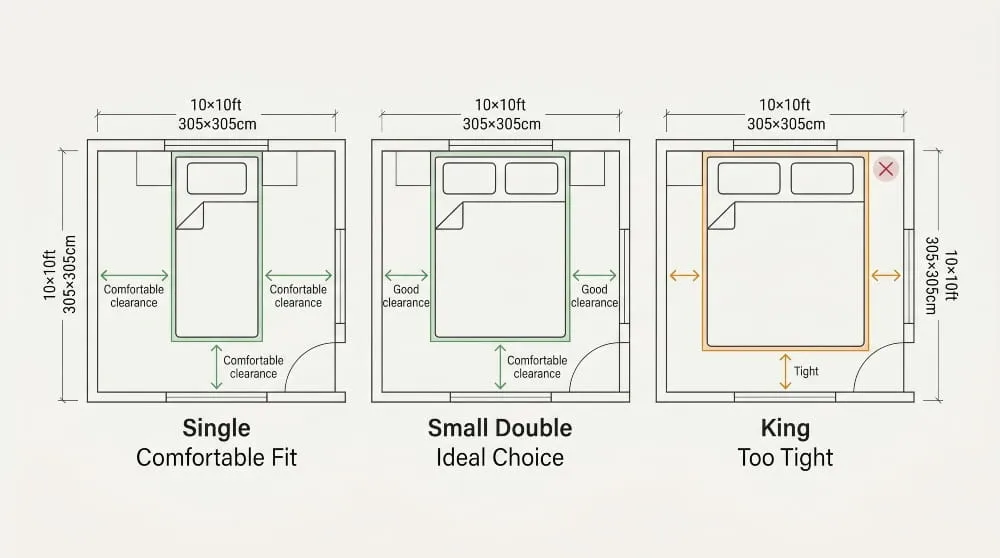
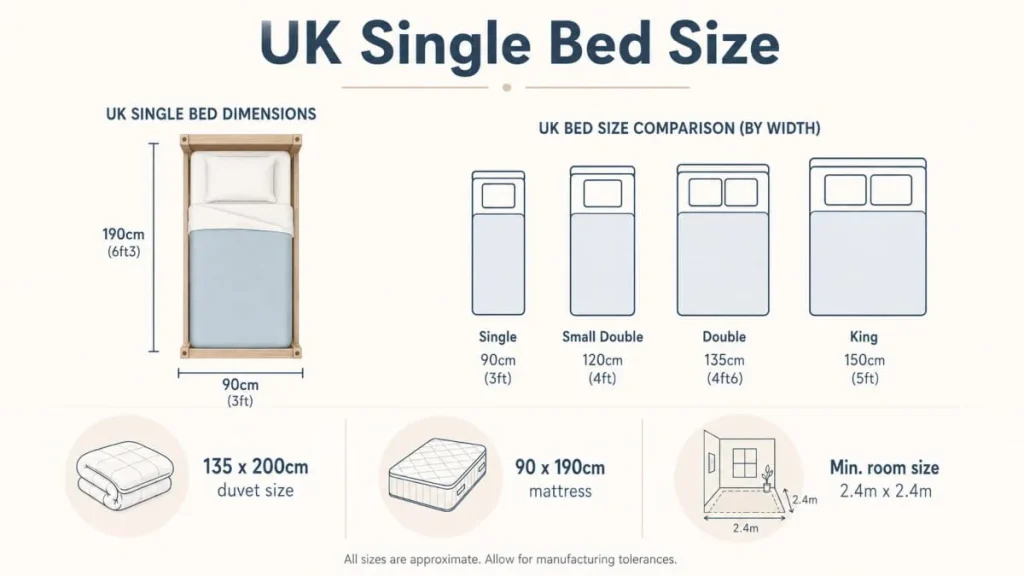
A single bed (90 × 190cm) in a 10 × 10 room leaves generous clearance on all sides, roughly 215cm of remaining width and 115cm of remaining length after the bed is placed. That’s enough room for a wardrobe, a desk, a chest of drawers, and comfortable movement around them all. For a child’s bedroom, a box room used as a study-bedroom, or a compact guest room that needs to earn its square footage, a single in a 10×10 room is a well-proportioned, practical solution.
A small double (120 × 190cm) steps up the sleeping surface without significantly compromising the room. With 185cm of remaining width and 115cm of remaining length, you retain enough floor area for furniture on both sides and a wardrobe against the opposing wall. The small double is increasingly the default choice for 10×10 rooms used as guest bedrooms or solo sleeper rooms, precisely because it offers noticeably more sleeping space than a single while still allowing the room to function as a proper bedroom rather than just a sleeping space.
A standard double bed (135 × 190cm) can fit in a 10 × 10 room, but the layout requires careful planning. Placed lengthways against one wall, the bed leaves 170cm of remaining width, enough for 60cm clearance on the open side and a slim wardrobe or chest of drawers beyond it. On the length axis, you’re left with 115cm from the foot of the bed to the opposite wall, which is workable for a doorway clearance and a modest piece of furniture.
The double works best in a 10×10 room when it sits with the headboard against the centre of one wall rather than pushed into a corner, allowing access from both sides. Push it into a corner to maximise space on one side, and you solve the width problem but create a less functional sleeping arrangement for two people. For a couple sharing a 10×10 room, a double is tight but liveable. For a solo sleeper, it’s a comfortable upgrade from a small double with minimal spatial sacrifice.
What a double in a 10×10 room doesn’t leave much of is flexibility. Furniture choices become constrained; a full wardrobe, two bedside tables, and a chest of drawers will feel crowded alongside a double in this footprint. Built-in or sliding-door wardrobes, wall-mounted bedside lighting instead of table lamps, and ottoman bed frames with internal storage all help recover the floor area the bed’s size takes up.
A king size bed measures 150 × 200cm. In a 10×10 room (305 × 305cm), placing a king leaves just 155cm of remaining width and 105cm of remaining length. Apply the 60cm clearance rule to both walkable sides, and you’re left with 35cm on one side, roughly a third of the recommended minimum. That’s not a walkable clearance; it’s a gap.
In a single specific configuration, headboard against one wall, one long side flush against another wall, a king-size bed can sit in a 10×10 room without physically blocking a door or making the room impassable. But one side of the bed becomes inaccessible, making it genuinely uncomfortable for two people and limiting how easily you can change bedding or move around the room in the morning. There is no room left for meaningful furniture beyond the bed itself.
The honest answer is that a king-size bed is the wrong size for a 10×10 room. It doesn’t just make the room feel small; it functionally compromises the space in ways you’ll encounter every single day. A 10×12 room is the realistic minimum for a king, and a 12×12 room is where a king-size bed stops feeling like a compromise and starts feeling like a proper choice. If the room is 10×10 and the priority is a larger sleeping surface, a small double or double is the right answer, not a king forced into a space that can’t support it.
A 10×12 room, 305 × 365cm, is one of the most common bedroom sizes in UK homes, and it sits at an interesting threshold: generous enough for a double to feel spacious, and just large enough for a king-size bed to be physically possible, though not without trade-offs.
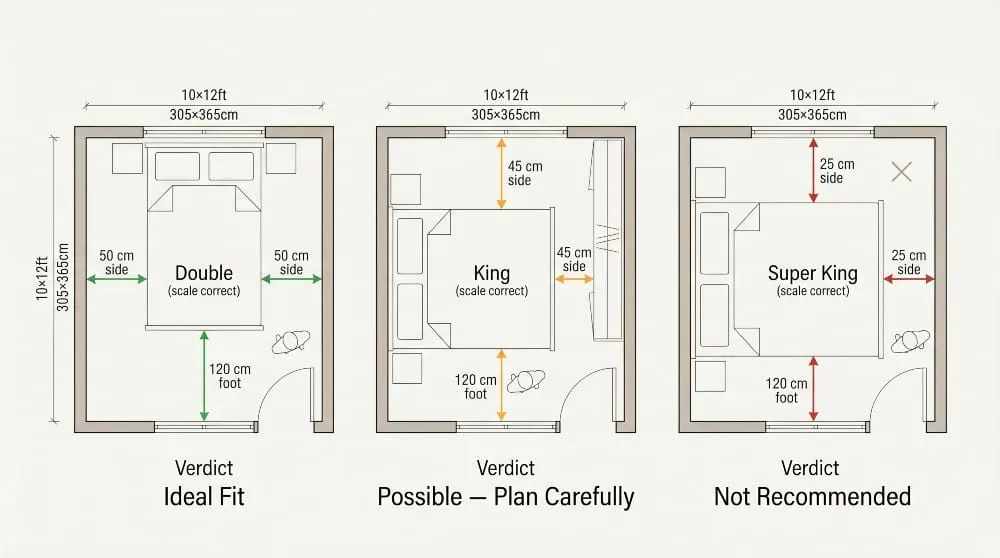
A standard double bed (135 × 190cm) is the natural match for a 10 × 12 room. Placed with the headboard against the shorter wall, the bed leaves 170cm of remaining width, enough for 60cm clearance on both sides with 50cm to spare, and 175cm of remaining length from the foot of the bed to the opposite wall. That’s sufficient space for a wardrobe, two bedside tables, and a chest of drawers without the room feeling overcrowded or the furniture choices feeling forced.
For couples sharing the room, a double in a 10×12 gives both people comfortable access to their side of the bed with room to move around freely. For a solo sleeper, the room feels genuinely spacious; there’s enough floor space left to add a small desk or armchair without compromising the bedroom’s primary function. The 10×12 room with a double bed is arguably the most balanced bedroom configuration in mainstream UK housing, which is why it remains the default in most new-build master bedrooms of this footprint.
A king size bed (150 × 200cm) can fit in a 10×12 room, and unlike a 10×10, the fit here is genuinely workable, but it requires accepting some meaningful constraints. Placed with the headboard against the 10ft wall, the bed leaves 155cm of remaining width. With 60cm clearance on both sides, that accounts for 120cm of the 155cm available, leaving 35cm for any furniture on the width axis, which realistically means bedside tables only, and slim ones at that.
On the length axis, the King leaves 165cm from the foot of the bed to the opposite wall. That’s a reasonable clearance for door swing and movement through the room, but it leaves limited depth for a wardrobe or chest of drawers on that wall without the room feeling cluttered.
The king-size bed works in a 10×12 room when the rest of the bedroom storage is handled elsewhere, built-in wardrobes, an en-suite with storage, or an ottoman bed frame that removes the need for additional drawer units. Go in with a king and a full suite of freestanding furniture and the room will feel dominated by the bed rather than organised around it. According to Rightmove’s bedroom-sizing data, a 10×12 room is classified as a standard double in UK property listings, suggesting that a king would stretch the space rather than comfortably fit.
The most important layout decision in a 10×12 room is which wall the headboard goes against. In most configurations, placing the headboard against the shorter 10ft wall works best; it orients the bed along the room’s length, maximising clearance on both sides and leaving the remaining 12ft of floor space for furniture and movement.
Avoid placing the bed diagonally. In a 10×12 room, diagonal placement is occasionally suggested to create visual interest. Still, it wastes more usable floor area than any other configuration and creates awkward triangular dead zones in each corner that are practically impossible to furnish.
For storage, prioritise vertical space. A double or King in a 10×12 room leaves enough width for a wardrobe against the opposite wall, but the depth of a freestanding wardrobe, typically 60cm, will reduce the foot-of-bed clearance noticeably. Sliding door wardrobes are worth considering here: they occupy the same floor area as hinged alternatives but eliminate the 60 to 90cm of swing clearance a hinged door requires, which in a 10×12 room is a meaningful recovery of usable space.
If the room needs to serve more than one purpose, a guest room that doubles as a home office, or a teenager’s room that needs a desk, position the desk in the remaining length beyond the foot of the bed rather than on the width walls, where it will immediately eat into the clearance you need to access both sides of the bed comfortably.
An 11×11 or 11×12 room sits in the sweet spot where a king-size bed becomes a realistic choice rather than a spatial compromise, provided the rest of the room is carefully planned around it. A double remains the most comfortable and flexible option at both dimensions; a king is achievable with the right layout decisions.
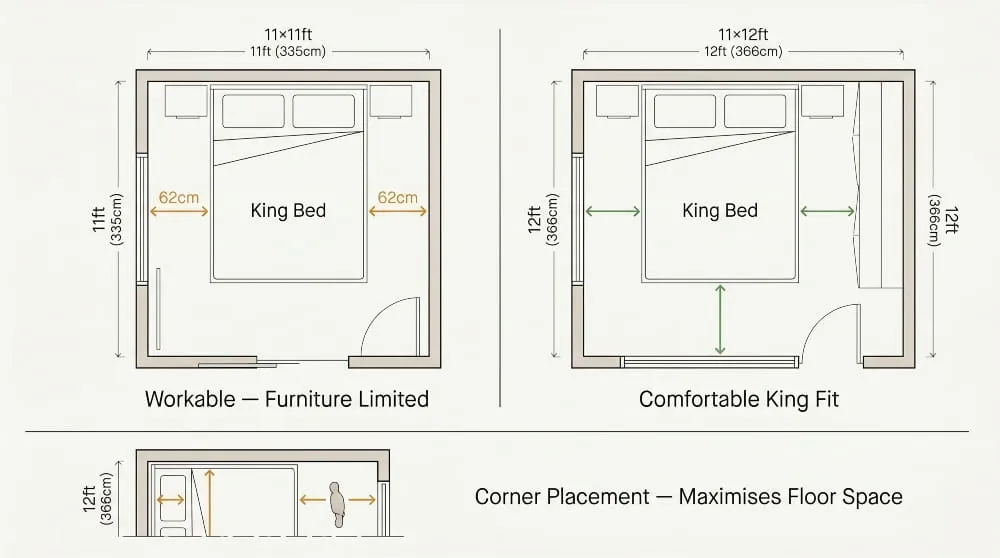
A king size bed (150 × 200cm) in an 11×11 room (335 × 335cm) leaves 185cm of remaining width and 135cm of remaining length. Applied against the 60cm clearance rule, both sides of the bed have workable passage, roughly 62cm wide each, which clears the minimum threshold, but only just. The 135cm length clearance from the foot of the bed to the opposite wall is comfortable for movement but limits what furniture can sit on that wall without crowding the room.
Step up to an 11×12 room (335 × 365cm) and the picture improves noticeably. The extra foot of length gives 165cm of clearance beyond the foot of the bed, enough for a modest chest of drawers or blanket box against the far wall without the room feeling congested. The width clearances remain the same as in an 11×11, but the additional depth makes the overall layout feel less tight and gives furniture arrangement more breathing room.
The caveats are real but manageable. In both room sizes, a king works best when bedside tables are the only furniture on the width walls. Any wardrobe or chest of drawers needs to go on the length walls, specifically the wall the foot of the bed faces, or in an alcove if the room has one. Attempt to fit a full freestanding bedroom suite alongside a king in an 11×11 and the room will feel overcrowded regardless of how well it’s arranged.
In an 11×11 or 11×12 room with a king-size bed, furniture placement isn’t a styling decision; it’s a spatial one. The sequence matters: position the bed first, apply the 60cm clearance rule to establish the no-go zones, and only then determine which furniture the remaining floor area can accommodate.
The most common mistake is treating the wardrobe as a fixed element and working the bed around it. In a room this size, the wardrobe is the second largest piece of furniture and its depth, typically 58 to 62cm for a freestanding unit, directly competes with the clearance the bed needs. A full-depth wardrobe on the width wall of an 11×11 room effectively reduces the usable width from 335cm to 273cm, which drops the clearance on one side of a king from 62cm to just over 10cm. That’s not a workable bedroom; that’s a corridor with a bed in it.
Built-in or sliding-door wardrobes significantly change this calculation. A fitted wardrobe recessed into the wall or built across an alcove recovers the swing clearance a hinged door would consume, and a sliding door system eliminates the depth penalty on the usable floor area. In an 11×11 or 11×12 room with a king-size bed, built-in storage isn’t a luxury; it’s often what makes the layout function at all.
Placing a king-size bed in the corner of an 11×11 or 11×12 room, with the headboard against one wall and one long side against the adjacent wall, is a legitimate layout strategy that frees up significantly more usable floor area than a centred placement. With two sides of the bed against the walls, the 60cm clearance rule applies only to the two open sides, meaning the total floor area reserved for bed clearance is roughly halved compared to a standard centred position.
The practical result is that corner placement in an 11×11 room can recover 60 to 90cm of usable floor width on the wall side, enough for a bedside table on the open long side, a wardrobe on the far wall, and genuinely comfortable movement around the accessible sides of the bed. It’s the layout approach most frequently recommended by interior designers working with rooms in the 10 to 12ft range precisely because it concentrates the bed’s spatial footprint into the room’s least functional zone, the corner, and releases the central floor area for movement and furniture.
The trade-off is access. A king-size bed in the corner means one person has to climb over or past the other to reach the wall side, which works well for a solo sleeper but is a daily inconvenience for two. For couples, corner placement is best treated as a last resort when the room dimensions leave no other workable option, not as a first choice. For a single occupant, it’s often the smartest layout decision in a room of this size.
A 12×12 room, 365 × 365cm, is where a king-size bed stops being a spatial challenge and becomes a natural fit. It’s also the minimum room size where a super king becomes physically possible, though the margins are tight enough that the decision deserves careful thought before committing.
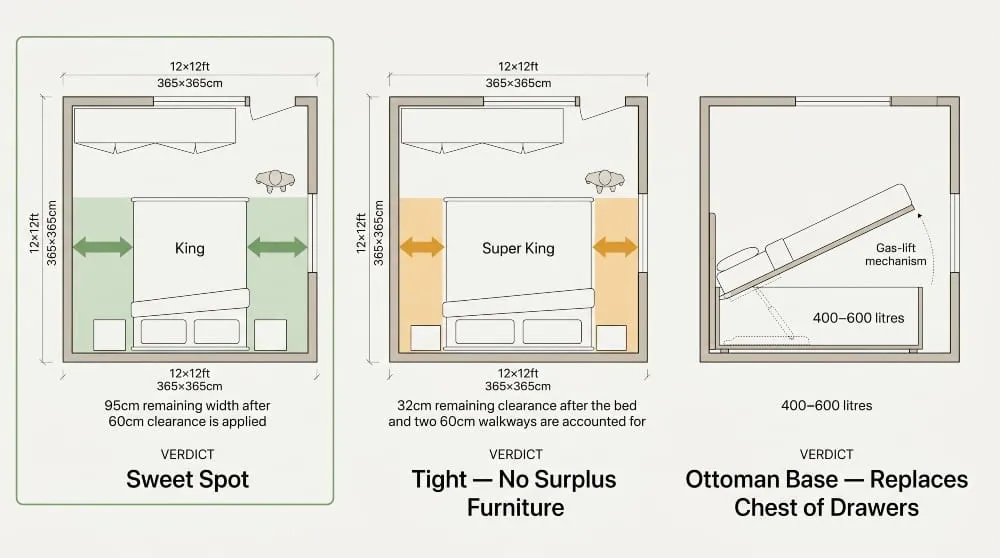
A king size bed (150 × 200cm) in a 12×12 room (365 × 365cm) leaves 215cm of remaining width and 165cm of remaining length. With 60cm clearance applied to both sides of the bed on the width axis, there’s still 95cm remaining, enough for two slim bedside tables and comfortable passage on both sides simultaneously. On the length axis, 165cm from the foot of the bed to the opposite wall is generous enough for a full-depth chest of drawers or blanket box and still leaves clear walking space in front of it.
This is the configuration interior designers consistently point to as the benchmark for a well-proportioned king-size bedroom. The bed occupies its space with authority without dominating it; there’s enough surrounding floor area for the room to feel balanced rather than consumed. A 12×12 room with a king-size bed can accommodate two bedside tables, a freestanding wardrobe, and a chest of drawers without any of those pieces feeling forced into position. The layout has room to breathe, which is what separates a functional bedroom from a comfortable one.
For context, a 12×12 room is approximately the size of the average UK main bedroom in homes built after 2000, according to LABC (Local Authority Building Control) new-build bedroom data. That alignment between the most common main bedroom footprint and the recommended room size for a king is not coincidental; it reflects decades of housing design built around the assumption that the main bedroom is a king-sized room.
A super king bed measures 180 × 200cm. In a 12×12 room (365 × 365cm), it leaves just 185cm of remaining width. Apply 60cm clearance to both sides, and you’ve consumed 120cm of that 185cm, leaving 65cm for any furniture on the width walls, which means one slim bedside table on each side and nothing else. The length clearance mirrors the King at 165cm, which is workable, but the width constraints are where the super King in a 12×12 room starts to feel genuinely compromised.
It fits. It clears the minimum threshold on both sides. But the margins are thin enough that any deviation from a near-perfect layout- a slightly oversized bed frame, a radiator on the width wall, a door that opens inward on the long side- tips the room from tight to impractical. Super king bed frames are also typically wider than the mattress dimensions suggest, with some upholstered and ottoman frames adding 8 to 12cm to the overall footprint. At 12×12, those extra centimetres matter.
The honest assessment is that a super king belongs in a 12×14 room or larger. In a 12×12 room, it’s a bed that technically fits but spatially dominates, and the difference between a room that works and one that merely accommodates is felt every morning as you navigate around the frame to get dressed. If the room is 12×12 and the priority is the largest possible sleeping surface, a king-size bed delivers a far better balance between bed size and room quality than a super king squeezed into the same footprint.
A 12×12 room is large enough for a king-size bed and a reasonable furniture arrangement, but not so large that floor space becomes irrelevant. This is where the choice of bed frame, specifically whether it includes integrated storage, has a meaningful impact on how well the room functions as a whole.
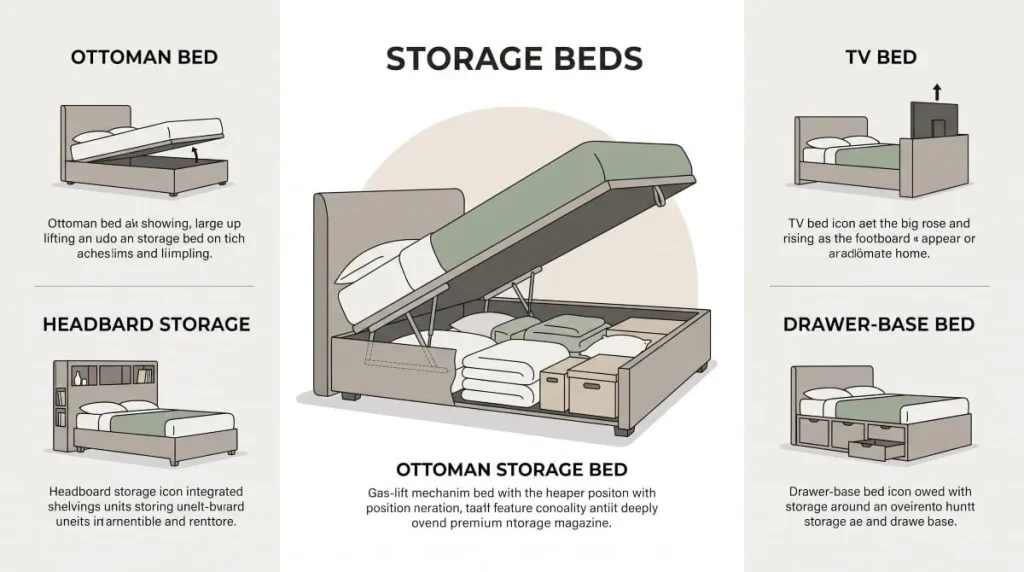
An ottoman bed frame with a gas-lift base converts the entire under-bed volume into usable storage, typically 400 to 600 litres depending on the frame height, without adding a single centimetre to the bed’s floor footprint. In a 12×12 room, that storage capacity can replace a chest of drawers entirely, recovering the 60 to 80cm of floor depth a chest of drawers would occupy along the length wall. The practical result is a room where the king-size bed, two bedside tables, and a wardrobe sit comfortably without the space feeling cluttered or the layout feeling like a compromise.
Divan beds with drawer bases offer a similar benefit on a smaller scale, with two or four drawers built into the base providing accessible storage for bedding, clothing, or seasonal items without requiring additional floor-standing furniture. For a 12×12 room used as a main bedroom, where storage demands are typically higher than in a guest or secondary bedroom, an ottoman or divan base is worth factoring into the bed choice from the outset, not as an afterthought once the room already feels full.
A king size bed requires a minimum room size of 10×12ft (305 × 365cm) to fit with basic clearance on all walkable sides. For the bed to sit comfortably within the space, with room for furniture and free movement, a 12×12ft (365 × 365cm) room is the realistic target.
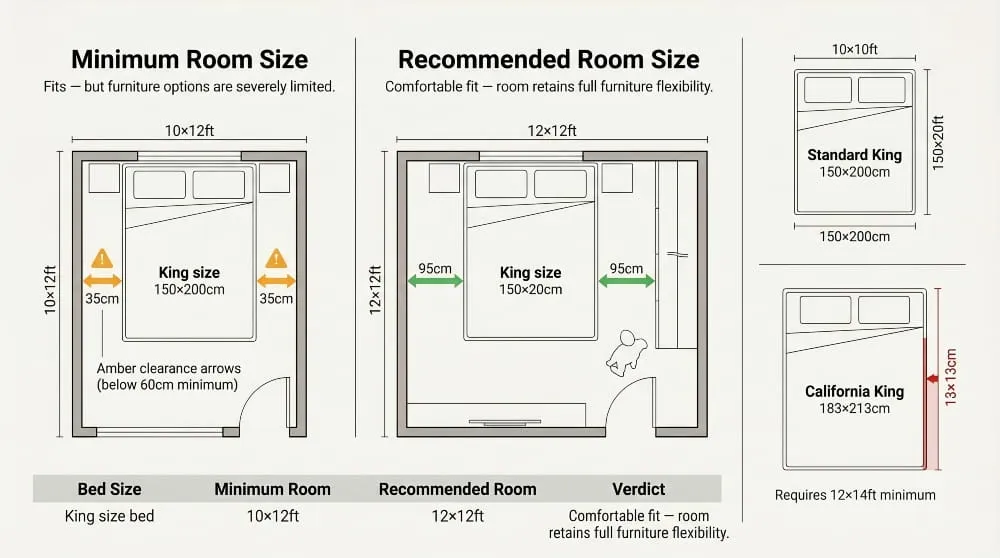
The minimum room size for a king-size bed is 10×12ft. At these dimensions, the bed (150 × 200cm) leaves approximately 155cm of remaining width and 165cm of remaining length. Applying the 60cm clearance rule to both sides on the width axis leaves 35cm, below the recommended minimum, but sufficient to avoid the room becoming impassable. On the length axis, 165cm provides comfortable clearance beyond the foot of the bed.
At the minimum room size, the king-size bed is the dominant feature of the space by a significant margin. Furniture options are limited to slim bedside tables on the width walls and a single storage piece, ideally a wardrobe or chest of drawers, against the length wall facing the foot of the bed. There is no surplus floor area, which means every other piece of furniture is a considered trade-off against clearance and comfort.
The 10×12 minimum assumes a standard king mattress and frame combination. Upholstered bed frames, particularly those with wide wing headboards or thick padded side rails, frequently add 8 to 15cm to the overall footprint beyond the mattress dimensions. In a minimum-size room, that additional width is the difference between a tight but workable layout and one that doesn’t function at all. Always measure the full frame, not just the mattress, before concluding that a king fits your room.
The recommended room size for a king-size bed is 12×12ft (3.7×3.7 m). At this dimension, the bed sits within the space with genuine comfort; 215 cm of remaining width provides 60cm clearance on both sides, with 95 cm to spare, enough for two bedside tables and unobstructed passage simultaneously. The 165cm of remaining length gives the far wall enough depth for a full-size wardrobe or chest of drawers without crowding the foot of the bed.
The 12×12 recommendation isn’t arbitrary. It reflects the point at which a king-size bed stops competing with the room’s other functions and starts complementing them. Below this threshold, furniture decisions are driven by spatial constraint. At 12×12 and above, they’re driven by preference, which is where bedroom design should start, not end.
For those planning a new build, an extension, or a significant renovation, the recommended room size should be treated as a specification rather than a guideline. The cost difference between a 10×12 and a 12×12 main bedroom at build stage is modest relative to the long-term quality of the space. According to Savills residential research, bedroom size is consistently ranked among the top three factors affecting satisfaction with the main bedroom in owner-occupied UK homes, ahead of storage provision and natural light.
A king size bed in a small room works when the room has one specific characteristic: a clear, unobstructed wall long enough to place the headboard against without competing with a door, radiator, or window. In that configuration, with the long side of the bed parallel to the room’s longest axis, a king can function in a space as small as 10×10ft, but only for a single occupant, only without additional freestanding furniture, and only with an ottoman or divan base providing the storage that floor-standing pieces cannot.
It doesn’t work when the room has an awkward shape, multiple door or window openings on the same wall, or when two people need comfortable access to both sides of the bed. It also doesn’t work when the room needs to serve more than one purpose; a bedroom that doubles as a home office or dressing room cannot accommodate both a king-size bed and the furniture those secondary functions require in a small room. The bed wins the space, and the secondary function loses it entirely.
The clearest signal that a king is the wrong size for the room is when the layout conversation becomes entirely about the bed, where to put it, how to get around it, what has to be removed to make it fit. A bed that requires the room to be reorganised around it is too large for the room. The right size bed is one the room accommodates without negotiation.
The California king is not a standard UK bed size. Still, it appears frequently in search results and is occasionally available from specialist UK retailers, making it worth considering for anyone comparing options. A California king measures 183 × 213 cm, 3 cm wider and 13cm longer than the standard UK king (150 × 200cm). Those dimensions require a reassessment of the room fit, particularly along the length axis.
In a 12×12 room (365 × 365cm), a California king leaves 182cm of remaining width, comparable to a standard king, but only 152cm of remaining length, compared to 165cm for a standard king. That 13cm difference on the length axis is not trivial in a room already operating close to its comfortable limits. A wardrobe or chest of drawers against the far wall needs to be either shallower than standard or positioned to one side rather than centred, to maintain clear walking space between it and the foot of the bed.
The practical conclusion is that a California king requires a room at least one foot longer than the equivalent standard king recommendation, putting the comfortable minimum at 12×14ft rather than 12×12ft. For UK buyers, the California king also carries a significant practical penalty beyond room size: non-standard mattress dimensions mean limited replacement options, higher prices, and incompatibility with standard UK bedding. For most people, the standard King delivers equivalent sleeping width with considerably less spatial and logistical friction.
A double bed, known interchangeably as a full size bed, requires a minimum room size of 9×10ft (274 × 305cm) to fit with safe clearance on all walkable sides. In practice, a 10×12ft room is where a double bed genuinely feels at home rather than merely tolerated by the space around it.
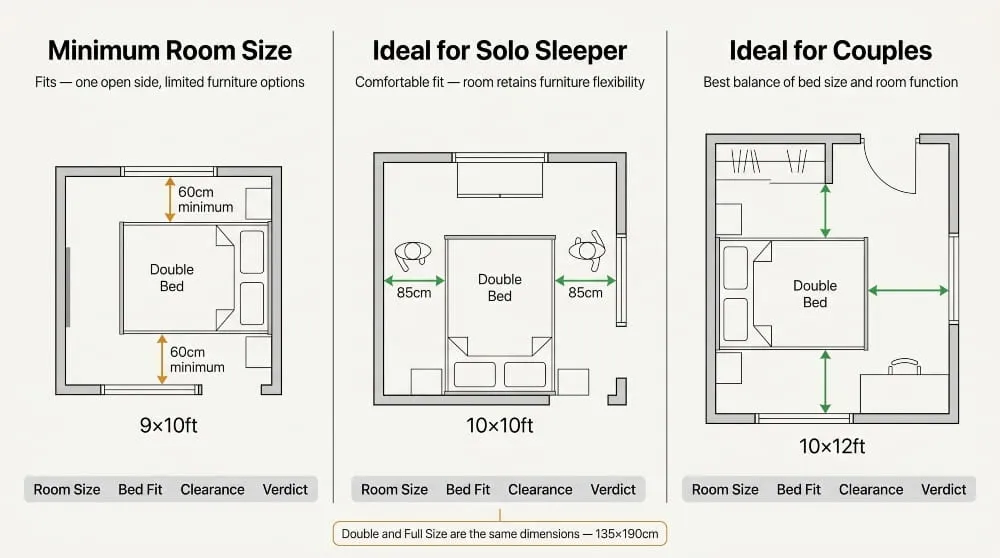
The minimum room size for a double bed is 9×10ft (274 × 305cm). At these dimensions, the bed (135 × 190cm) leaves approximately 139cm of remaining width and 115cm of remaining length. With 60cm clearance applied to one walkable side, the other side sitting against or close to a wall, the room remains passable, though only just on the tighter axis.
What separates the double from the King at minimum room sizes is the degree of remaining flexibility. A double at 9×10ft leaves enough width for a slim bedside table on the open side and enough length clearance at the foot of the bed for a door to swing without obstruction. It’s a constrained layout, but one that functions as a complete bedroom without requiring furniture to be eliminated. The room holds the bed, and enough supporting pieces to be genuinely usable, which is the baseline test any minimum room configuration has to pass.
One important distinction worth noting: in the UK, the terms “double” and “full size” describe the same bed dimensions, 135 × 190cm. The term “full size” is used more commonly in American contexts, where it refers to the same 135cm width but sometimes a slightly shorter 190cm length. For UK buyers, they are the same product. The confusion occasionally arises when shopping across international retailers, but domestically the two terms are interchangeable.
A full-size double bed in a 10×10 room (305 × 305cm) works well. It works noticeably better than the minimum 9×10ft configuration because the extra foot of width on both axes provides meaningful additional clearance and furniture flexibility. The bed leaves 170cm of remaining width and 115cm of remaining length, which, with 60cm of clearance on each open side, still gives 50cm of spare width, enough for a narrow bedside table on both sides simultaneously.
For a 10×10 room used as a solo sleeper’s bedroom, a double is an excellent fit: more sleeping surface than a small double without the spatial compromise that a king would demand. For a couple sharing a 10×10 room, a double is manageable but close; both people have their own side of the bed with reasonable clearance, but the room’s remaining floor area is limited enough that furniture choices need to be deliberate. A wardrobe on the far wall, slim bedside tables, and under-bed or ottoman storage in place of a chest of drawers gives the room what it needs without overcrowding it.
The 10×10 double bed configuration is one of the most common setups in UK secondary bedrooms. It is the default arrangement in millions of Victorian and Edwardian terrace houses, where the second bedroom typically measures 9×10ft to 10×11ft. It works because the double bed was effectively sized for rooms of this proportion, a design relationship that has remained consistent across a century of British housing.
A tiny room, anything below 9×10ft, doesn’t disqualify a double bed outright, but it does require layout thinking that goes beyond simply placing the bed against a wall and working backwards. Below the minimum threshold, the priority shifts from comfort to function: the goal is to make the room work as a sleeping space without creating a layout that feels punishing to live in day to day.
The single most effective solution is corner placement. With the headboard against one wall and one long side flush against the adjacent wall, corner placement eliminates the need for 60cm clearance on two sides simultaneously, recovering the floor area those two clearances would have consumed. In a room of 8×10 ft or 9×9 ft, corner placement can be the difference between a double that works and one that blocks the door or makes the room impassable.
Beyond placement, the bed frame choice is the most powerful space-recovery tool available. An ottoman bed with a gas-lift base eliminates the need for a separate chest of drawers by converting the under-bed volume into storage, typically enough to hold a full wardrobe’s worth of folded clothing and bedding. A low-profile platform base without a footboard significantly reduces the bed’s visual weight and can make a small room feel less dominated by the sleeping surface. Wall-mounted bedside lighting in place of table lamps removes two pieces of furniture from the floor plan entirely.
According to a 2023 survey by the HomeOwners Alliance, 34% of UK homeowners say their second bedroom is too small to accommodate a double bed as a guest room comfortably. This figure reflects how many British homes have secondary bedrooms that fall short of the recommended double-bed threshold. The solution in most of those cases isn’t a smaller bed; it’s a smarter layout combined with a bed frame designed to earn its floor space twice over.
Two full-size double beds can fit in one room, but the space required is larger than most people expect. To fit two doubles side by side with safe clearance on all walkable sides, you need a room of at least 14×12ft (427 × 365cm), and that’s before accounting for any additional furniture.
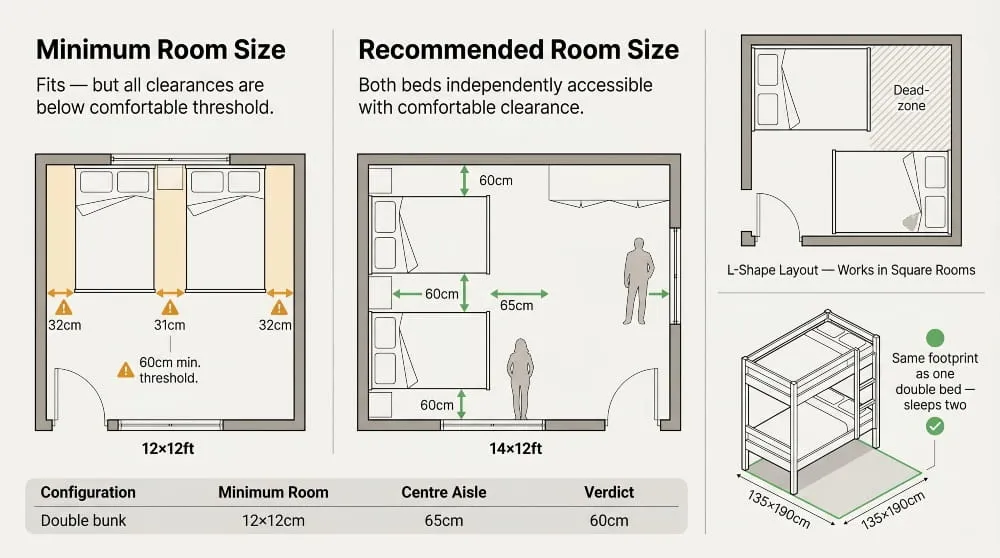
Two full-size beds (each 135 × 190cm) placed side by side demand a combined width of 270cm for the mattresses alone. Add 60cm clearance on each outer side and a minimum 60cm walkway between the two beds, and the total width requirement reaches 450cm, just under 15ft. That’s a generous room by UK standards, and it immediately explains why the two-double configuration is relatively rare in standard British housing, where even master bedrooms typically fall short of that width.
The length requirement is more forgiving. A double bed is 190cm long, so a room of 10 to 12ft on the length axis provides adequate clearance at the foot of both beds for movement and a door swing. It’s the width that determines whether two doubles genuinely fit or whether one becomes permanently inaccessible against a wall.
A more realistic minimum for two full-size beds in one room, accepting that the gap between beds will be narrower than ideal, is 12×12ft (3.7×3.7 m). At this dimension, the combined mattress width of 270cm leaves 95cm of remaining width to distribute across three gaps: both outer sides and the centre aisle. That allows roughly 32cm per gap, which is below the recommended 60cm but sufficient for a child’s bedroom or occasional guest room where the configuration is functional rather than luxurious. For a room that two adults share permanently, 14×12ft is the realistic target.
The most common layout for two full-size beds is parallel placement, with both beds oriented in the same direction, headboards against the same wall, and a shared gap down the centre. This configuration is space-efficient on the length axis. It keeps both beds equally accessible, making it the standard arrangement for shared children’s bedrooms and twin hotel rooms for good reason. It concentrates the width demand into a single band across the room and leaves the wall opposite the headboards free for a shared wardrobe or chest of drawers.
An L-shaped layout, one bed against each of two adjacent walls, oriented perpendicular to each other, works well in square rooms where neither wall is long enough to hold both beds in parallel. The L-shape distributes the width demand across two walls rather than one, which often makes better use of a square room’s proportions. The trade-off is that the corner zone between the two foot ends becomes a dead space that’s difficult to furnish or use productively.
A third option, rarely discussed but worth considering in longer rooms, is end-to-end placement, both beds along the same wall with their lengths running parallel to it. This requires a room at least 20ft long to hold two 190cm beds with clearance at each end and a gap between them, which places it outside the range of most standard UK bedrooms. Where it does work, typically in converted loft rooms or long attic bedrooms, it leaves the full width of the room free for furniture and movement.
The spatial case for bunk beds over side-by-side doubles is straightforward and significant. A standard double bunk bed occupies the floor footprint of a single double bed (135 × 190cm) while providing two sleeping surfaces. Against the 450cm of width that two side-by-side doubles require at recommended clearances, a double bunk achieves the same sleeping capacity in a footprint of approximately 215cm, including clearance on both sides. That’s less than half the floor demand.
In a 10×10 room, a size where two side-by-side doubles are essentially impossible, a double bunk fits comfortably, leaving enough remaining floor area for a wardrobe, a desk, and clear movement around the room. For children’s bedrooms, shared teenage rooms, and compact guest rooms that need to sleep two, the bunk bed solves the two-bed problem without requiring a room large enough for side-by-side sleeping.
The trade-off is practical rather than spatial. Bunk beds require ceiling height of at least 220cm, ideally 240cm, to provide safe headroom on the upper bunk, and they’re less suitable for adults who find climbing to the upper bunk impractical or uncomfortable. They’re also less flexible than two freestanding beds, since they can’t be separated or rearranged when the room’s use changes. According to the British Furniture Manufacturers Association, bunk bed sales in the UK have grown by over 20% since 2020, driven primarily by urban households maximising space in smaller secondary bedrooms, a clear signal that UK buyers increasingly well understand the spatial logic of the bunk.
The right bed size for a guest room depends on two things: who is likely to sleep in it and how large the room is. For most UK homes, a double bed strikes the best balance, comfortable for a single guest, manageable for a couple, and proportionate to the secondary bedroom sizes where guest rooms most commonly sit.
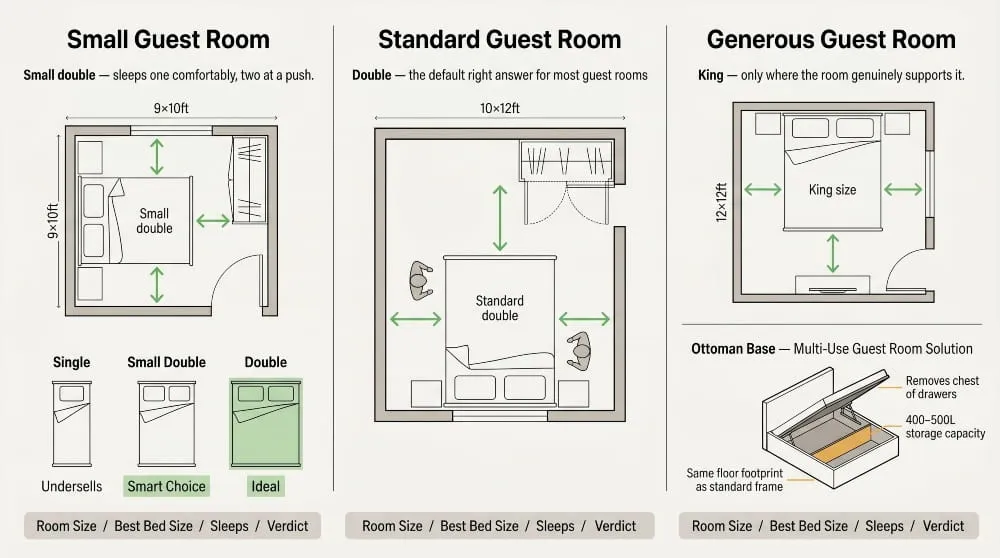
A single bed in a guest room works when the room is genuinely small, below 9×10ft, or when the guest room doubles as a child’s bedroom that occasionally hosts adult visitors. For any room above that threshold, a single undersells the space. A guest sleeping in a single bed in a room that could hold a double will notice, and the room will feel sparse and underequipped relative to its size. Guests register the difference between a room that’s been thought about and one that hasn’t.
A double is the default right answer for most guest rooms. It accommodates a solo guest with room to spread out and a couple without either person feeling compressed against a wall. At 135 × 190cm, it fits comfortably in rooms from 10 × 10 ft upwards, which covers the vast majority of UK secondary bedrooms. It also signals to guests that the room was furnished with their comfort in mind rather than the minimum viable sleeping arrangement, a distinction that matters more than most hosts realise.
A king-size bed in a guest room is a genuine upgrade, but only when the room can accommodate it without compromising space. A king in a 12×12ft guest room feels considered and generous. A king crammed into a 10×10ft room with no space for luggage, no bedside table on one side, and a wardrobe that barely opens feels worse than a well-placed double, because the oversized bed signals poor planning rather than hospitality. The bed size should serve the guest, not impress them at the expense of the room’s function.
For a small guest room, typically 9×10ft to 10×11ft, a double is almost always the best choice, and a small double is worth serious consideration when the room falls at the lower end of that range. The small double (120 × 190cm) is underused in UK guest rooms despite being well-suited to the purpose: it sleeps a single adult comfortably, fits two at a push for short stays, and leaves meaningfully more floor area than a standard double in rooms where that extra 15cm of width genuinely changes what the layout can hold.
In a 9×10ft guest room, the difference between a small double and a standard double is whether the room has a wardrobe. That wardrobe matters in a guest room; visitors need somewhere to hang clothing for stays longer than a night, and a room without storage quickly feels like a temporary arrangement rather than a considered space.
The practical priorities for a small guest room bed, in order of importance, are: a bed that leaves 60cm clearance on at least one side for entry and exit, a frame with integrated storage to reduce the need for additional furniture, and a mattress quality that reflects the room’s purpose. According to a YouGov survey, 61% of UK adults say mattress comfort is the single most important factor in whether they sleep well as a guest, ahead of room temperature, noise, and light. A smaller bed on a better mattress outperforms a larger bed on a poor one every time.
A guest room that earns its square footage beyond the occasional overnight stay is one of the most valuable rooms in a home, and the bed frame choice is central to making that work. In a room that functions as a home office, hobby space, or dressing room for 350 days of the year and a guest bedroom for the remaining 15, every piece of furniture needs to justify its permanent presence.
An ottoman bed frame is the most practical solution for a multi-use guest room. The gas-lift base converts the entire under-bed volume into accessible storage, typically 400 to 500 litres on a double frame, removing the need for a chest of drawers or additional storage units that would otherwise occupy floor space the room needs for its primary function. The bed’s floor footprint remains identical to a standard frame, but its storage contribution eliminates one or two additional pieces of furniture.
For rooms where a permanent bed is genuinely impractical, a divan base with a high-quality mattress topper stored separately allows the bed to function as a sofa or day seat for most of the year, with the guest configuration restored quickly when needed. This approach works best in rooms 10×12ft or larger, where the divan can sit against one wall without dominating the space, even in the room’s everyday configuration. The key is choosing a divan base with a removable headboard; fixed headboards make the dual-purpose transition awkward and signal the room’s guest function even when it’s not being used as one.
Dorm room beds are almost universally single beds, 90 × 190cm in the UK, or the slightly longer twin XL (97 × 203cm) in the US, and understanding that distinction matters when you’re buying bedding or planning what to bring to halls. The bed itself is fixed; everything else in a dorm room has to work around it.
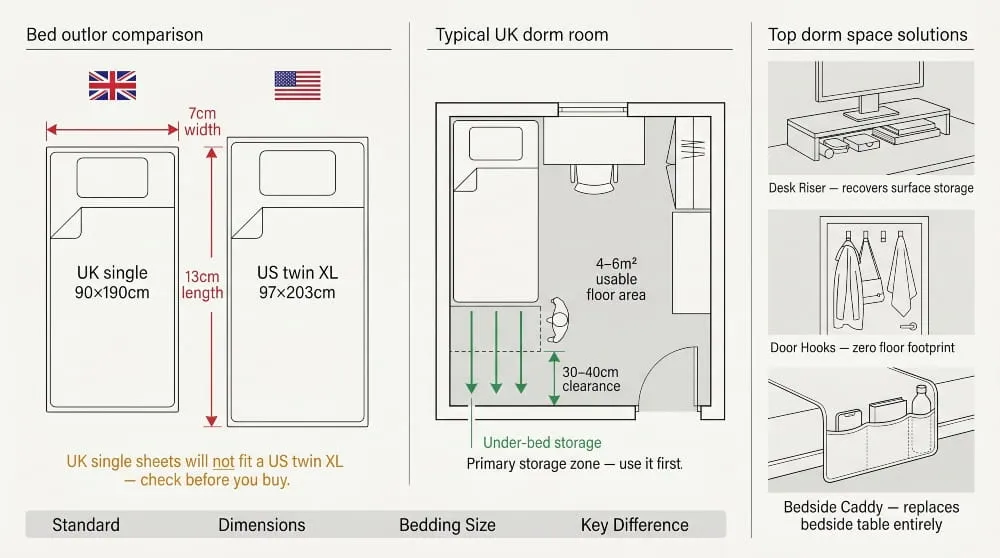
In UK university halls of residence, the standard dorm room bed is a single at 90 × 190cm. Some newer or premium halls have upgraded to a small double (120 × 190cm) in en-suite or studio rooms. Still, the 90cm single remains the default across most UK student accommodation. The beds are typically provided as a fixed divan base with a standard single mattress, not a bed frame in the conventional sense. They are almost always non-negotiable in terms of position, since they’re built into or fixed within the room layout.
In American university dorms, the standard is the twin XL, 97 × 203cm, which is 7cm wider and 13cm longer than the UK single. That difference is relevant primarily for bedding: UK single sheets do not fit a US twin XL mattress without bunching or slipping, which catches out international students buying bedding before they arrive. If you’re heading to a US institution, confirm whether the beds are standard twin or twin XL before purchasing any bedding from home.
The typical UK dorm room measures between 10 × 12ft and 12 × 14ft for a single-occupancy room, with the bed occupying one wall and the remaining floor area divided among a desk, a wardrobe, and a narrow circulation space. According to the Unite Students annual accommodation survey, the average UK student bedroom in purpose-built student accommodation is 13.5 square metres, a footprint that leaves limited floor area beyond the essential furniture, making under-bed storage one of the most important spatial considerations in the entire room.
For a UK dorm bed, a standard single at 90 × 190cm, you need single bedding throughout: a single fitted sheet (90 × 190cm), a single flat sheet or duvet cover, and a single duvet (135 × 200cm is the standard UK single duvet size). The duvet is wider than the mattress by design, providing the overhang needed to tuck in or drape over both sides without leaving the mattress exposed.
The most common bedding mistake in dorm rooms is buying a double duvet for a single bed on the assumption that more coverage equals more comfort. A double duvet on a single bed creates excess fabric that bunches against the wall if the bed is against one, or drapes onto the floor on the open side, neither of which is practical in a small room where floor space is already limited. A single duvet with a high tog rating is the correct solution for warmth, not a larger size.
For US twin XL beds, standard UK single bedding will not fit correctly—the fitted sheet in particular needs to match the mattress dimensions precisely to stay in place overnight. Twin XL fitted sheets are widely available from US retailers and increasingly from UK international student supply services; buy them specifically, not as an afterthought on arrival.
The fixed position of a dorm bed, almost always against one wall, often with a shelf unit or pinboard above it, means the spatial decisions available to a student are limited to the floor area the bed doesn’t occupy. In a 13.5 square metre room with a 90 × 190cm bed, desk, and wardrobe already installed, the remaining usable floor area is typically between 4 and 6 square metres. How that area is used determines whether the room feels liveable or relentlessly cramped.
Under-bed storage is the highest-return space in any dorm room. Most divan-style dorm beds sit 30 to 40cm off the floor, enough clearance for flat storage boxes, vacuum compression bags, or purpose-made under-bed drawers. That volume can hold a full season’s worth of clothing, freeing the wardrobe for the items in current rotation. It’s not glamorous storage, but in a room where every square metre matters, it removes the need for additional freestanding units that would otherwise occupy what little floor area remains.
Beyond storage, the most effective dorm room space decisions are vertical ones. A monitor riser on the desk recovers the surface space beneath it for books or a printer. Adhesive hooks on the back of the door hold coats, bags, and towels without taking up floor space. A bedside caddy, a fabric organiser that hooks over the mattress edge, replaces a bedside table entirely in rooms where there’s no floor space to spare alongside the bed. None of these solutions change the room’s dimensions, but they change how much of those dimensions feel usable, which in a dorm room is the closest thing to making the room larger.
Bedroom clearance is the floor space left around a bed once it’s positioned in a room, and getting it right is what separates a bedroom that functions well from one that merely contains a bed. The standard minimum is 60cm on every side you regularly walk past, though the specific clearances needed vary depending on what else shares that wall.
The 60cm walkway rule applies to every side of the bed that serves as a regular access route: the sides you walk past to get in, get out, make the bed, or move around the room in the morning. At 60cm, two people can pass on the same side without turning sideways, a person can dress without bumping into the bed frame, and the bedding can be changed without contorting around the furniture. Below 60cm, all of those tasks become physically awkward in ways that compound into daily irritation.
On sides where the bed sits against a wall or into a corner, the clearance requirement drops to zero; the wall takes the place of the walkway. This is why corner placement is such an effective space-recovery strategy in smaller rooms: it eliminates the clearance requirement on two sides simultaneously, concentrating the bed’s spatial demand into the room’s least functional zone and releasing the remaining floor area for movement and furniture.
For bedrooms shared by two people, 60cm is the minimum on both long sides, not a target to meet on one side and ignore on the other. A bed where one person has generous clearance, and the other is climbing over the frame is a layout problem that doesn’t improve with time. Both sides need to be independently accessible for the bedroom to function properly as a shared space.
The two fixed elements that most frequently conflict with bed clearance are wardrobes and doors, and both demand clearances that run perpendicular to the bed rather than alongside it. A standard hinged wardrobe door requires 55 to 65cm of clear swing space in front of it, approximately the same depth as the wardrobe itself. If the foot of the bed sits within that swing zone, the wardrobe either can’t open fully or requires the bed to be repositioned every time clothing is needed. Neither is acceptable in a room used daily.
Sliding door wardrobes eliminate this problem. Because the door travels along a fixed track rather than swinging outward, the clearance requirement in front of a sliding wardrobe is purely ergonomic, enough space for a person to stand comfortably while reaching inside, typically 60 to 75cm. In bedrooms where the foot of the bed and the wardrobe share the same wall axis, sliding doors can recover 55-65cm of usable floor depth compared to hinged alternatives. In a 10×12 or 11×11 room, that recovery is often what makes the layout viable.
Door clearance is a harder constraint than wardrobe clearance because it’s structural rather than a matter of furniture choice. A bedroom door that swings into the room requires the same clearance as a wardrobe door, 60 to 75cm in the swing arc, and any part of the bed frame cannot occupy that arc. Measure the door swing before finalising the bed position. In rooms with awkward door placements, a bed even 20cm in the wrong direction can reduce an already narrow clearance to the point where the door is difficult to open fully.
Bedside tables are the most commonly overlooked element in bedroom clearance planning, not because they’re large, but because they’re assumed to fit wherever there’s a gap rather than being planned as part of the layout from the start. A standard bedside table measures 40 to 55cm wide and 35 to 45cm deep. In a room where the bed clearance is already at minimum, that footprint competes directly with the walkway rather than sitting outside it.
The practical rule is simple: bedside table space should be factored into the total width calculation before you commit to a bed size, not treated as a bonus if any width remains. If a room leaves 70cm of total width between the edge of a king-size bed and the wall, placing a 50cm bedside table in that space reduces the walkway to 20cm, functionally impassable. Either the bedside table gets smaller, the bed gets smaller, or the bedside table goes on the wall instead.
Wall-mounted bedside alternatives, floating shelves, wall-mounted sconces with a narrow shelf, or clip-on bedside caddies eliminate the need for a floor footprint. According to a Houzz UK bathroom and bedroom trends report, wall-mounted bedside storage increased in specification by 34% between 2020 and 2023, driven primarily by smaller bedroom sizes in new-build properties where floor-standing bedside tables consistently compromised walkway clearance. The shift reflects a growing awareness that the bedside table is a clearance problem dressed as a furniture decision, and that the most elegant solution is to take it off the floor altogether.
You now have everything you need to match your room to the right bed size, dimensions, clearance rules, room-by-room fit guides, and layout strategies that make any configuration work. The next step is finding the bed itself.
At Style Beds, every bed frame is handcrafted in our Dewsbury workshop in West Yorkshire, upholstered to order in your choice of fabric and headboard height. Whether you’ve landed on a double for a compact secondary bedroom or a king for a well-proportioned master, the size pages below take you directly to the relevant collection.
Browse by size:
Every frame is available with optional ottoman storage, the practical choice for any room where floor space is working hard. All orders include free UK delivery, a 30-night trial, and a 3-year manufacturer’s warranty. If you’re still weighing up sizes or have a room with an unusual layout, the team in Dewsbury is available to help, no scripts, no pressure, just straightforward advice from people who know the product.
A king size bed can physically sit in a 10×10 room, but the clearances it leaves are too tight for comfortable daily use, roughly 35cm on each side, well below the 60cm minimum. A double or small double is the right size for a 10×10 room.
The minimum room size for a king-size bed is 10×12ft (305 × 365cm), which provides just enough clearance on both sides to remain functional. A 12×12ft room is the recommended size for a king to sit comfortably without compromising the layout.
For rooms below 10×10ft, a single or small double is the best choice; they leave enough floor area for the room to function as a proper bedroom rather than just a sleeping space. A standard double works well in most rooms from 10×10ft upwards.
Two full-size double beds can fit in one room, but require a minimum of 12×12ft and ideally 14×12ft for comfortable clearance on all sides, including a walkway between the beds. A bunk bed achieves the same sleeping capacity in roughly half the floor space.
A double bed is the right choice for most guest rooms; it comfortably sleeps one adult or a couple and fits in the secondary bedroom sizes where guest rooms typically sit. A single undersells any room above 9×10ft; a king only makes sense when the room can genuinely support it.
UK dorm room beds are standard singles at 90 × 190cm; US dorm beds are typically twin XL at 97 × 203cm, slightly wider and longer. The distinction matters when buying bedding, as UK single sheets will not fit a US twin XL mattress correctly.
Yes, a 12×12ft room is the recommended size for a king-size bed, leaving 60cm of comfortable clearance on both sides and enough remaining floor area for bedside tables and a wardrobe. It’s the configuration where a king stops feeling like a compromise and starts feeling like a considered choice.