)
&description=&image=https://stylebeds.co.uk/wp-content/uploads/2026/06/King-Size-Bed-Dimensions-1024x572.webp)
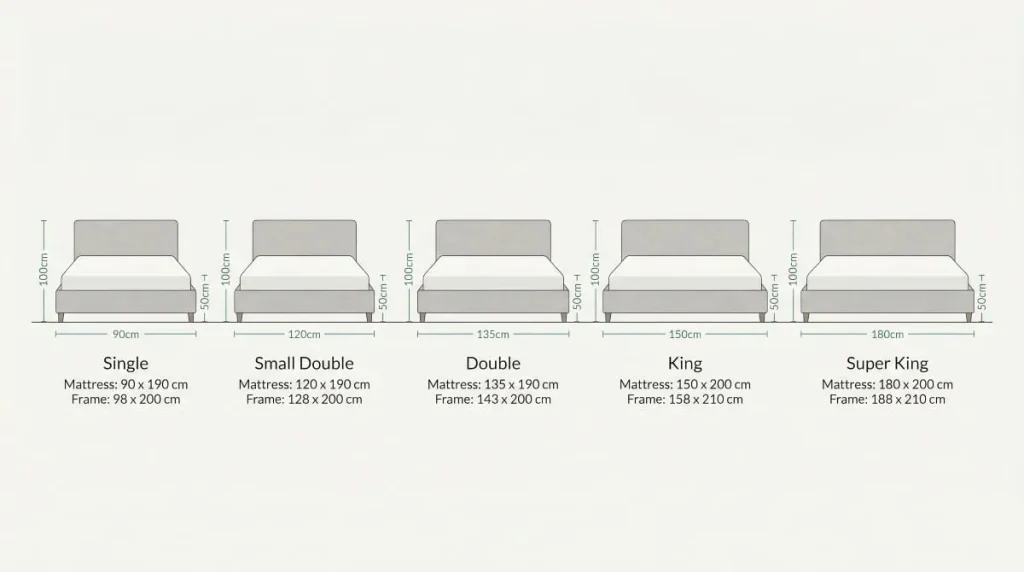
Bed Frame Dimensions Every UK Size Explained (cm, inches & feet)
A king size bed frame in the UK measures 150cm wide by 200cm long (5ft × 6ft 6in), that’s the frame’s external footprint, not just…
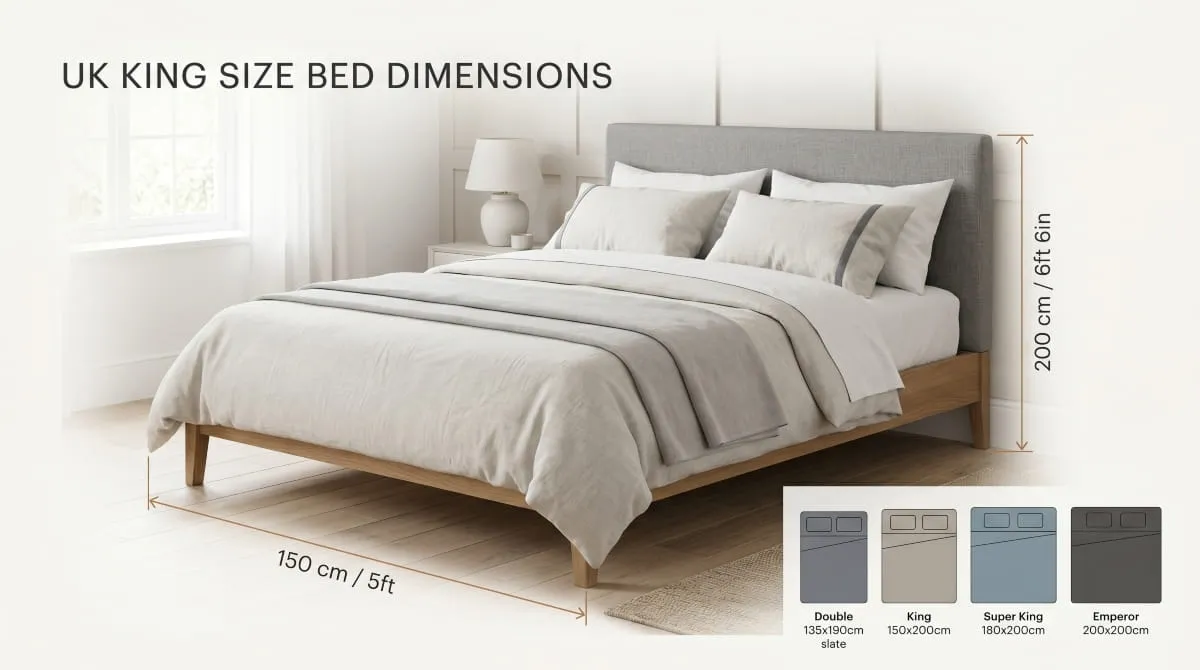
A king-size bed in the UK measures 150 cm wide by 200 cm long (5 ft × 6 ft 6 in). That is the standard you will find across virtually every British bed retailer and mattress manufacturer.
If you are upgrading from a double, you are gaining 30 cm of extra width. If you are deciding between a king and a super king, or trying to figure out whether a California king even exists in UK sizing, this guide covers all of it: exact measurements in centimetres, inches, and feet; side-by-side comparisons with every other UK bed size; international variants; and practical answers to the questions most buyers have before they commit.
One number worth keeping in mind as you read: according to the Sleep Foundation, couples who share a bed need at least 76 cm of personal sleeping space each to sleep undisturbed. A king size bed gives each person exactly 75 cm, which is why it sits at the tipping point between genuinely comfortable and just-about-adequate for two adults, and why the decision between king and super king matters more than many buyers realise until after they have bought.
A king size bed in the UK is 150 cm wide and 200 cm long. That is the standard measurement used by British bed manufacturers, mattress makers, and bedding brands, so when you buy a king size frame, mattress, or duvet in the UK, those are the dimensions you are buying for.
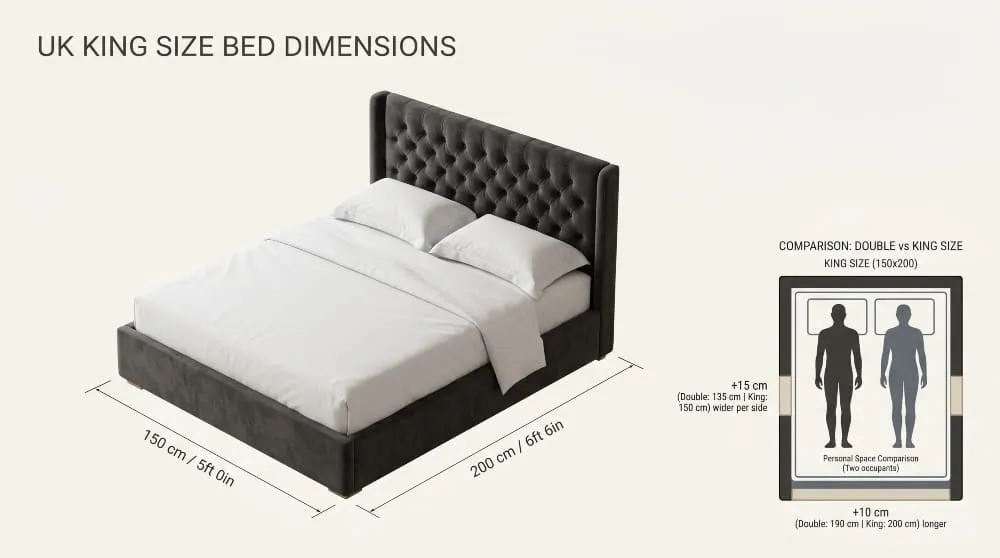
The UK king size bed measures 150 cm × 200 cm. Width is the more important figure when you are buying for two people; 150 cm gives each sleeper 75 cm of personal space, which is comfortable but not generous. If you find yourself regularly encroaching on each other’s side, that is the measurement telling you a super king may suit you better.
In inches, a UK king size bed measures 59 inches wide by 78.7 inches long, often rounded to 60 × 79 in product listings. This is worth knowing when you are shopping for throws, mattress protectors, or bedding sold in imperial sizes, as the rounding can cause a slight fit variance.
A king-size bed is 5ft wide by 6ft 6 in long. The 5ft width is the most commonly referenced shorthand in UK retail; you will often see beds listed simply as “5ft king size” on product pages, which is why 5ft has become synonymous with king in British bed buying.
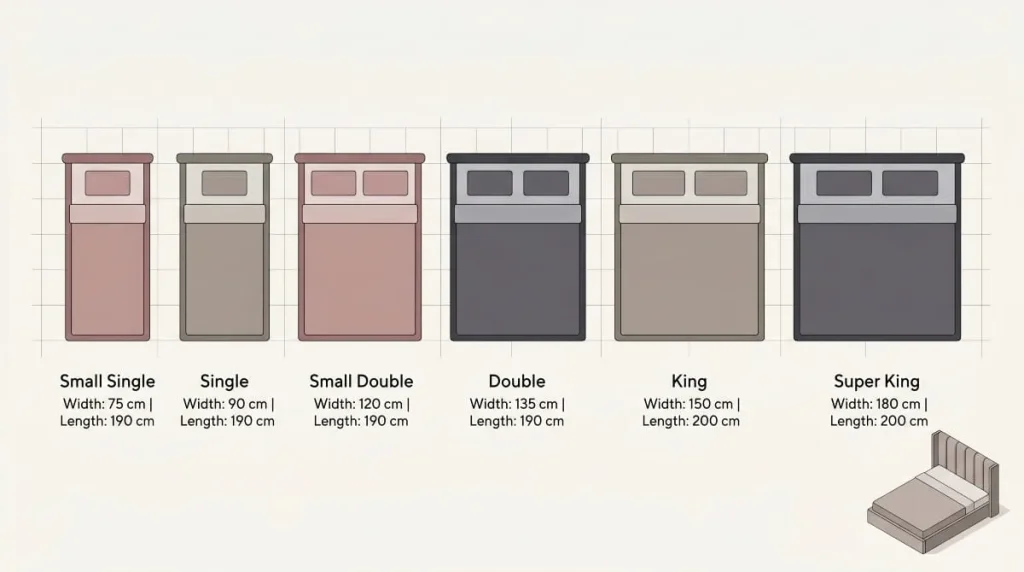
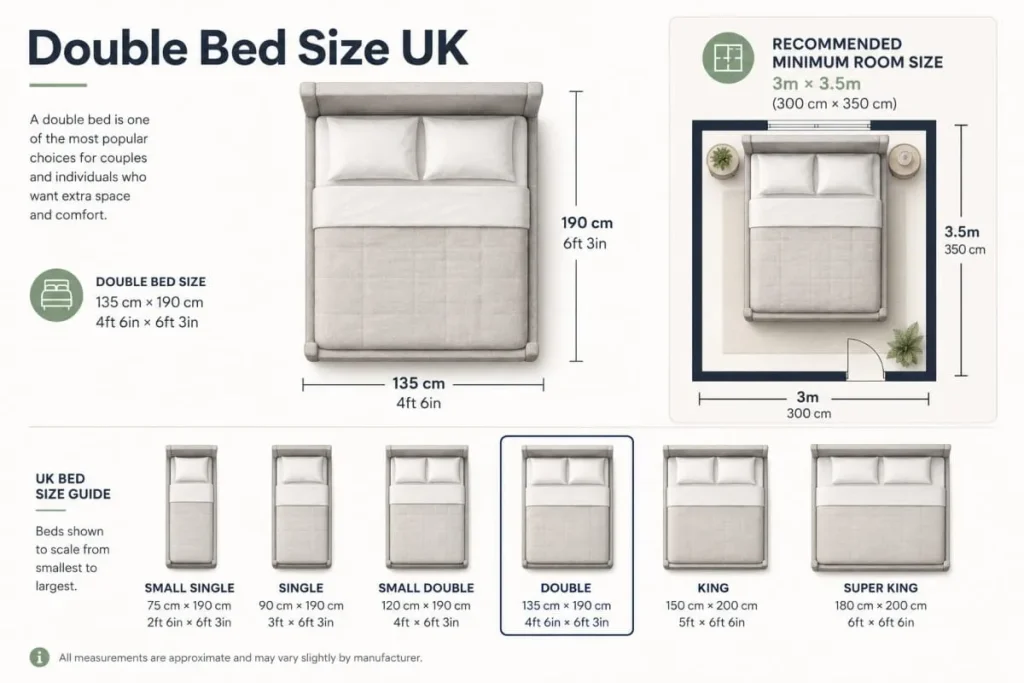
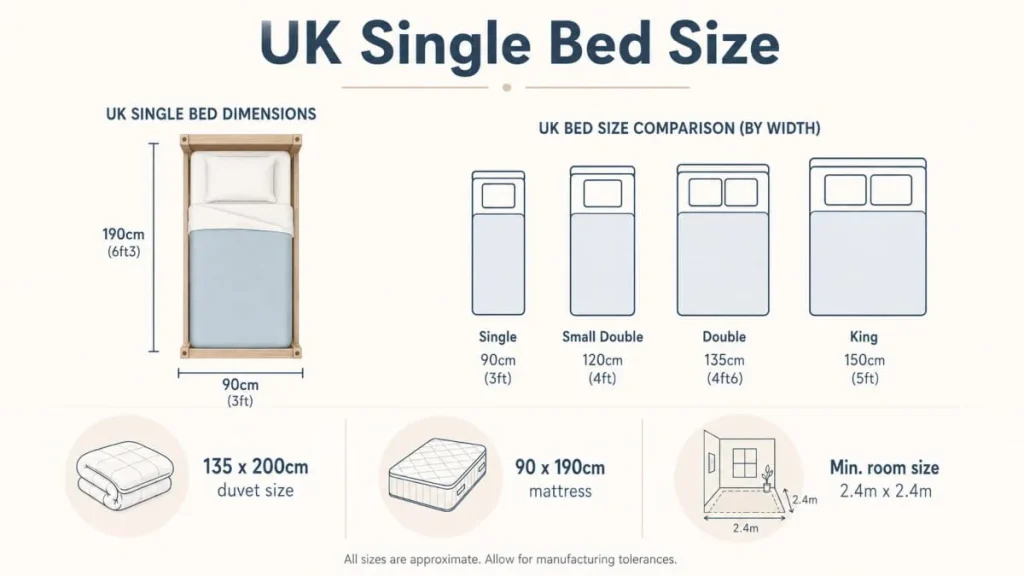
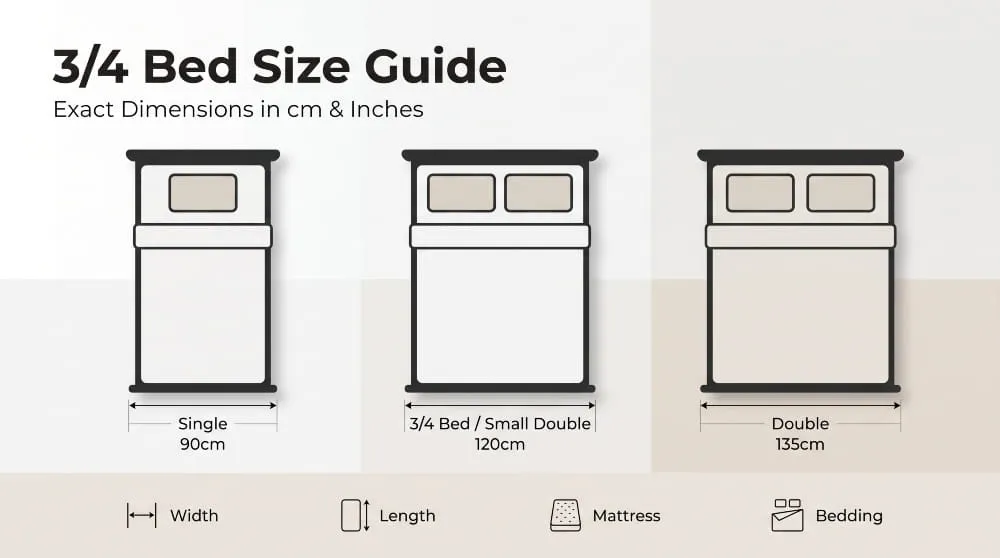
The table below covers all standard UK bed sizes in all three measurement units so that you can compare at a glance.
Two things stand out in that table. First, the king is the only standard size where the length steps up from 190 cm to 200 cm, making it meaningfully longer than a double, not just wider. Second, the jump from king to super king is a full 30 cm in width, the same increment as moving from double to king. That consistency is useful when you are weighing up whether the next size up is worth the room space.
A super king size bed in the UK measures 180 cm wide by 200 cm long (6ft × 6ft 6in), making it the largest standard bed size you will find in mainstream British retail, and 30 cm wider than a king.
The super king measures 180 cm × 200 cm, or 70.9 inches × 78.7 inches in imperial. The length is identical to a king at 200 cm; the only dimension that changes is the width. That single extra 30 cm is the entire case for or against upgrading, so it is worth thinking carefully about what 30 cm actually means in practice: it is roughly the width of a standard pillow, shared equally between two sleepers as 15 cm each.
In bedding terms, a super king duvet is typically 260 cm × 220 cm, noticeably larger than the 225 cm × 220 cm you would buy for a king, so factor that into your linen budget when making the switch.
The difference between a super king and a king size bed is straightforward: 30 cm of width. Length is the same at 200 cm for both. But that width gap has real consequences for how a bed feels to share.
On a king, each person has 75 cm of sleeping space. On a super king, that rises to 90 cm, closer to the width of a single bed (90 cm) than most people realise. For couples where one or both partners move around in their sleep, that additional 15 cm per person shifts the experience from manageable to genuinely comfortable. The price difference between a king and a super king frame is typically £75 to £100 at most retailers, making the super king one of the better value-per-centimetre upgrades in bedroom furniture.
For most couples who can accommodate it, yes, provided the room can take it. The practical threshold most interior designers recommend is a bedroom of at least 4 metres × 4 metres to comfortably fit a super king with adequate clearance on three sides. In a room smaller than that, a super king can make the space feel oppressive rather than luxurious, which defeats the purpose.
If your room sits between sizes, large enough to feel cramped with a king but tight for a super king, the answer usually comes down to which compromise bothers you more: slightly less sleeping space, or slightly less floor space. Most people who make the upgrade to super king do not go back. Most people who squeeze one into a genuinely too-small room regret it within a month.
The super king is also worth serious consideration for taller sleepers. At 200 cm long, both king and super king offer the same length, but the super king’s extra width means taller sleepers who tend to sleep diagonally have more room to do so without disturbing a partner.
A king size bed is 15 cm wider and 10 cm longer than a standard double. That gap is modest on paper but makes a meaningful difference in practice, particularly for couples who have been sharing a 135 cm double and regularly run out of room.
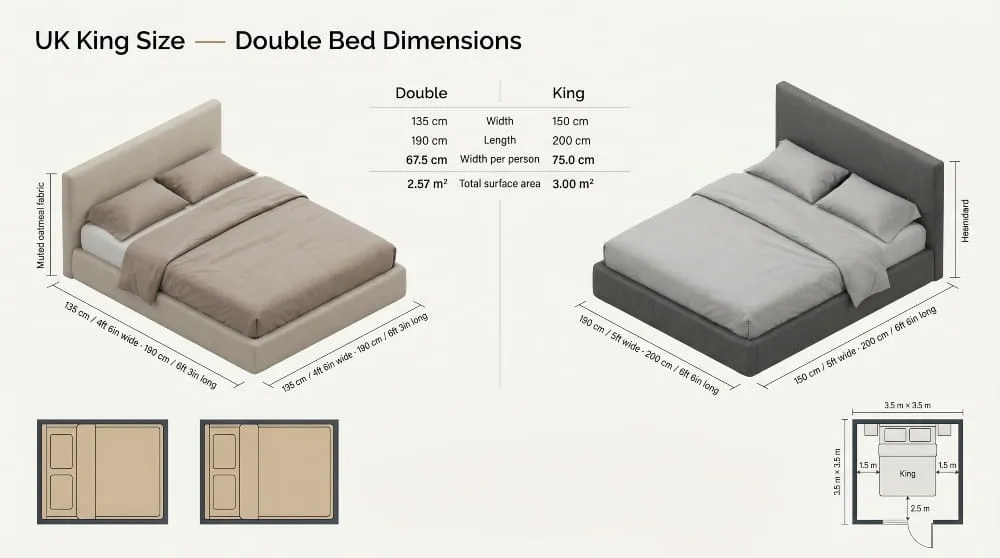
A standard double bed measures 135 cm × 190 cm (4ft 6 in × 6ft 3 in). A king-size bed measures 150 cm × 200 cm (5ft × 6ft 6 in). Laid side by side, the difference looks like this:
The total surface area increase is approximately 17%, which sounds significant until you translate it back into the number that matters most for shared sleeping: each person gains 7.5 cm of personal width. That is not a transformation, but combined with the extra 10 cm in length, the overall sleeping experience on a king feels noticeably less cramped than a double, especially for taller sleepers or those who sleep on their side with their arms extended.
For couples, almost always. For a single sleeper, it depends on how much you move in the night and how large your room is.
The case for upgrading from a double to a king rests less on the raw centimetre gain and more on what that gain eliminates: the nightly negotiation for space that gradually erodes sleep quality for both partners. Research published in the journal Sleep found that co-sleeping couples who reported poor sleep were significantly more likely to cite partner disturbance as the primary cause than any other factor. More width does not eliminate disturbance, but it reduces its frequency.
The financial case is also reasonable. The price difference between a double and a king-size bed frame at most UK retailers sits between £50 and £150 depending on the style, a relatively small premium for something you use every single night for the better part of a decade. The mattress uplift is typically similar. Where the cost adds up more noticeably is bedding: king-size duvets, fitted sheets, and mattress protectors all cost more than their double equivalents, so factor an additional £50 to £100 into your first-year budget for linen.
A king size bed frame typically measures slightly larger than the mattress itself, usually around 157 cm × 207 cm once the frame is accounted for, so use those figures rather than the bare mattress dimensions when measuring your room.
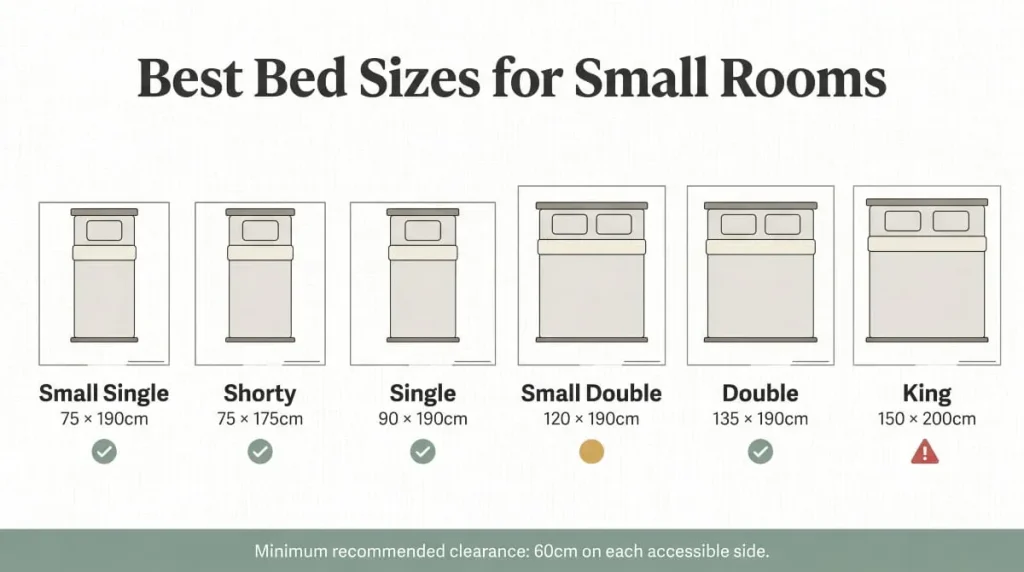
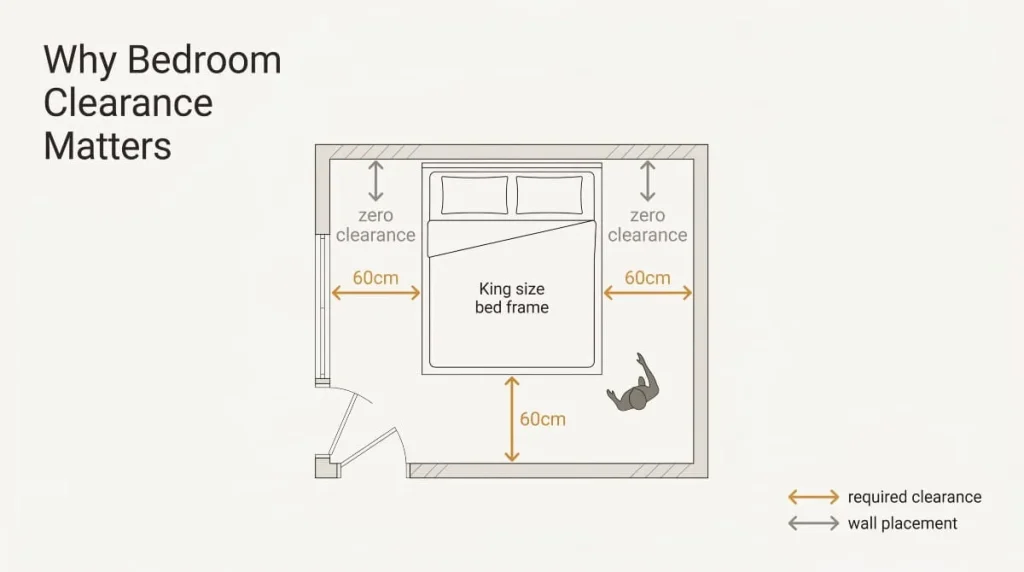
The minimum room size most interior designers recommend for a king size bed with comfortable clearance on all sides is 3.5 metres × 3.5 metres. That allows for roughly 60 cm of walkway on each side of the bed and clearance at the foot, enough to open wardrobe doors and move around freely without the room feeling like a corridor.
If your bedroom falls below that threshold, a king can still work, but you will likely need to sacrifice clearance on one side, typically placing the bed against a wall. That is a practical solution for many rooms, particularly in older UK terraced houses and flats where bedroom dimensions were never designed with a 5ft bed in mind. What you want to avoid is a room where the bed dominates to the point where other furniture becomes inaccessible, or the door arc is obstructed.
Before you buy, measure twice: the room, the doorways the frame needs to pass through during delivery, and the staircase if the bedroom is on an upper floor. Most king size bed frames are delivered in sections precisely because of this, but it is worth confirming with your retailer before the delivery day.
The queen size bed does not exist as a standard size in the UK. It is an American sizing convention, and confusion between queen and king arises frequently among UK shoppers who have encountered the term through US retailers, interior design content, or international travel.
No, the UK bed size system does not include a queen. British sizing skips double (135 cm × 190 cm) and goes directly to king (150 cm × 200 cm), with no queen in between. If you see “queen size” listed on a UK retail website, it is almost certainly either a marketing term being used loosely as a synonym for double, or an imported product using American labelling. Neither the British Standards Institution nor mainstream UK bedding manufacturers recognise queen as a distinct size category.
This matters practically because if you buy a queen size mattress or bedding from a US-based retailer and try to fit it to a UK king frame, or vice versa, the dimensions will not align cleanly. The two systems are close enough to confuse but different enough to cause problems.
A US queen size bed measures 153 cm × 203 cm (60 × 80 inches). A UK king size bed measures 150 cm × 200 cm (59 × 78.7 inches). The two are remarkably similar; the American queen is just 3 cm wider and 3 cm longer than the British king, which is precisely why the terms get conflated.
The practical takeaway is this: if you are buying a bed frame or mattress in the UK, ignore queen size entirely. If you are buying bedding or accessories from a US retailer, a queen size fitted sheet will technically fit a UK king mattress with a small amount of slack, but it is not a precise match, and over time the fit will be looser than a purpose-made UK king sheet.
In the American sizing system, a king is bigger than a queen. A US king measures 193 cm × 203 cm (76 × 80 inches), substantially wider than a US queen at 153 cm. The length is the same for both; the king’s advantage is entirely in width, giving each person in a couple approximately 96 cm of personal sleeping space compared to 76 cm on a queen.
In the UK context, the question does not quite apply, but if you are comparing a US king to a UK king, the American version is considerably larger: 193 cm wide versus 150 cm. A US king is closer in size to a UK super king (180 cm) than to a UK king, which is a useful reference point if you are relocating between countries and trying to work out whether your existing bed and bedding will translate.
“King size” does not mean the same thing in every country. The term is used across the US, Europe, and Australia. Still, the dimensions behind it vary significantly, and assuming otherwise is one of the more common and costly mistakes people make when buying beds or bedding across borders.
A California king measures 183 cm × 213 cm (72 × 84 inches), making it narrower but longer than a standard American king. It was designed specifically for taller sleepers who need extra length rather than extra width, and it remains predominantly a US product. You will not find California king frames or mattresses stocked as standard in UK retailers.
In direct comparison to a UK king, the California king is 33 cm longer but only 33 cm wider, with notably different proportions, closer to a long rectangle than to the more balanced proportions of the British king. If you are 6 ft 3 in or taller and sleeping alone, the California king’s 213 cm length offers genuine relief. For couples prioritising shared width, it is the wrong trade-off.
The Alaskan king is the largest commercially available bed size in the world, measuring 274 cm × 274 cm (108 × 108 inches), a perfect square nearly twice the width of a UK king. It is a niche American product, custom-made rather than mass-produced, and has no equivalent or presence in the UK market.
It exists primarily as a novelty or luxury statement piece for very large master bedrooms, and occasionally as a practical solution for families who co-sleep with children or pets. For context, an Alaskan king has roughly the same surface area as four UK single beds placed together. There is no standard bedding manufactured for it; everything is bespoke, which reflects both the price point and the extremely limited demand outside the United States.
A standard American king, often called an Eastern king in the US to distinguish it from the California variant, measures 193 cm × 203 cm (76 × 80 inches). A UK king measures 150 cm × 200 cm. The width difference is substantial: the American king is 43 cm wider, making it closer in width to a UK super king (180 cm) than to a UK king.
This distinction matters most when purchasing online from American retailers or when relocating to or from the US. An American king mattress will not fit a UK king frame; the 43 cm width gap makes that impossible. Bedding is equally incompatible. If you are moving countries and intend to bring a bed, treat it as a full replacement rather than a transfer.
The European king, sometimes listed as EU king or Continental king, typically measures 160 cm × 200 cm, though this varies by country. Germany and the Netherlands commonly use 180 cm × 200 cm as their standard large size, which aligns more closely with the UK super king than with the UK king. Scandinavia often defaults to two single mattresses of 90 cm × 200 cm placed side by side within a shared frame, a system with no direct British equivalent that produces a combined width of 180 cm, again matching the UK super king.
The absence of a single agreed European standard is the key practical point here. If you are buying a bed frame from a European manufacturer or retailer, particularly through a marketplace like Wayfair where international stock mingles, always check the exact dimensions in centimetres before purchasing rather than relying on the size label alone. A “European king” listed without further specification could mean anything from 160 cm to 180 cm wide, and neither will accept a UK king mattress without a significant size mismatch.
For a king size bed, you need bedding made specifically for a 150 cm × 200 cm mattress. The dimensions vary slightly between the duvet, throw, and blanket; each is sized differently by design, not by inconsistency, so it is worth knowing the correct measurements for each before you buy.
A king size duvet in the UK typically measures 225 cm × 220 cm. The width (225 cm) is deliberately larger than the mattress width (150 cm) to allow for overhang on both sides, with a drop of around 37 cm per side, which is enough to tuck under or leave draped, depending on your preference.
One number worth knowing: the British Standard for duvet sizing (BS 5335) recommends a minimum overhang of 30 cm on each side for a properly fitted duvet. At 225 cm wide across a 150 cm mattress, a standard UK king duvet lands almost exactly on that threshold. If you prefer a more generous drape, particularly if you have a deeper mattress with a thick topper, sizing up to a super king duvet at 260 cm × 220 cm is a legitimate choice, and one many king size bed owners quietly make.
A king-size bed throw typically measures between 150 cm × 200 cm and 180 cm × 230 cm, depending on the manufacturer. Unlike duvets, throws do not follow a strict British Standard, so sizing varies more widely across retailers.
For a king-size bed, the most versatile throw size is 150 cm × 200 cm if you want it to cover only the sleeping surface, or 180 cm × 230 cm if you prefer it to drape over the sides and create a layered, styled look at the foot of the bed. The latter is the size most commonly used in interior styling, where the throw is folded across the bottom third of the bed rather than used as a full cover. If you are buying a throw primarily for warmth rather than aesthetics, prioritise weight and fabric over dimensions.
A king-size blanket in the UK generally measures 230 cm × 250 cm, larger than a throw blanket and designed to function as a full bed covering with generous overhang on all sides. Some manufacturers produce blankets at 260 cm × 240 cm, particularly in wool and weighted blanket ranges where full coverage is the primary requirement.
The distinction between a blanket and a throw is one retailers frequently blur. Still, the functional difference is consistent: a blanket is sized to cover the full bed, including the sides, while a throw is sized for partial coverage or decorative layering. If you are replacing a duvet with a blanket for summer use or minimalist bedding preferences, aim for a minimum width of 230 cm to ensure adequate side coverage on a 150 cm king mattress.
Yes, and it is more common than most people realise. A super king duvet measures 260 cm × 220 cm compared to the standard king size duvet at 225 cm × 220 cm. The length is identical; the only difference is an additional 35 cm of width. On a king size bed, that extra width translates to approximately 17 cm of additional overhang on each side, producing a fuller, more draped appearance that many people find more visually appealing and practically warmer.
The trade-off is that a super king duvet on a king bed will bunch more noticeably if you tuck it in, and in a duvet cover sized for a king, the internal duvet will shift and bunch over time. The cleaner solution if you want a more generous drape is to buy a super king duvet and a super king duvet cover together, accepting that the cover will be slightly oversized for the bed. It is an aesthetic choice rather than a functional problem, and one worth making deliberately rather than discovering by accident after a mismatched online order arrives.
For a king-size bed, the most commonly recommended rug size is 200 cm × 300 cm, large enough to extend beyond both sides of the bed and the foot, so that when you step out of bed in the morning, your feet land on the rug rather than the floor. Anything smaller tends to look visually underwhelming and defeats the practical purpose of having a rug in the bedroom.
The right rug size depends less on the bed and more on the amount of floor space around it. Three layouts cover the majority of UK bedrooms.
The most popular option for a well-proportioned main bedroom is a 200 cm × 300 cm rug placed centrally under the bed, extending roughly 75 cm beyond each side and 50 cm beyond the foot. This is the layout most interior designers default to because it grounds the bed as a focal point without overwhelming the room or making it disappear beneath it.
In a larger room, typically 4 metres or wider, a 240 cm × 340 cm rug gives a more proportionate result. At this size, the rug becomes a true anchor for the whole space rather than simply a bed accessory, and it works particularly well if you have bedside tables you want visually unified within the same zone.
For smaller rooms where a full rug beneath the bed is impractical, two 60 cm × 120 cm runners placed on either side of the bed are a practical alternative. They serve the primary functional purpose of providing a soft landing when you get out of bed, without competing with limited floor space or making the room feel cluttered.
The standard positioning rule for a bedroom rug is that it should extend at least 60 cm beyond each side of the bed and at least 45 cm beyond the foot of the bed. For a king-size bed at 150 cm wide, that means a rug width of at least 270 cm if you want full bilateral coverage, which is why many interior stylists round up to a 300 cm width rather than cutting it precisely to the minimum.
The head of the bed is the one side where rug coverage does not matter. Since the headboard sits flush against the wall and that strip of floor is never walked on, running the rug from beneath the middle of the bed to beyond the foot is both more practical and more economical than extending it all the way under the headboard.
One widely cited interior design principle worth applying here: the rug should be large enough that it does not appear to float in the middle of the room when the bed is on it. If there is visible floor between the edge of the rug and the wall on the sides, and the gap is under 30 cm, the rug reads as too small for the space. Either size up or reposition. In a UK main bedroom with a king-size bed, erring toward a larger rug is almost always the better decision; a rug that is too large for a room is far rarer than one that is too small.
The UK uses seven standard bed sizes, running from small single through to emperor. Each step up increases the width by a consistent increment. Understanding the full sequence makes it easier to see where a king sits relative to everything below and above it, and whether the next size up is worth the space it requires.
Several patterns in this table are worth drawing out explicitly, because they are not obvious until you see the full sequence together.
First, the length stays fixed at 190 cm for every size up to and including small double and double, then steps up to 200 cm at king and holds there through super king and emperor. That 10 cm length increase at the king tier is one of the less-discussed advantages of upgrading from a double, particularly for taller sleepers who have always felt slightly compressed at the foot of a standard 190 cm mattress.
Second, the width increments between sizes are consistent at 15 cm steps through the lower range: small single to single is 15 cm, single to small double is 30 cm, small double to double is 15 cm, before the gaps widen at the top end. King to super king is 30 cm. Super king to emperor is 20 cm. The emperor, at 200 cm × 200 cm, is a perfect square, a genuinely unusual shape for a bed and one that requires a bedroom large enough to absorb it without the proportions feeling wrong.
Third, and most practically useful: the small double is frequently overlooked by solo sleepers upgrading from a single. At 120 cm wide, it offers substantially more personal space than a single, without the room footprint of a full double, making it one of the better size options for single occupants in a modestly sized bedroom. Similarly, the jump from king to super king is the single most impactful upgrade available to couples, 30 cm of additional width at a price premium that, spread across the lifespan of the bed, works out to a negligible nightly cost difference.
Yes. A UK king size bed is exactly 5ft wide, which converts to 150 cm. The 5ft shorthand is so widely used in British retail that you will often see king-size beds listed simply as “5ft beds” on product pages; the two terms are interchangeable in the UK market.
The only difference is width: a king is 150 cm wide, a super king is 180 cm wide, a gap of 30 cm, or about 15 cm of extra sleeping space per person. Length is identical at 200 cm for both, so the entire case for upgrading to a super king rests on whether that additional width meaningfully improves how comfortably two people share the bed.
A king size bed is 15 cm wider and 10 cm longer than a standard double, which measures 135 cm × 190 cm. That translates to approximately 17% more total surface area, modest in percentage terms, but enough to give each person in a couple an extra 7.5 cm of personal sleeping width, which most shared sleepers notice within the first few nights.
The largest standard UK bed size is the emperor at 200 cm × 200 cm (6ft 6in × 6ft 6in), a perfect square and a niche product requiring a very large bedroom to work proportionately. Beyond that, bespoke oversized beds can be commissioned from specialist manufacturers, but nothing larger exists as an off-the-shelf UK standard.
A king-size bed can work in a smaller bedroom, but the room should ideally measure at least 3.5 metres × 3.5 metres to maintain comfortable clearance on all sides. Below that threshold it is still possible, though you may need to place one side of the bed against a wall, a practical compromise that many UK homeowners make successfully in older terraced houses and flats where bedroom dimensions were never built with a 5ft bed in mind.
A California king is longer but narrower than a UK king; it measures 183 cm × 213 cm compared to the UK king’s 150 cm × 200 cm, making it 33 cm longer and 33 cm wider in total but with a distinctly different shape. It is designed for tall sleepers who need extra length rather than couples prioritising shared width, and it is not available in standard sizes from UK retailers.