

Bed Frame Dimensions Every UK Size Explained (cm, inches & feet)
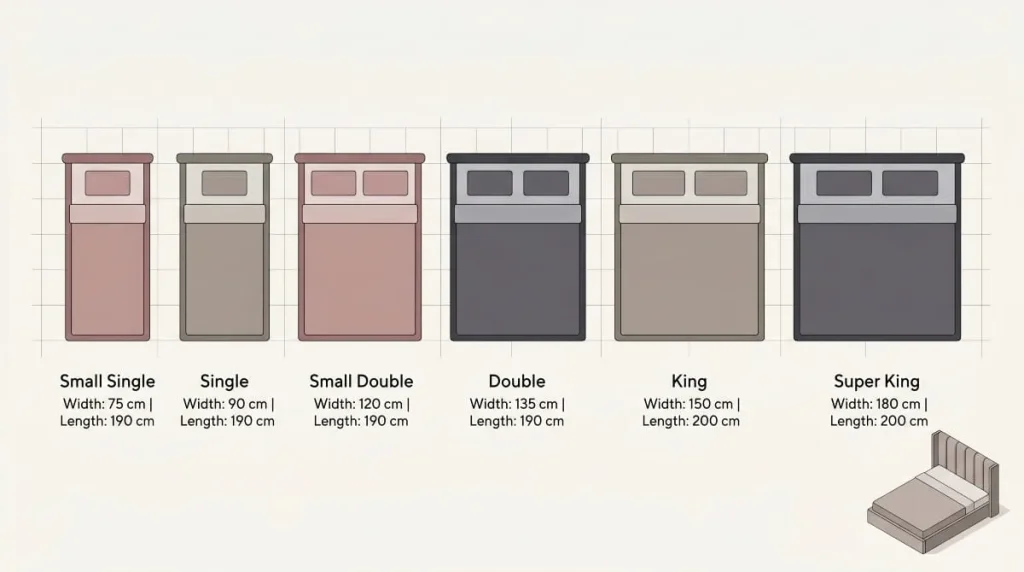
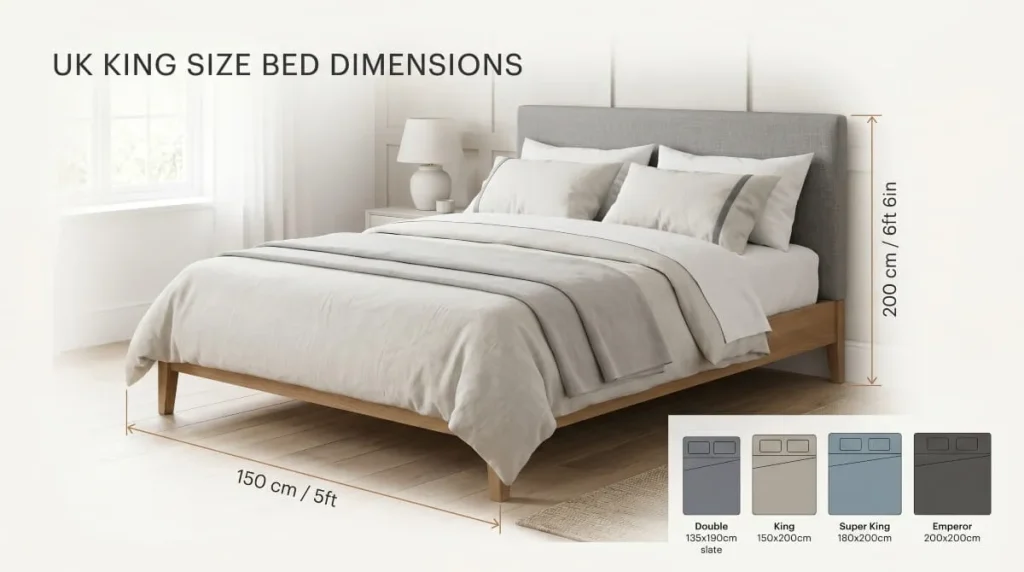
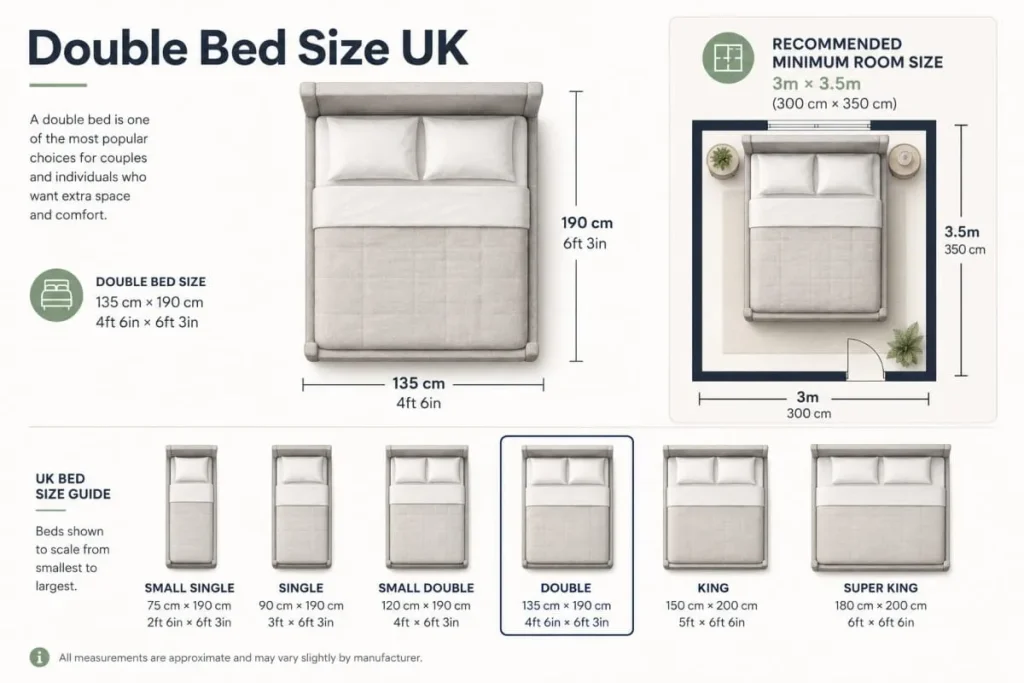
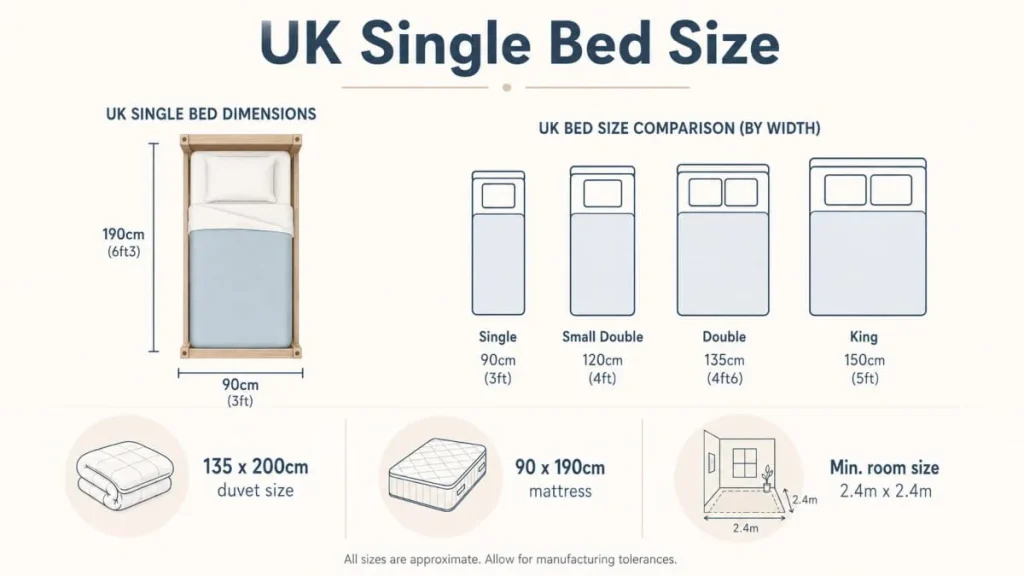
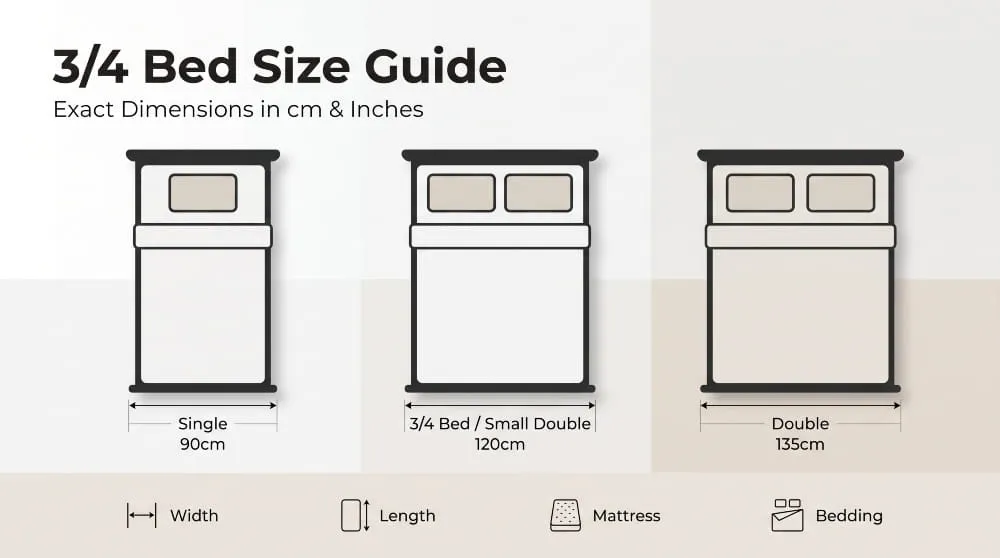
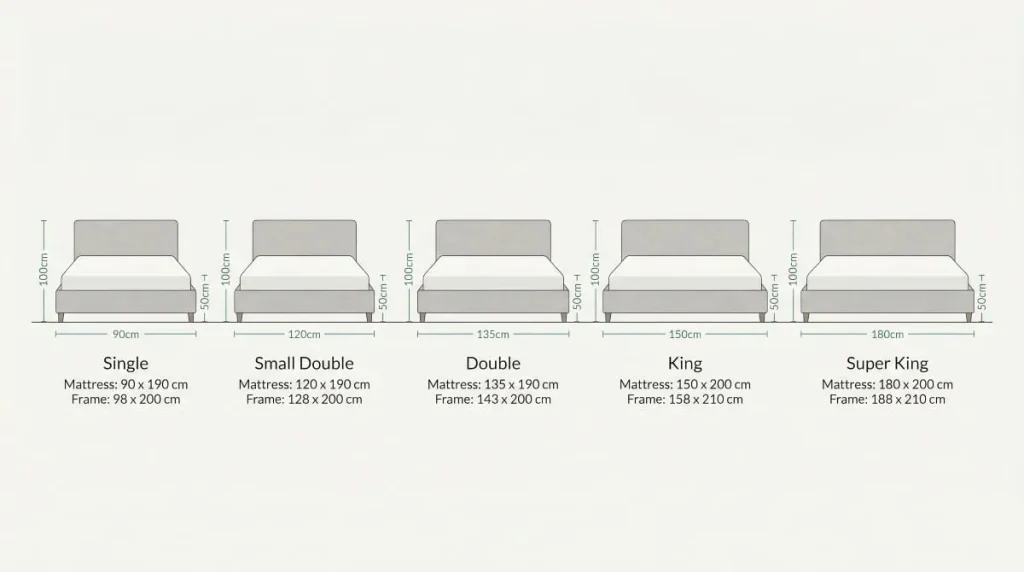
A king size bed frame in the UK measures 150cm wide by 200cm long (5ft × 6ft 6in), that’s the frame’s external footprint, not just…
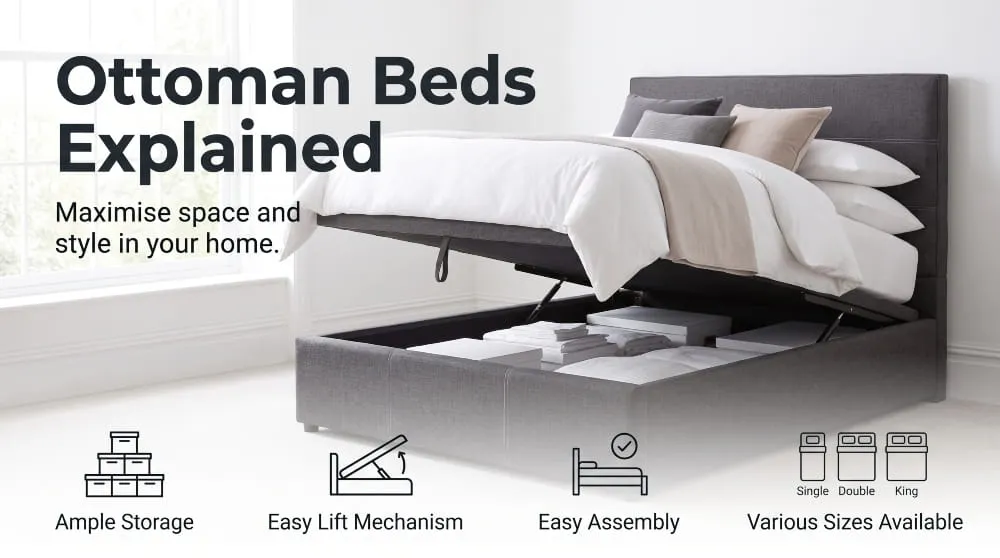
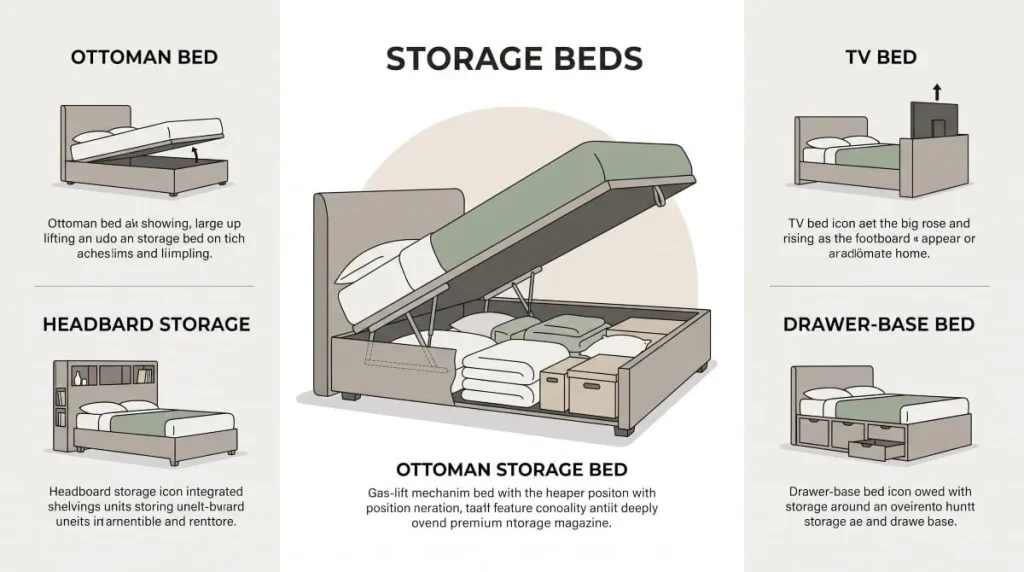
An ottoman bed is a bed frame with a hinged, upholstered base that lifts on gas struts to reveal a full-size storage compartment underneath, giving you significantly more space than a standard divan or bed frame without sacrificing floor room. It works much like the lid of a car boot: lift the mattress platform, and the entire under-bed area opens up for bedding, seasonal clothing, or anything else you’d rather keep out of sight.
For anyone furnishing a smaller UK bedroom, this makes the ottoman bed one of the most practical style choices available; industry estimates suggest the average under-bed ottoman storage space can hold the equivalent of two to three large storage boxes, all accessed without a single external unit cluttering the room. Unlike a traditional divan with drawers, which only offers partial storage and requires floor clearance to pull them open, an ottoman bed’s lift mechanism uses the entire base, and the bed itself stays completely still while you access it.
Below, we cover exactly how the ottoman mechanism works, whether ottoman beds are safe and durable, how to assemble and troubleshoot one, and how to choose the right size, style, and fabric for your bedroom.
An ottoman bed is a bed frame built around a hinged base that lifts on gas struts, turning the entire area underneath the mattress into a single, deep storage compartment. Instead of drawers, shelving, or separate under-bed boxes, the whole sleeping platform tilts upward as one unit, usually from the foot end. However, side-opening versions are also available, giving access to a space that typically runs the full length and width of the bed.
The name comes from the traditional ottoman: a padded storage box or footstool with a lid that lifts to reveal space inside. Ottoman beds apply that same lift-lid principle at bed scale, and the format has become one of the most searched storage solutions for UK bedrooms, particularly among buyers in flats, terraced houses, and smaller box rooms where floor space for wardrobes or chests of drawers is limited.
A standard bed frame offers no storage at all, just a slatted or solid base sitting on legs, with usable space underneath only if you add your own boxes or containers. A divan bed improves on this with built-in drawers, but those drawers only ever account for a portion of the base, since the drawer mechanism itself takes up depth and the remaining area is fixed and inaccessible.
An ottoman bed removes that limitation entirely. Because the whole base lifts as one hinged unit, there are no dividing panels or drawer runners eating into the available space, which is why ottoman beds are widely considered the most storage-efficient bed format on the market. The trade-off is that access is vertical rather than side-on: you lift the bed rather than sliding a drawer, which means items need to be reasonably accessible from above rather than tucked into a shallow drawer front.
Most ottoman beds share a consistent set of features regardless of style or fabric. The base is supported by either gas struts (which allow the platform to lift with minimal effort and hold itself open safely) or a manual lift mechanism, with gas lift now the standard choice across the majority of UK ottoman beds due to the ease and control it offers. The frame itself is usually upholstered in fabrics such as velvet, boucle, or linen, matching the headboard for a complete look, and sits on either a low profile or raised legs depending on the model.
Storage capacity varies by size, but even a single ottoman bed typically offers space comparable to two to three large under-bed storage boxes, all contained within one unit rather than scattered around the room. Reinforced hinges and a sturdy frame are standard on well-made ottoman beds, since the base needs to support both the mattress and sleeper weight when closed and remain stable when lifted open.
An ottoman bed mechanism works by using hinges fixed along one edge of the frame and either gas struts or a manual spring-assisted arm to lift the mattress platform upward, exposing the storage base beneath. Once open, the mechanism holds the platform securely in place so that you can access the full storage space hands-free, and lowering it back down simply reverses the motion until the base locks flat again.
Gas lift is now the standard mechanism on most UK ottoman beds, using pressurised struts similar to those found in a car boot to lift the mattress platform with very little physical effort, regardless of mattress weight or size. The struts hold the bed open safely at full extension, so there’s no risk of it dropping unexpectedly while you’re reaching into the storage space, and closing it back down is a smooth, controlled motion rather than a sudden drop.
Manual mechanisms, by contrast, rely on a spring-assisted hinge that still requires the user to lift and hold the platform, which can be considerably harder on larger sizes like king or super king where the mattress and frame add significant weight. For this reason, gas lift has become the preferred choice across the ottoman bed market, particularly for larger sizes or for anyone who wants to open the bed regularly without physical strain.
The two most common ottoman bed configurations differ in where the hinge sits and, as a result, how much clearance the room needs to open the bed fully. End-opening ottoman beds hinge at the foot of the bed and lift the platform vertically toward the headboard, which needs clear space at the end of the bed rather than along either side, a practical choice for bedrooms with furniture positioned close to the walls.
Side-opening ottoman beds hinge along one long edge instead, lifting the platform sideways, which suits rooms where there’s more open space beside the bed than at the foot of it. Neither configuration offers more storage than the other; the choice comes down entirely to which side of the bedroom has enough clearance for the platform to lift and stay open comfortably.
Ottoman beds are available either raised on legs, giving a visible gap beneath the frame, or as a low-profile base that sits close to the floor with no exposed legs at all. Beds on legs tend to suit more traditional or classic bedroom styles and can make a room feel slightly more open, since light passes beneath the frame. At the same time, low ottoman bases give a more modern, grounded look that’s become popular in contemporary UK bedroom design.
The storage mechanism itself works identically in both versions, since the lift and hinge system sits within the frame rather than the legs, so the choice between the two is purely aesthetic and doesn’t affect either the amount of storage space or how the bed opens.
Ottoman beds are a good choice for most UK bedrooms, offering significantly more storage than a standard divan or bed frame while remaining safe and durable when well made. However, like any furniture format, they come with a few trade-offs worth knowing before you buy. The right ottoman bed for you depends less on whether the format works and more on getting the size, mechanism, and build quality suited to your room and how you’ll use it.
The main draw of an ottoman bed is space efficiency: because the entire base lifts as one unit, it typically holds the equivalent of two to three large storage boxes, all without the need for a separate wardrobe, under-bed boxes, or extra furniture taking up floor space. This makes ottoman beds especially popular in flats, box rooms, and smaller UK bedrooms where every square foot counts.
Beyond storage, ottoman beds tend to offer a cleaner, more streamlined look than a divan with visible drawer fronts, since the upholstered base reads as one continuous surface. Comfort isn’t compromised either; the mattress sits on the same solid, supportive base as any other bed frame, so day-to-day sleep quality is unaffected by the storage mechanism underneath.
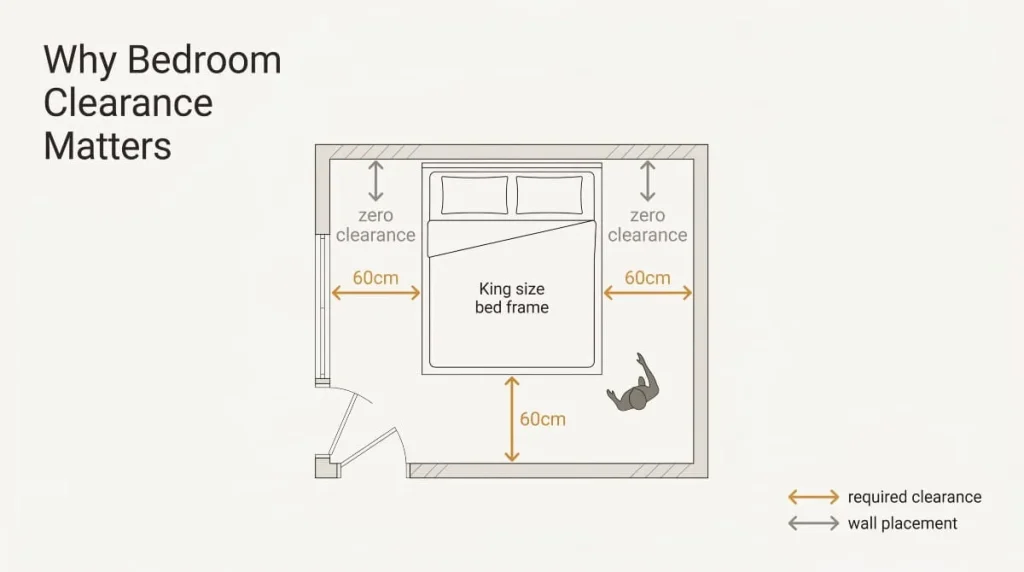
The main trade-off with an ottoman bed is that opening it requires clearing anything on top of the mattress first, so it’s less convenient for quick, frequent access compared with a drawer you can simply slide open. It also needs clearance either at the foot or side of the bed to lift fully, which is worth measuring for before buying if your room is tightly furnished.
Build quality varies more between ottoman beds than with standard bed frames, since the hinges and lift mechanism carry real mechanical load. It’s worth checking the frame material, the type of mechanism (gas lift generally outperforms manual), and the manufacturer’s weight rating before choosing one, particularly for larger sizes like king or super king.
Ottoman beds are safe when built to a proper standard, and the gas strut mechanism used on most modern beds is specifically designed to hold the platform securely open, preventing it from dropping unexpectedly while you’re accessing storage. This is the same fundamental engineering used in car boots and office chairs, which has been safely used in furniture and automotive applications for decades.
Safety concerns typically arise only with poorly made frames or worn mechanisms, where struts have weakened over time or hinges weren’t properly reinforced at manufacture. Buying from a reputable maker and checking the weight rating for your mattress and usage is the most reliable way to ensure long-term safety.
Ottoman beds don’t break easily when they’re properly constructed, but build quality is the deciding factor, since the hinges, frame joints, and lift mechanism all bear repeated mechanical stress that a standard bed frame never experiences. A well-made ottoman bed uses a reinforced frame and commercial-grade gas struts rated for the mattress size and expected weight, which allows it to open and close reliably for years.
Budget or poorly engineered ottoman beds are more likely to develop issues such as loosening hinges or struts that no longer hold the platform open, which is generally a manufacturing or component-quality issue rather than a flaw in the ottoman format itself. Choosing a bed from a manufacturer that specifies its mechanism grade and frame construction is the best way to avoid this.
Assembling an ottoman bed typically takes one to two hours for two people, following a sequence of building the base frame, attaching the gas struts or lift mechanism, fixing the headboard, and fitting the mattress platform on top. While the exact steps vary slightly between manufacturers, the core process is consistent across most ottoman beds sold in the UK.
Most ottoman beds arrive with all necessary fixings included, along with an Allen key for the bolts used throughout the frame. A power drill or screwdriver speeds up the process considerably, particularly for the headboard brackets and side rail bolts, and a second pair of hands is strongly recommended given the size and weight of the frame panels, especially on king and super king sizes.
It’s also worth having the base packaging or a soft blanket nearby to rest panels on during assembly, since upholstered fabric can mark or snag on hard flooring if panels are dragged rather than lifted into place.
Assembly generally begins with the side rails and footboard, bolted together to form the outer frame before anything else is attached. From there, the central support slats or base panel are fitted to strengthen the frame, followed by the gas lift mechanism, which is bolted to the hinge points at the base. This step is easiest with two people, since the struts need to be aligned and tightened evenly on both sides to avoid uneven lifting later.
Once the frame and mechanism are secure, attach the headboard to the head-end brackets, then lower the hinged mattress platform into place and test it by lifting and closing it fully before adding the mattress. Manufacturer instructions should always take priority over general guidance, since strut positioning and bolt torque can vary between models. Still, this sequence- frame, slats, mechanism, headboard, platform- holds across the vast majority of ottoman beds.
Dismantling an ottoman bed follows the assembly sequence in reverse, starting with removing the mattress and opening the platform fully to relieve tension on the gas struts before disconnecting them. The struts should always be detached with the platform supported or fully open, never while under load, since releasing a bolt on a strut that’s bearing weight can cause the platform to drop suddenly.
Once the struts are removed, the platform lifts away, followed by unbolting the headboard and finally separating the side rails and footboard. Keeping all bolts and fixings together in a labelled bag makes reassembly considerably easier if the bed is being moved or stored.
DIY assembly is straightforward for most people comfortable with flat-pack furniture, particularly with two people working together, and typically saves the cost of a professional service. That said, an assembly service is worth considering for larger sizes like king or super king, where panel weight and strut alignment become harder to manage alone, or simply for anyone who’d rather not spend an afternoon building a bed frame.
Many UK bed retailers, including Style Beds, offer assembly as an optional add-on at checkout, which covers full setup and disposal of packaging, a straightforward option if convenience matters more than the modest cost saving of doing it yourself.
Most ottoman bed problems come down to either worn gas struts, an obstruction inside the storage compartment, or a hinge that’s shifted out of alignment, and the majority can be diagnosed and often fixed without needing a full replacement. Identifying which of these three areas is causing the issue is the fastest route to a fix.
If an ottoman bed won’t close, the most common cause is something inside the storage compartment obstructing the platform, so it’s worth fully emptying the base and checking for anything caught near the hinge points before assuming a mechanical fault. Overfilled storage, particularly bulky items pressed up against the lid, is responsible for a large share of closing issues reported on ottoman beds.
If the base is clear and the bed still won’t close, check that the struts are moving evenly on both sides rather than one side lagging, since uneven strut resistance can cause the platform to jam at an angle rather than sitting flush. Gently guiding the platform down evenly on both sides, rather than pushing from the centre, often resolves this without needing any parts replaced.
Gas struts naturally lose pressure over time, which is the most common reason an ottoman bed becomes harder to lift or no longer holds itself open. A strut typically lasts several years of regular use, but heavier mattresses or more frequent opening will shorten that lifespan. If the platform now drops on its own after lifting, or requires noticeably more effort to open than when new, weakened struts are almost always the cause.
Struts are a standard replaceable component rather than something requiring a full bed replacement, and most manufacturers, including Style Beds, can supply matching replacement struts rated to the correct mattress size and weight. It’s important to replace struts as a matching pair rather than individually, since mismatched strut strength on either side causes the uneven lifting problem covered above.
Replacement hinges, struts, and fixings are generally available directly from the retailer or manufacturer of the original bed, since parts are model-specific and sized to the exact frame and mattress dimensions. Contacting the retailer with the bed’s model name and mattress size is the most reliable way to get a correctly matched part, rather than sourcing generic hinges or struts that may not fit or bear the correct weight rating.
For beds bought from Style Beds, our team can advise on the correct replacement part for your specific model and arrange for it to be sent out, so it’s worth reaching out directly rather than searching for generic parts elsewhere.
Ottoman beds come in every standard UK bed size and a wide range of fabrics and finishes, so choosing the right one comes down to matching the size to your room’s storage needs and the style to the rest of your bedroom. The mechanism and storage benefits stay consistent across every option; what changes is capacity, footprint, and finish.
Ottoman beds are available across the full range of UK bed sizes, and storage capacity scales directly with size: a Single ottoman bed offers the smallest footprint and suits box rooms, guest rooms, or children’s bedrooms, while a Double ottoman bed is the most common choice for main bedrooms, balancing sleep space with storage. Moving up, a King-size ottoman bed adds noticeably more storage volume alongside extra sleeping width, and a Super King ottoman bed offers the largest storage compartment of any size, often equivalent to several large storage boxes in one base.
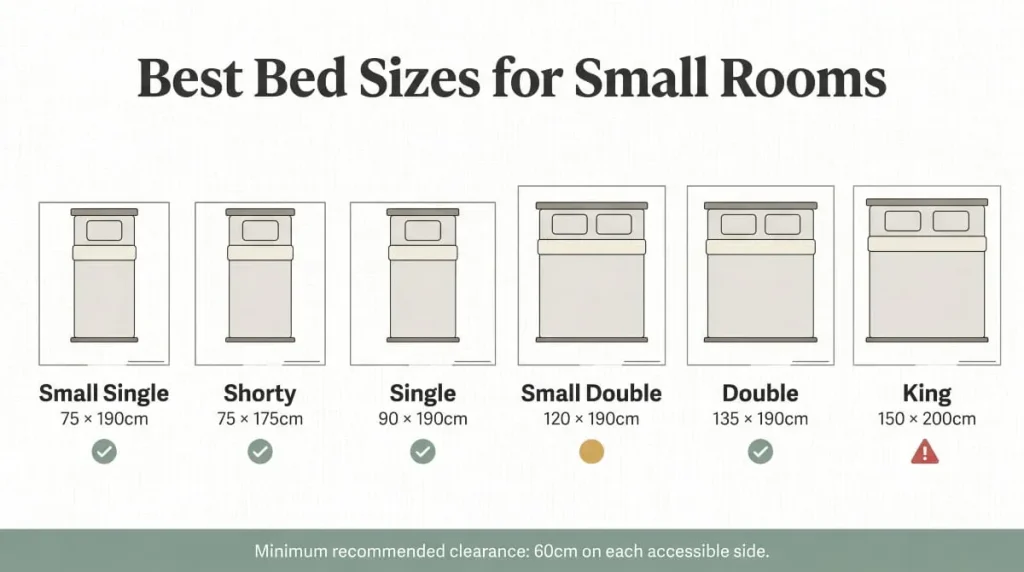
Larger sizes do require more clearance to open fully, whether end- or side-opening, so it’s worth measuring the room before sizing up purely for storage; a King or Super King only adds real value if there’s enough floor space around the bed to lift the platform comfortably.
Ottoman beds are typically upholstered in fabrics such as plush velvet, teddy boucle, or linen-look weaves, chosen to match or complement the headboard and the wider bedroom scheme. Neutral tones, taupe, ivory, beige, and grey remain the most popular choices for their versatility. At the same time, navy, teal, and burnt orange have grown in popularity for buyers wanting a stronger statement piece as the bed’s largest visible surface.
Velvet in particular has become the leading fabric choice for ottoman beds in the UK, prized for its combination of a soft, hotel-style finish and durability under regular use. You can browse the full range of fabrics and colourways available across our ottoman divan collection.
Beyond standard upholstered frames, ottoman beds are also available in more decorative formats, including four-poster designs that pair the storage mechanism with tall corner posts for a dramatic focal point, and French-style frames featuring curved, carved detailing on the headboard and footboard. These statement styles suit bedrooms where the bed is intended as the centrepiece of the room, rather than a purely functional piece.
Because the ottoman mechanism sits within the base rather than the headboard or posts, these decorative styles offer the same storage capacity as a simpler frame; the added detailing is purely aesthetic and doesn’t affect function.
A growing category combines the ottoman lift mechanism with a built-in TV storage compartment, typically housed in a raised footboard that lifts or slides to reveal a television, giving both under-bed storage and a hidden entertainment unit in one piece of furniture. This format has become particularly popular in smaller flats and studio bedrooms, where fitting a separate TV unit isn’t practical.
The under-bed storage in a TV ottoman bed works identically to a standard ottoman base, so buyers get the full storage benefit of the format alongside the added TV functionality, without any trade-off in capacity.
Ottoman beds designed for children’s rooms use the same lift mechanism as adult sizes but in Single or Small Double dimensions, offering a practical way to store toys, bedding, and clothing in rooms that are often the smallest in the house. The enclosed, lidded storage also tends to keep a child’s room looking tidier day-to-day than open shelving or freestanding boxes, since everything sits out of sight beneath the bed.
Build quality and strut reliability matter just as much on a kids’ ottoman bed as an adult one, so it’s worth choosing a model with a reinforced frame and a manufacturer that specifies its mechanism rating, even at the smaller Single size.
The right choice between an ottoman bed and a divan bed comes down to how much storage you need versus how you prefer to access it: an ottoman bed offers significantly more total storage space in one lift-up compartment. In contrast, a divan bed offers more limited, easier day-to-day access through individual drawers. Both are solid choices; the better fit depends on your bedroom and your habits.
Storage capacity is the clearest point of difference. Because an ottoman bed’s entire base lifts as a single unit, it typically holds the equivalent of two to three large storage boxes, well beyond what even a four-drawer divan can offer, since drawer mechanisms only ever use a portion of the base and leave the rest of the space fixed and inaccessible. For anyone in a smaller flat or bedroom where a wardrobe or chest of drawers isn’t practical, this makes the ottoman format the more space-efficient option by a clear margin.
Access is where the divan bed has the advantage. Sliding open a drawer takes seconds and doesn’t require clearing the mattress, which makes a divan better suited to items you reach for often, like bedding you change weekly or clothes in daily rotation. An ottoman bed, by contrast, is better suited to less frequently accessed items, seasonal clothing, spare bedding, and luggage, since opening it means lifting the full platform rather than a quick drawer pull.
Price and build considerations also differ slightly. Divan beds are generally simpler in construction, with no gas struts or hinge mechanism to account for, which can make them a marginally more affordable option at the same size and fabric tier. Ottoman beds cost a little more to engineer properly, but the storage gain is substantial enough that most buyers prioritising space over quick access find the difference worthwhile.
If your main goal is maximising storage in a smaller room, an ottoman bed is the stronger choice. If you value quick, frequent access to what’s stored under your bed and don’t need maximum capacity, a divan bed may suit your routine better. You can compare both formats directly across our ottoman divan collection and full bed frame range.
If you’re ready to bring the storage benefits of an ottoman bed into your own bedroom, Style Beds’ ottoman divan collection is handcrafted in Dewsbury, West Yorkshire, and available across every UK size from Single through to Super King. Each bed uses a reinforced frame and gas lift mechanism as standard, so you get the storage capacity and reliable, effortless opening covered throughout this guide, without needing to check specifications elsewhere.
The range spans a variety of fabrics, including plush velvet, teddy boucle, and linen-look weaves, in colourways from timeless neutrals to statement navy and teal, with headboard heights and finishes to match your bedroom’s style. Every bed comes backed by a 3-year warranty and a 30-night trial so that you can be confident in the build quality and comfort covered in the sections above.
Whether you’re upgrading from a standard divan for more storage or replacing a worn-out ottoman bed, browse the full collection to find the size, fabric, and style that fits your bedroom.
Yes, for most buyers an ottoman bed is worth it, particularly in smaller UK bedrooms where the extra storage, typically equivalent to two to three large storage boxes, removes the need for a separate wardrobe or under-bed containers. The value comes down to how much storage you need; if space is tight and you’d otherwise be buying additional furniture to store bedding or clothing, the ottoman format pays for itself in saved floor space alone.
Weight capacity depends on the specific bed and its gas struts. Still, a well-made ottoman bed is engineered to support both the mattress and sleeper weight when closed, plus a reasonable load of stored items when open, without strain on the mechanism. Manufacturers typically specify a maximum storage weight for the compartment separately from the sleeping load, so it’s worth checking this figure for your chosen model rather than assuming capacity based on size alone.
One person can usually lift a Single or Double ottoman bed’s platform without difficulty, since gas struts are designed to make opening effortless regardless of mattress size. Still, larger sizes like King or Super King carry more weight and can be harder to manage solo, especially during assembly when the struts aren’t yet fully supporting the frame. Once assembled and in regular use, the gas lift mechanism does the bulk of the work on every size.
Assembly typically takes one to two hours with two people, following the standard sequence of frame, slats, gas lift mechanism, headboard, and platform. Larger sizes and more decorative styles, such as four-poster or French-style frames, can take longer due to additional panels and detailing, while assembly services offered by most UK retailers remove the time commitment entirely for buyers who’d rather not build it themselves.