

UK Bed Mattress Sizes Guide (All Sizes in cm, Inches & Feet)
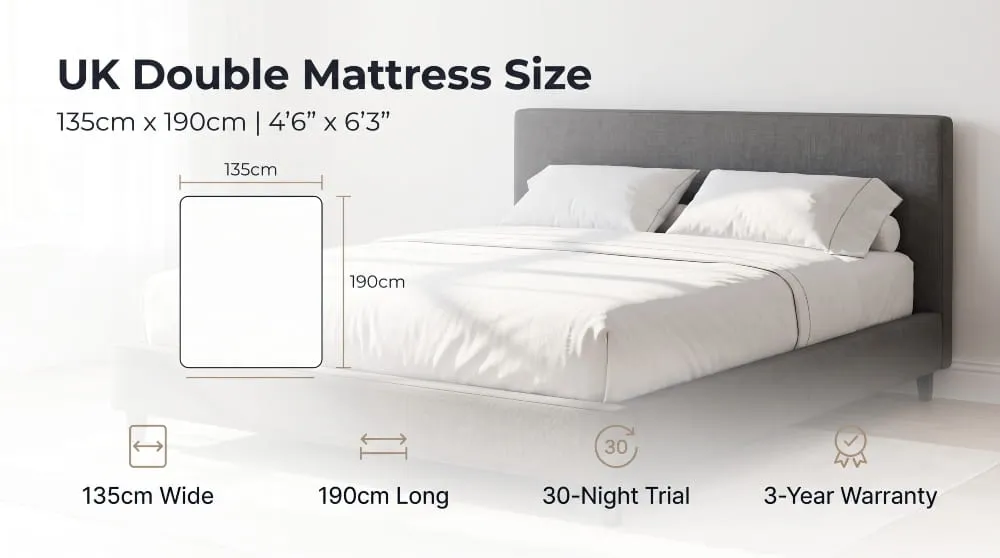
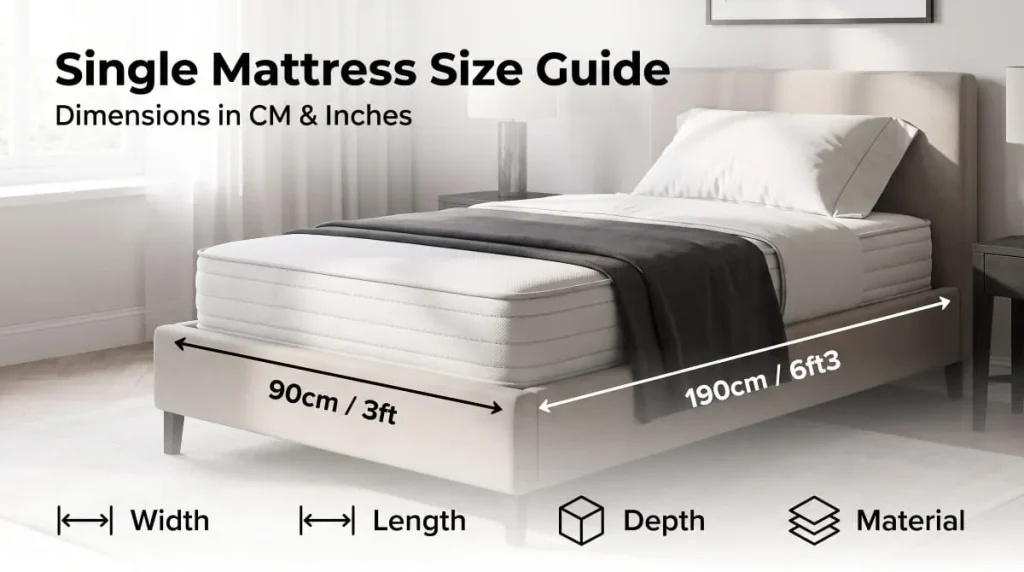
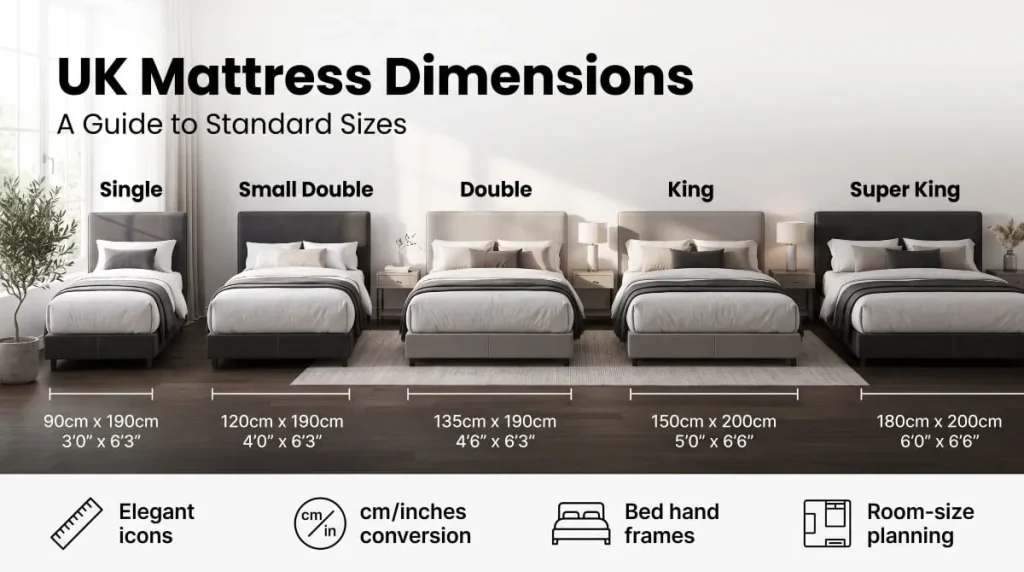
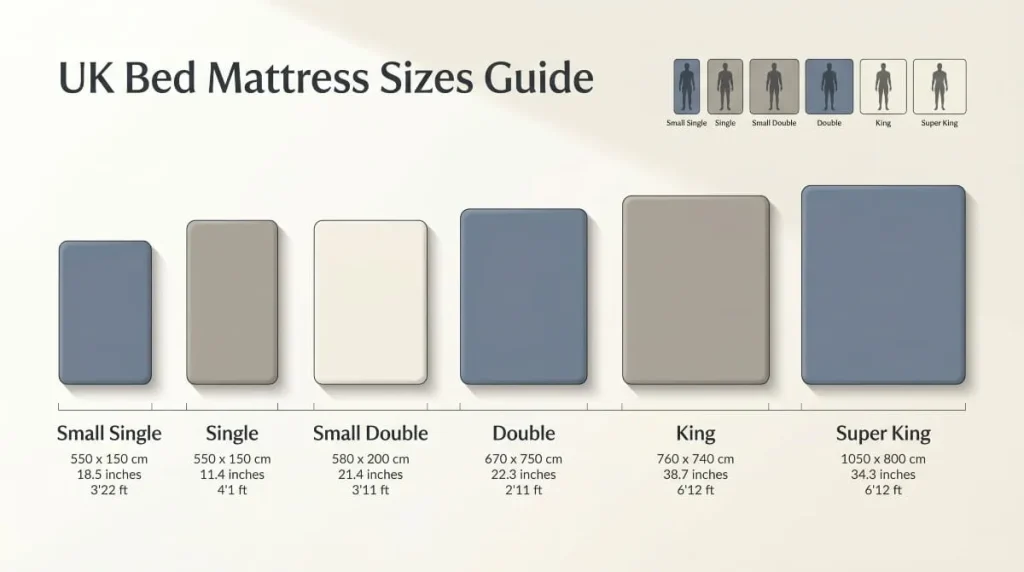
UK bed mattress sizes follow a standardised set of dimensions, from the 90 × 190 cm single up to the 180 × 200 cm super…
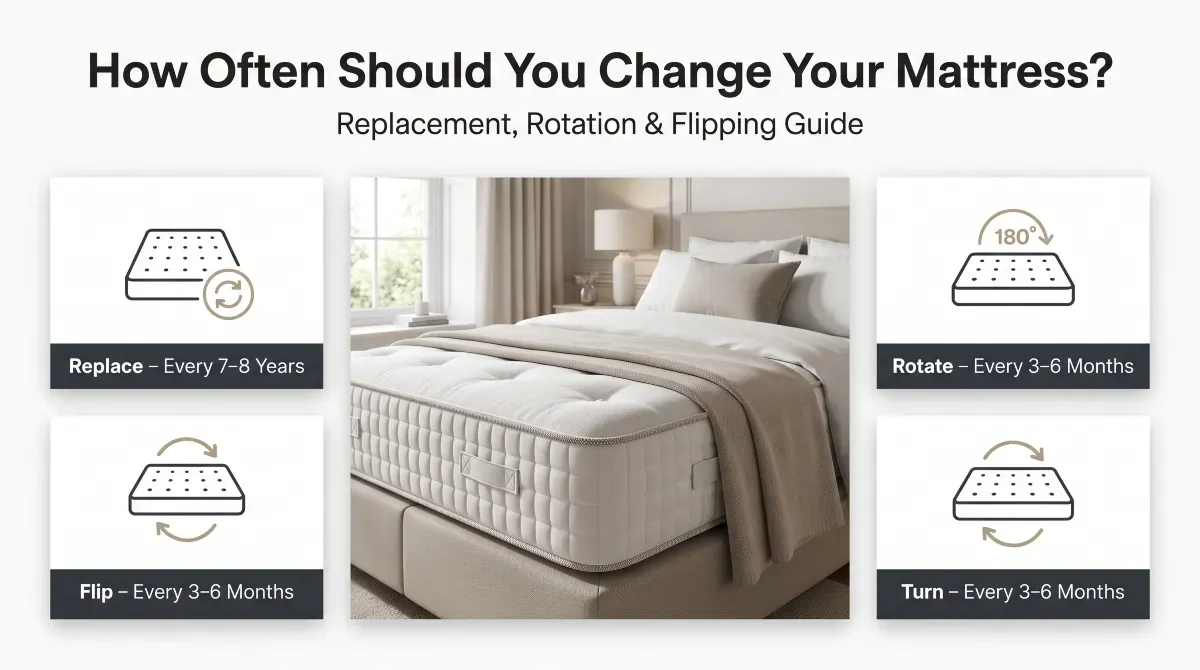
Most mattresses should be replaced every 7–8 years, though this varies depending on the mattress type, how well it’s been cared for, and how much wear it sees night after night. A pocket sprung mattress may start losing support closer to the seven-year mark, while a well-maintained memory foam mattress can sometimes last a little longer, but once a mattress passes the eight-year point, most people are sleeping on worse support than they realise.
The trouble is, “change your mattress” gets used to mean several different things: replacing it entirely, rotating it end to end, flipping it over, or simply turning it. Each does a different job. Rotating and flipping are maintenance habits that slow down wear and extend a mattress’s working life; replacing is what happens once that life is genuinely over. Knowing which one you actually need, and how often, is the difference between a mattress that supports you properly for a decade and one that quietly stops doing its job years before you notice.
According to the Sleep Council, one in four people in the UK are sleeping on a mattress that’s over seven years old, well past the point most manufacturers recommend replacement, which helps explain why so many people wake up with unexplained back pain or stiffness they’ve simply learned to live with.
This guide covers exactly how often to replace, rotate, flip and turn your mattress, the signs your current one is past its best, and a simple maintenance schedule to help you get the most out of whichever mattress you own.
As a general rule, you should replace your mattress every 7–8 years. This isn’t an arbitrary number; it’s roughly how long most quality mattresses take to lose the support and comfort they had when new, even if they still look fine on the surface.
The 7–8-year guideline exists because mattress materials, springs, foams, and fillings gradually compress and break down with nightly use, long before any visible damage appears. A mattress doesn’t fail all at once; it loses maybe 5–10% of its original support each year, so by year seven or eight, you’re often sleeping on a noticeably softer, less supportive surface than the one you bought, without ever having noticed the change happening. The National Bed Federation recommends replacing a mattress every seven years for exactly this reason; sleep quality and spinal support decline well before a mattress becomes visibly worn out.
How long your mattress actually lasts depends on more than just its age. Body weight and sleeping position affect how quickly materials compress, with heavier weights and side-sleeping typically accelerating wear in specific pressure zones. Daily use also matters; a mattress slept on every night by two adults wears faster than one in an occasional guest room. Mattress protectors extend lifespan by shielding against moisture, dust, and general wear and tear. At the same time, a poor-quality or unsupportive base can cause a mattress to sag prematurely, regardless of how good the mattress itself is. Regular rotation and flipping (covered later in this guide) also play a significant role in how evenly, and how slowly, a mattress wears.
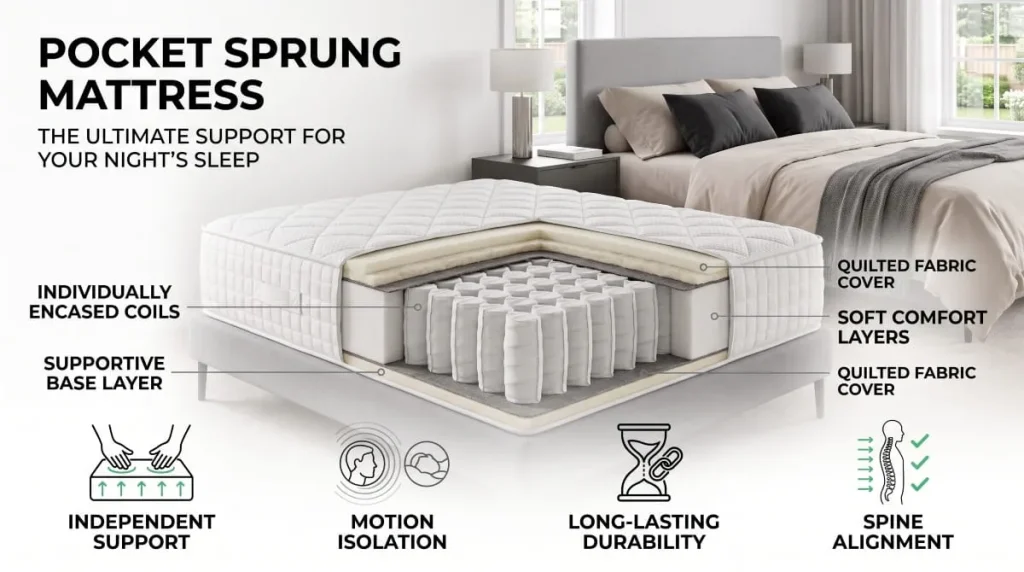
Different mattress types wear out at different rates, so the 7–8-year rule shifts slightly depending on what’s inside yours. Pocket sprung mattresses typically last 7–8 years, as individual springs gradually lose tension with sustained use. Memory foam mattresses often perform well for 8–10 years, since high-density foam is naturally slower to break down than springs, provided it’s genuine, quality foam rather than a thin comfort layer. Standard foam mattresses tend to have a shorter lifespan of around 6–8 years, particularly lower-density options. Open coil (or “bonnell spring”) mattresses, the most basic and affordable spring construction, generally need replacing sooner, around 6–7 years, as the interconnected coil system wears less evenly than pocket springs. If you’re unsure which type you’re sleeping on, checking the product listing or original receipt is the quickest way to know which timeline applies to you.
Age is only part of the picture; your body and your mattress usually give clear physical signs long before the 7–8-year mark, or sometimes even before it. Knowing what to look for means you don’t have to rely on guesswork.
A permanent dip or indentation where you normally sleep is one of the clearest signs a mattress needs replacing. Once a mattress develops a visible body impression, usually more than an inch deep, the internal materials have compressed beyond the point of recovery, and no amount of rotating or flipping will restore proper support. This is especially common along the edges and in the centre third of the mattress, where body weight concentrates most heavily night after night.
If you’re waking up with lower back pain, stiff shoulders, or general soreness that eases once you’re up and moving, your mattress is a likely cause. A mattress that’s lost its support forces your spine out of its natural alignment throughout the night, particularly around the hips and shoulders, where pressure builds up most. This kind of ache is different from an old injury or muscular strain; it tends to appear consistently every morning and improve as the day goes on, which is a strong indicator the mattress itself is the problem rather than anything else.
Noticing that you sleep more comfortably in a hotel, on holiday, or at a friend’s house is a subtle but reliable sign your own mattress has declined. It’s easy to dismiss this as unfamiliarity or a change in routine. Still, consistently better sleep on an unfamiliar mattress usually points to your own mattress no longer providing the support and comfort it once did; you’ve simply adjusted to the discomfort gradually enough that you don’t notice it day to day.
Worsening allergies, congestion, or skin irritation that improves when you’re away from your bedroom can indicate a buildup of dust mites, skin cells, and other allergens inside an older mattress. The average mattress can double in weight over ten years from accumulated dust mites and debris, and this buildup happens regardless of how often it’s vacuumed or protected, simply because it occurs within the mattress fillings themselves. A mattress protector helps slow this process, but it doesn’t stop it; visible discolouration, a persistent odour, or an increase in allergy symptoms are all signs the mattress itself has reached the end of its useful, hygienic life.
Creaking, squeaking or popping sounds when you move are usually a sign that springs have loosened or begun to fail structurally. This is most common in pocket-sprung and open-coil mattresses, where individual coils lose tension unevenly over time. Alongside the noise, you may also notice the mattress feels less responsive, springing back more slowly, or not at all, when you shift position, which signals the support layer is breaking down even if no visible sagging has appeared yet.
Rotating, flipping, and turning are three different maintenance actions often used interchangeably, but each affects your mattress differently. Understanding the difference matters because using the wrong technique on the wrong mattress can do more harm than good.
Rotating a mattress means turning it 180 degrees so the head end becomes the foot end, while the top surface stays facing up. This redistributes the wear caused by consistent pressure points, where your hips, shoulders and feet press down night after night, so no single area of the mattress bears the load indefinitely. Rotation is suitable for virtually every mattress type on the market today, including one-sided designs, which makes it the most universally recommended maintenance habit for extending mattress lifespan.
Flipping a mattress means turning it completely over so the underside becomes the new sleeping surface. This only works on mattresses genuinely designed to be slept on from both sides, with identical comfort and support layers built into each face. Flipping evens out wear across the entire mattress structure rather than just repositioning it, which is why traditional two-sided mattresses were historically flipped far more often than modern ones.
“Turning” is often used as a general term covering both rotation and flipping, which is part of why the terminology is confusing. In UK usage specifically, turning most commonly refers to rotating the mattress end-to-end rather than flipping it over entirely. If a manufacturer’s care guide simply says “turn regularly” without further detail, it’s worth checking whether your mattress is one-sided or two-sided before assuming which action they mean.
No, most modern mattresses are one-sided and were never designed to be flipped. Memory foam, hybrid, and many pocket-sprung mattresses now have a single comfort layer bonded to a non-sleep base, meaning the underside offers no cushioning, and flipping it would mean sleeping directly on a firm, unfinished surface. Two-sided mattresses, once the standard, are now a minority in the UK market, largely replaced by layered constructions that concentrate comfort materials on one face only. Checking the manufacturer’s label or care instructions is the most reliable way to confirm which category your mattress falls into before attempting to flip it.
You should rotate your mattress every 3–6 months as a general rule, though some mattress types benefit from more frequent rotation. This simple habit is one of the most effective ways to extend a mattress’s working life between full replacements.
Rotating a mattress every three to six months helps prevent uneven wear by regularly shifting which section absorbs the most body weight. A useful way to stay consistent is to tie rotation to a seasonal change, spring and autumn, for example, so it becomes a habit rather than something easily forgotten. Skipping rotation entirely doesn’t cause immediate problems. Still, over several years, it leads to noticeably faster sagging in the areas used most, shortening the mattress’s overall lifespan well before the expected 7–8-year replacement point.
Rotating a mattress correctly is straightforward and takes only a few minutes. Start by stripping the bedding fully so the mattress is easier to handle. With a second person if possible, lift the mattress from one end and turn it 180 degrees so the foot end becomes the head end, keeping the same side facing up throughout. Once repositioned, check that it sits evenly on the base or slats before remaking the bed. Doing this on a fixed schedule, rather than only when you remember, is what makes the habit actually effective.
Rotation frequency varies slightly depending on what’s inside the mattress. Pocket sprung mattresses benefit from rotation every 3 months, since individual springs compress unevenly under sustained pressure. Memory foam mattresses can generally be rotated every 3–6 months, as the foam is slower to develop permanent impressions than springs. Standard foam mattresses should also be rotated every 3 months, particularly lower-density foams that compress more readily. Open coil mattresses benefit from more frequent rotation, around every 2–3 months, due to their less even weight distribution compared with pocket sprung designs. Checking your mattress care label is the most reliable way to confirm the manufacturer’s specific recommendation for your model.
You should only flip your mattress if it’s specifically designed to be slept on from both sides, and even then, every 3–6 months is generally recommended. For most modern mattresses, flipping isn’t applicable, and attempting it can actually cause more harm than good.
Flipping only applies to genuinely two-sided mattresses, where identical comfort and support layers are built into both the top and bottom faces. Traditional mattresses, particularly older sprung designs, were commonly built this way, allowing the sleep surface to be alternated to even out wear across the full structure. Most mattresses manufactured in the last decade or so aren’t built to this standard, so before assuming your mattress can be flipped, it’s worth checking the manufacturer’s care label or original product listing to confirm.
For genuinely two-sided mattresses, flipping every 3–6 months, often alongside rotation, helps distribute wear evenly across both sleep surfaces rather than concentrating it on one side. A practical approach is to alternate rotating and flipping at each seasonal changeover, so the mattress is never left facing the same direction and side for more than a few months at a time. This combined habit is one of the most effective ways to extend the working life of a traditional double-sided mattress toward the upper end of its expected lifespan.
Most mattresses sold today are built with a single comfort layer, memory foam, pocket springs, or layered foam, bonded permanently to a firmer base layer that was never intended to be slept on. Flipping one of these mattresses doesn’t rotate the wear at all; it simply exposes an unfinished, unsupportive surface with none of the cushioning of the top layer, which can actively cause discomfort and poor spinal support rather than preventing it. If you’re unsure whether your mattress falls into this category, checking the manufacturer’s guidance is essential; flipping the wrong type of mattress is a common and easily avoidable mistake.
You should turn your mattress every 3–6 months, in line with the rotation schedule. In UK usage, “turning” and “rotating” almost always refer to the same action, so the guidance for one applies directly to the other.
In practice, yes, “turning” a mattress in UK terminology typically means the same as rotating it: shifting it 180 degrees so the head end becomes the foot end, while the sleep surface stays facing up. This is different from flipping, which involves turning the mattress over entirely to sleep on the opposite face. The terms are used interchangeably in everyday conversation and even on some care labels, which is why it’s worth checking a manufacturer’s specific instructions if there’s any doubt about which action they mean, particularly since flipping a one-sided mattress by mistake can cause genuine discomfort.
Turning your mattress every 3–6 months helps prevent uneven compression that builds up from sleeping in the same position on the same section of the mattress night after night. Setting a reminder or tying it to a seasonal date, like the clocks changing, makes it easier to stay consistent, since this is a habit that’s easy to forget once a mattress is a few years old and feels “settled in.” Kept up over the years, regular turning is one of the simplest ways to help a mattress reach its full expected lifespan rather than needing early replacement.
Neglecting mattress maintenance doesn’t cause sudden damage; it causes a slow, largely invisible decline in support that leaves you sleeping on a worse mattress for years before it becomes obvious. The effects compound over time, and by the point they’re noticeable, much of the damage is already permanent.
Without regular rotation, the same section of the mattress absorbs your body weight every single night, causing that area to compress far faster than the rest. Over time, this uneven pressure leads to a permanent dip or body impression that the mattress can no longer recover from, even if rotation is started later. Once this stage is reached, the only real fix is replacement; no amount of rotating or flipping will restore support that’s already been lost through years of concentrated wear.
A mattress that’s sagged or worn unevenly can no longer hold the spine in proper alignment through the night, particularly around the hips and shoulders, where pressure is highest. This tends to show up as lower back pain, stiffness, or discomfort that’s worse first thing in the morning and eases as the day goes on. Left unaddressed, this isn’t just a comfort issue; sustained poor spinal alignment during sleep is a recognised contributor to chronic back and neck problems over time.
A mattress that’s never rotated, flipped, or otherwise maintained typically needs replacing years earlier than one that has been properly cared for, sometimes as much as 2–3 years sooner than its expected 7–8 year lifespan. Combined with skipping a mattress protector or a supportive base, the effect compounds, leading to years of reduced sleep quality followed by an earlier-than-necessary replacement cost. Simple, consistent maintenance is by far the most cost-effective way to get full value from a mattress before it genuinely needs replacing.
Keeping a mattress in good condition comes down to a few consistent habits, rather than anything complicated. Spacing these tasks across the year makes them easy to stick to and easy to forget least often.
A handful of simple tasks, done on a regular rhythm, cover almost everything a mattress needs to reach its full expected lifespan. Monthly, it’s worth airing the mattress by stripping the bedding and letting it breathe for a few hours, and vacuuming the surface to remove dust and skin cells before they build up in the fillings. Quarterly, roughly every three months, the mattress should be rotated (and flipped too, if it’s a genuine two-sided design), and this is also a good point to check the mattress protector for wear or staining. Annually, it’s worth inspecting the mattress more closely for early signs of sagging, indentations, or spring noise, and reviewing whether the base or slats are still providing even support. None of these tasks takes more than a few minutes, but done consistently, they’re what separates a mattress that lasts the full 7–8 years from one that needs replacing early.
A simple way to stay on top of mattress care is to treat it like any other seasonal home task, tied to an easy-to-remember date, such as the clocks changing in spring and autumn. A basic schedule might look like: rotate and check the protector every March and September, vacuum and air the mattress on the first of each month, and carry out a full condition check every January. Writing this into a phone reminder or calendar takes a minute and removes the guesswork of trying to recall when the mattress was last turned, which, for most people, is the single biggest reason mattress maintenance gets skipped altogether.
The short answer to how often you should change your mattress is this: replace it every 7–8 years, but rotate or turn it every 3–6 months in between to help it get there in good condition. These aren’t competing pieces of advice; they work together, with regular maintenance extending the life of your mattress and replacement being the eventual, non-negotiable step once that life runs out.
Getting this right doesn’t require overhauling your routine. It simply means treating rotation as a seasonal habit rather than an afterthought, watching for the physical warning signs- sagging, noise, morning aches, worsening allergies- rather than relying on age alone, and accepting that once a mattress is genuinely past its best, no amount of turning or flipping will bring the support back. Mattresses don’t fail suddenly; they fade gradually enough that most people adjust to reduced comfort without noticing, which is exactly why a fixed schedule matters more than instinct.
The distinction usually comes down to whether the wear is reversible. If your mattress feels slightly uneven or worn on one side but hasn’t permanently sagged, rotating it can often correct the issue by redistributing pressure to a fresher section. However, if there’s a visible dip, body impression, or noticeable loss of support that doesn’t disappear when you press on it, rotation won’t fix it; that’s a sign the materials have compressed beyond recovery and replacement is the only real solution. As a general guide, if the mattress is under 5 years old and the issue is minor, try rotating it first; if it’s approaching or past the 7-year mark and there’s clear sagging, it’s time to replace.
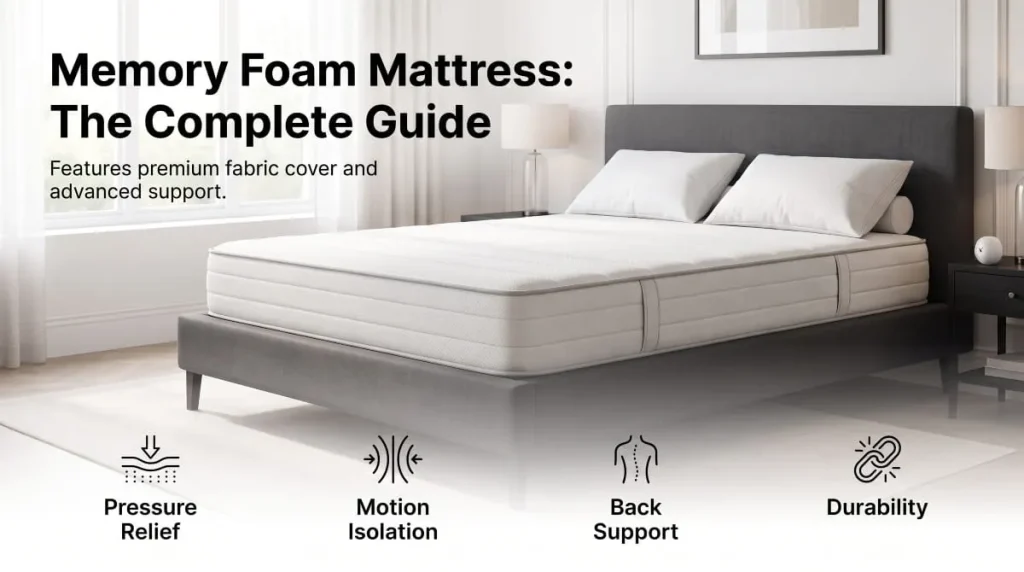
Yes, memory foam mattresses benefit from rotation every 3–6 months, even though foam compresses more slowly and evenly than springs. Rotating helps prevent the gradual formation of a body-shaped impression in one fixed spot, which is the most common way memory foam mattresses lose support over time. Memory foam should never be flipped, however, since it’s almost always a single comfort layer bonded to a firmer, non-sleep base; rotation is the only maintenance action that applies.
If a mattress already has permanent sagging or a deep body impression, rotating it at this stage won’t restore lost support, since the compression has already set into the material. That said, rotating an older mattress can still slightly slow further decline and is worth doing if you’re not ready to replace it immediately. The real value of rotation is preventive; it’s most effective when started early and maintained consistently, rather than introduced only after damage has already occurred.
Most people should buy a new mattress roughly every 7–8 years, though this can shift slightly depending on mattress type, body weight, and how well it’s been maintained through rotation and use of a protector. Some people stretch this to a decade with a well-cared-for, higher-quality mattress, while others may need to replace it sooner if the mattress has been used heavily or hasn’t been rotated regularly. Rather than fixing on a single number, it’s more reliable to combine the 7–8 year guideline with the physical warning signs, sagging, noise, or morning discomfort, covered earlier in this guide.
Yes, the type of mattress has a real impact on replacement timing. Pocket sprung mattresses typically last 7–8 years as individual springs lose tension, memory foam often performs well for 8–10 years due to slower material breakdown, standard foam mattresses tend to need replacing sooner at 6–8 years, and open coil mattresses usually have the shortest lifespan at 6–7 years because of less even wear distribution. Checking which type you own, via the product listing or care label, gives a more accurate replacement timeline than relying on a single blanket figure for every mattress.