

UK Bed Mattress Sizes Guide (All Sizes in cm, Inches & Feet)
UK bed mattress sizes follow a standardised set of dimensions, from the 90 × 190 cm single up to the 180 × 200 cm super…
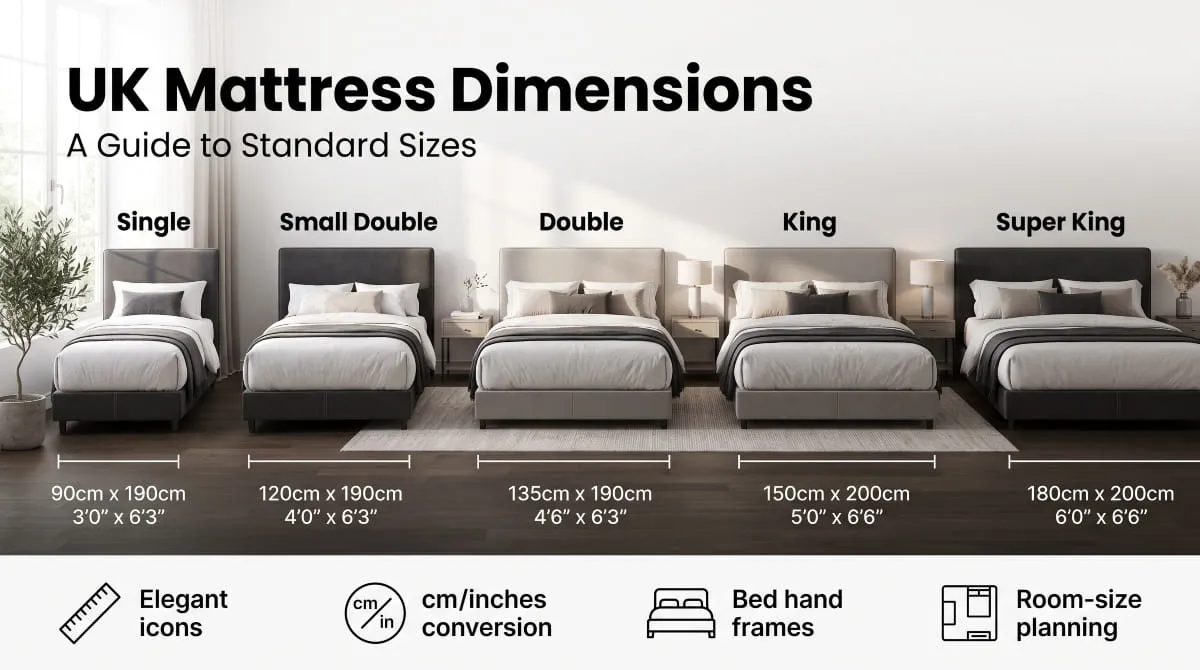
UK mattress dimensions span five standard sizes, from a 90cm-wide Single to an 180cm-wide Super King, with every size sharing a fixed 190cm length except King and Super King, which extend to 200cm. That’s the short answer, but which size fits your room, your bed frame, and your budget depends on a few details worth getting right before you buy.
Getting mattress sizing wrong is one of the most common, and most expensive, mistakes UK shoppers make. A mattress that’s even 5cm out from your bed frame’s dimensions won’t sit properly, will wear unevenly at the edges, and often can’t be returned once it’s been slept on. This guide gives you every UK mattress dimension in cm, inches, and feet, shows how they compare to US sizing, and explains exactly how to measure so you order the right size the first time.
Whether you’re replacing a mattress, sizing up for a new bed frame, or checking whether a mattress will actually fit your room, the chart and comparisons below cover every standard and non-standard UK size in one place.
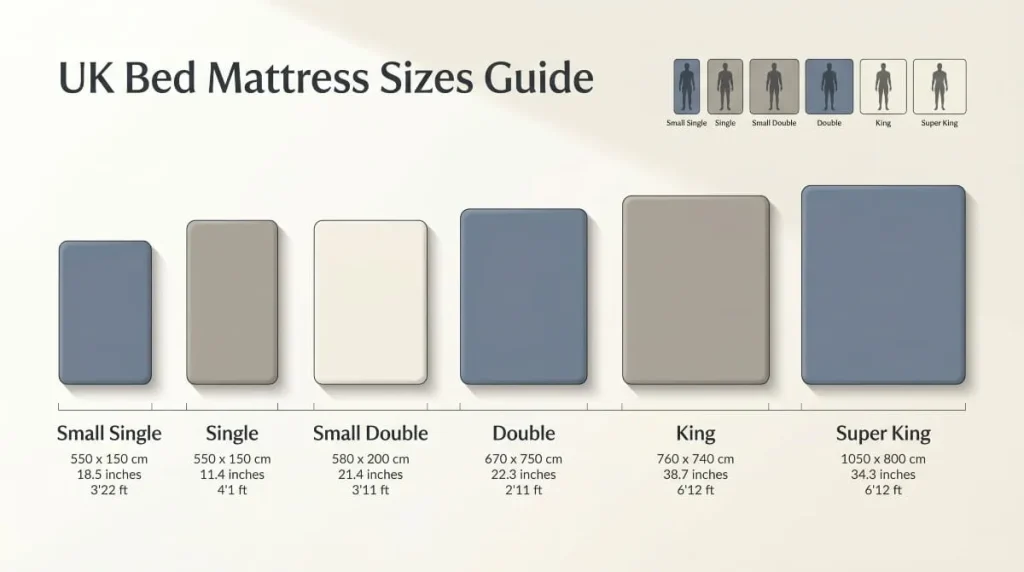
UK mattresses come in five standard sizes: Single, Small Double, Double, King, and Super King, each with fixed dimensions that correspond directly to standard UK bed frame sizes. Below is the complete size chart in centimeters, inches, and feet, followed by a closer look at each size and who it typically suits.
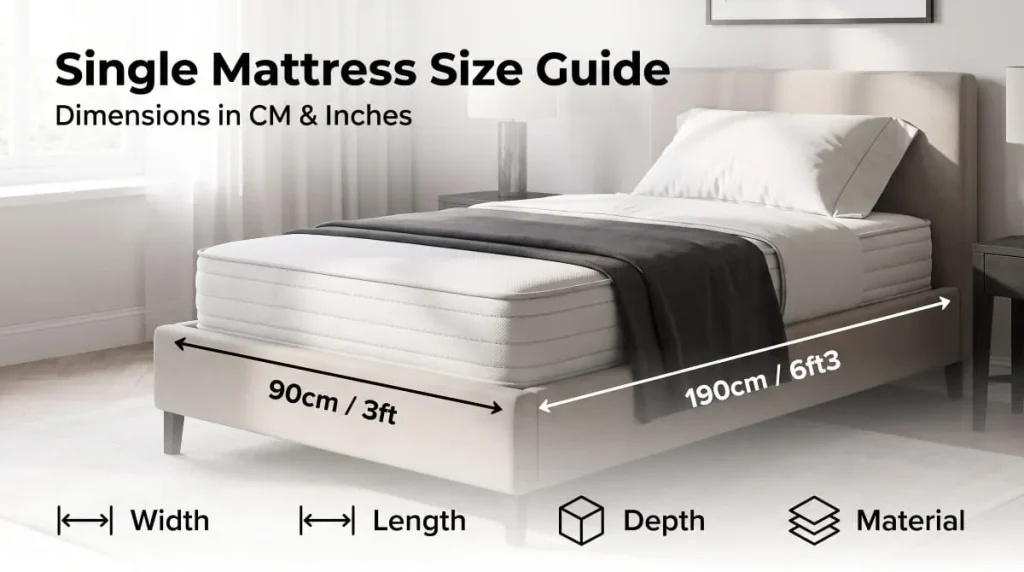
A Single mattress measures 90cm x 190cm, or roughly 3ft x 6 ft 3 in, making it the standard choice for children’s rooms, guest rooms, and single-occupancy adult bedrooms. In inches, that’s approximately 35.4″ x 74.8″. It’s the narrowest of the standard UK sizes, and the benchmark against which every other mattress size is measured; most UK box rooms and children’s bedrooms are designed around this footprint. If you’re furnishing a smaller room or a first bed for a child transitioning from a cot, Single is almost always the starting point.
A Small Double mattress measures 120cm x 190cm (roughly 4ft x 6ft3, or 47.2″ x 74.8″), sitting between Single and Double in width. It’s a popular choice for single sleepers who want extra shoulder room, or for smaller guest rooms that can’t quite accommodate a full Double. In the UK, Small Double is a genuinely standard size, unlike in some markets where it’s a niche variant, so bed frames and mattresses in this size are widely available rather than a compromise. Anyone furnishing a room with roughly 10-15cm less width than a full Double bedroom needs will find this the more practical fit.
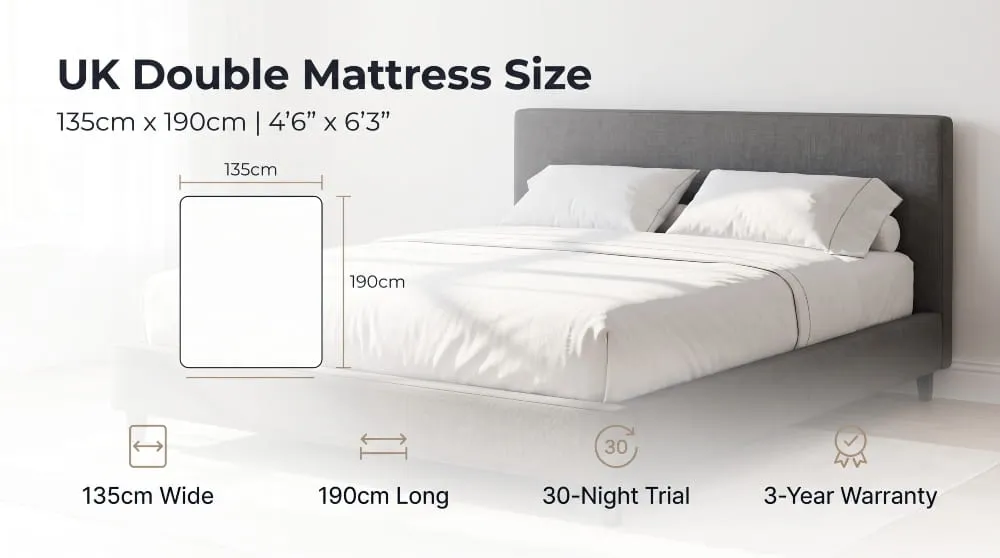
A Double mattress measures 135cm x 190cm, or approximately 4ft6 x 6ft3 (53.1″ x 74.8″), and remains the most commonly bought mattress size in the UK. It comfortably sleeps two adults, though with less per-person width than a King, which is why couples upgrading from a Double often cite space as the primary driver. Double is the natural midpoint size: wide enough for shared use, yet compact enough to suit standard UK bedroom dimensions and most stairwells and doorways without special delivery considerations.
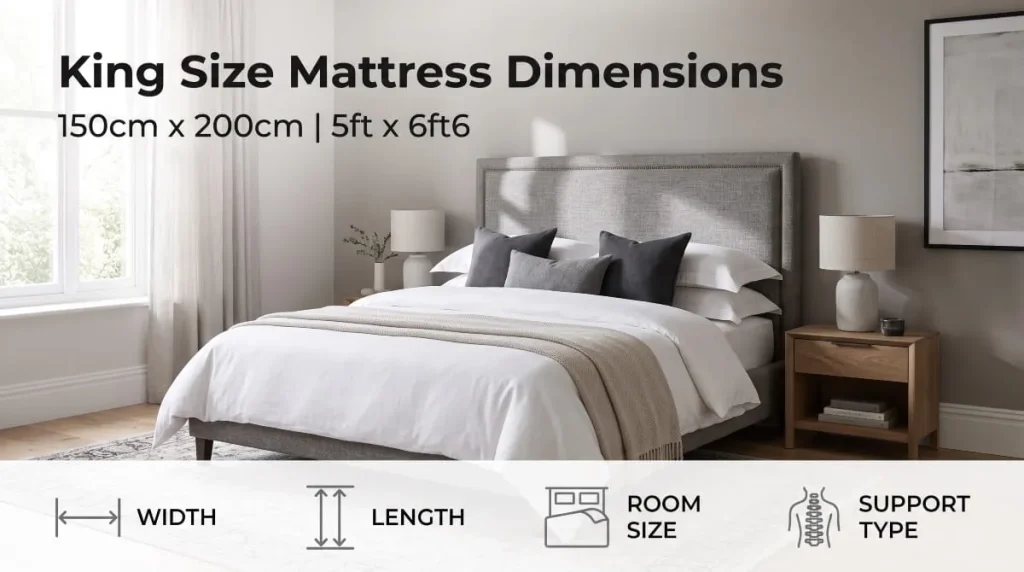
A King mattress measures 150cm x 200cm, or 5ft x 6ft6 (59.1″ x 78.7″), notably longer and wider than a Double, which makes it a common choice for taller sleepers as well as couples wanting more shared space. The extra 10cm of length compared to Double and Small Double sizes is often the deciding factor for anyone over approximately 6ft tall. King is the size where bedroom dimensions start to matter more: most guidance recommends a minimum room width of around 3.4m to comfortably fit a King bed frame with clearance on both sides.
A Super King mattress measures 180cm x 200cm, or 6ft x 6ft6 (70.9″ x 78.7″), making it the largest standard UK mattress size. It gives each person in a shared bed roughly 90cm of width, the same as a full Single mattress each, which is why it’s often recommended for couples who feel cramped even in a King. Super King has also become the go-to for statement headboards and premium bedroom setups, though it requires a genuinely spacious room to avoid overwhelming the space; most sources recommend at least 3.6m of room width as a comfortable minimum.
Standard mattress dimensions in the UK refer to the five fixed sizes, Single, Small Double, Double, King, and Super King, that match widely available bed frames, bedding, and mattress protectors. Anything outside these measurements is considered non-standard, and while it can solve a specific space or fit problem, it usually means a smaller pool of ready-made options.
A standard mattress is one manufactured to a fixed, industry-wide size so it fits standard bed frames, sheets, and mattress protectors without custom ordering. In the UK, that means widths of 90cm, 120cm, 135cm, 150cm, or 180cm, paired with either 190cm or 200cm in length. This standardization exists because bedding manufacturers, bed frame makers, and mattress producers all build to the same reference chart. Buy a Double mattress from any UK retailer, and it will fit any Double bed frame and any Double-fitted sheet, regardless of brand. That interoperability is precisely what non-standard sizes give up.
A 3/4, or “three quarter,” mattress typically measures around 107cm-120cm wide by 190cm long, sitting between a Single and a Small Double. Unlike the five standard UK sizes, there’s no single fixed measurement so that dimensions can vary noticeably between manufacturers. It’s a legacy size, more common in older bed frames and vintage furniture than in current retail ranges, which means sourcing a matching mattress or fitted sheet often means checking exact measurements rather than buying by name alone. Anyone with an inherited or antique 3/4-bed frame should measure the frame directly before ordering, since “3/4” alone isn’t a reliable enough spec to guarantee a fit.
A shorty mattress keeps the standard UK width. Still, it reduces the length to around 180cm instead of the usual 190cm or 200cm, and is built specifically for box rooms, caravans, and loft conversions where ceiling height or room depth won’t accommodate a full-length mattress. It’s most commonly found in the Single shorty format (90cm x 180cm), though wider shorty versions exist for the same space-saving reason. The 10-20 cm length reduction sounds small. Still, it’s often the difference between a bed fitting under a sloped loft ceiling or a stair box and not fitting at all, which is why shorty sizing tends to be a deliberate space-planning choice rather than a budget one.
Converting mattress dimensions between cm, inches, and feet is a simple matter of applying a fixed conversion rate: 1 cm equals 0.3937 inches, or roughly 2.54cm to the inch, but knowing the converted figures for each standard UK size saves you doing the maths every time you compare a mattress against a bed frame, a doorway, or a delivery van. Below are both conversion charts, along with an explanation of why mattress thickness doesn’t follow the same standardization as length and width.
Converting UK mattress widths from cm to inches follows a fixed 0.3937 multiplier, so a 90cm Single becomes 35.4″, a 120cm Small Double becomes 47.2″, a 135cm Double becomes 53.1″, a 150cm King becomes 59.1″, and a 180cm Super King becomes 70.9″. Length converts the same way: 190cm becomes 74.8″ for Single, Small Double, and Double, while the 200cm length used for King and Super King becomes 78.7″. These figures matter most when checking a mattress against furniture or fittings specified in imperial measurements; older UK homes, in particular, often have door frames, stairwells, and built-in alcoves measured in inches rather than cm, so having both figures to hand avoids a mismatch discovered too late.
For a quicker, rounder reference, UK mattress sizes are also commonly described in feet: Single is 3ft wide, Small Double is 4ft, Double is 4ft6, King is 5ft, and Super King is 6ft, with length given as 6ft3 for Single, Small Double, and Double, and 6ft6 for King and Super King. This feet-and-inches shorthand is how most UK bed frame retailers label their sizing, which is why “4ft6 Double” and “135cm Double” refer to the same mattress. Knowing both the cm figure and the feet shorthand means you can cross-check a listing regardless of which unit a retailer uses.
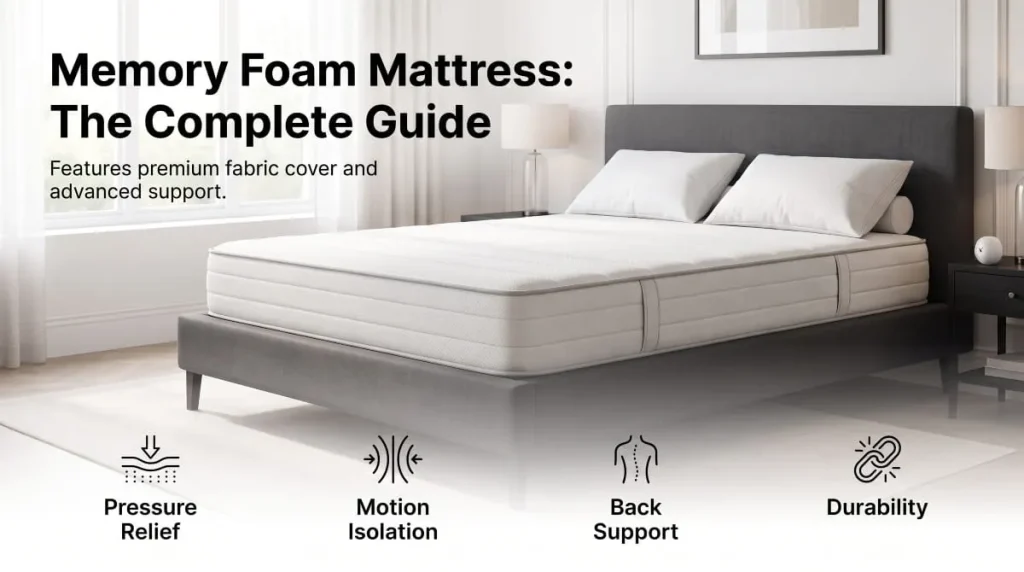
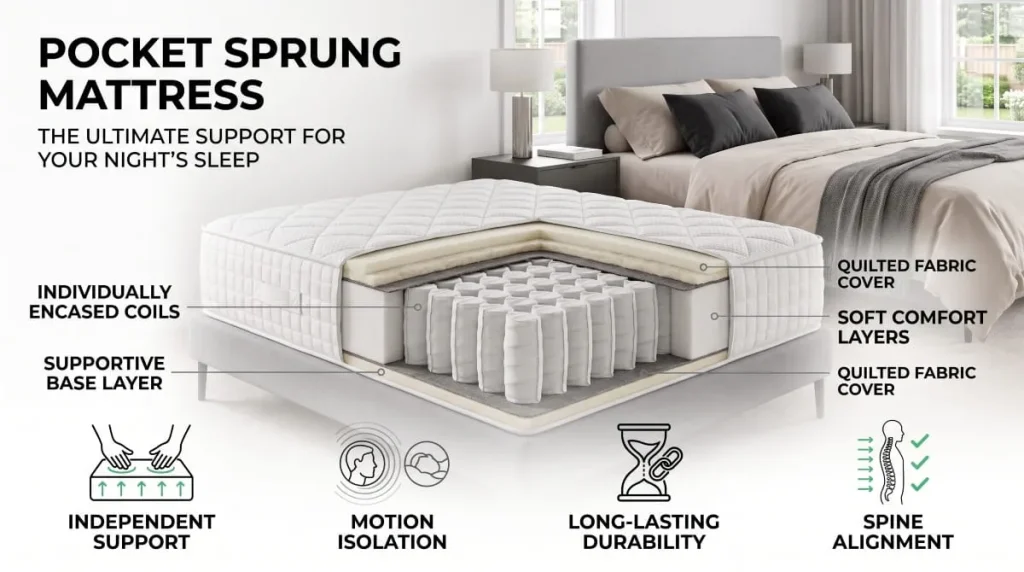
Unlike width and length, mattress thickness has no fixed UK standard; depths typically range from around 15cm for a basic foam mattress to 30cm or more for a premium pocket sprung or hybrid model, and that variation comes down to construction rather than sizing convention. A thicker mattress generally means more layers: additional pocket springs, deeper comfort foam, or added support layers, all of which add depth without changing the mattress’s width or length footprint. This is worth checking against your bed frame before buying, since a deeper mattress can sit noticeably proud of a low-profile frame or divan base, and some fitted sheets are cut for a maximum depth, usually around 30-32 cm, which a very thick mattress can exceed.
UK and US mattress sizes share similar names but rarely match in actual dimensions; a UK Double is smaller than a US Full, and a UK King is smaller than a US Queen, let alone a US King. Anyone buying bedding, importing furniture, or comparing measurements across the two markets needs to check the cm figures directly rather than relying on the size name alone.
A UK Double (135cm x 190cm) is close to but smaller than a US Full/Double (137cm x 191cm) in length and width, and considerably narrower than a US Queen (152cm x 203cm), which is roughly the same width as a UK King. This naming overlap is one of the most common sources of confusion for anyone shopping across both markets: a “Double” in the UK and a “Full” in the US are near-equivalents, but a US “Queen”, despite sounding like a mid-tier size, is actually closer to UK King dimensions. Fitted sheets and mattress protectors bought in one country will rarely fit a mattress bought in the other, even when the size names sound comparable.
A US Full size mattress measures 137cm x 191cm, just 2cm wider and 1cm longer than a UK Double at 135cm x 190cm, close enough that the two are often treated as interchangeable, though not identical. For most practical purposes, this 2cm difference won’t affect room planning or bed frame fit. Still, it does matter for bedding: a US Full fitted sheet will typically stretch to fit a UK Double, but the reverse fit is tighter and less reliable. Anyone furnishing a UK home with US-bought bedding, or vice versa, should treat this as a near match rather than an exact match.
UK King (150cm x 200cm) is notably narrower than US King (193cm x 203cm); in fact, a US King is 43cm wider, nearly matching the width of two UK Singles pushed together. UK Super King (180cm x 200cm) sits closer to US King territory but is still 13cm narrower. This is the size range where cross-market confusion causes the most problems: someone furnishing a UK home based on US size expectations may assume “King” means the same generous width in both countries, when in practice a UK Super King is needed to approach the width of a US King. For anyone relocating between the two markets, checking exact cm figures against the size chart above, rather than the size name, is the only reliable way to avoid ordering the wrong bed frame or mattress.
Measuring a mattress or bed frame correctly means taking length, width, and depth at the widest and longest points, using a rigid tape measure rather than a fabric one, and always measuring the existing mattress or frame directly rather than relying on its stated size name. This matters because bed frames and mattresses can vary by a centimeter or two even within the same “standard” size category, and that small margin is often enough to cause a poor fit.
To measure a mattress or bed frame accurately, measure length and width at the mattress’s widest points, corner to corner along each edge, not diagonally, and take depth as a separate, straight vertical measurement from the base to the top of the mattress at its thickest point. It’s worth measuring in centimeters even if you’re more familiar with feet and inches, since UK retailers list sizing in cm and small imperial conversion errors compound over larger measurements. For a bed frame, measure the internal frame dimensions, the space the mattress will actually sit in, rather than the frame’s external dimensions, since these can differ by several centimeters depending on frame design.
The most common measuring mistake is assuming a mattress or bed frame matches its size name exactly, when in practice manufacturing tolerances of 1- 2 cm are standard across the industry, a genuine issue when a mattress is being fitted to an existing, older frame rather than bought as a matching pair. Other frequent errors include measuring over bedding or a mattress topper rather than the bare mattress, measuring only one point along a length or width that may not be perfectly uniform, and confusing external bed frame dimensions with the internal space available for the mattress. Taking measurements at more than one point along each edge and double-checking the depth against what your fitted sheets and mattress protector are rated for are the two checks most likely to catch a mismatch before you order, rather than after.
Choosing the right mattress size for your room comes down to matching the mattress footprint to your available floor space, leaving enough clearance for doors, wardrobes, and comfortable movement around the bed. As a general rule, allow at least 60- 70 cm of clear space on each accessible side. Getting this right before buying avoids the two most common regrets: a mattress that overwhelms a small room, or one that leaves a couple feeling cramped in a room that could have fit something larger.
As a rough guide, a Single or Small Double mattress suits rooms from around 2.4m x 2.7m, a Double works comfortably in rooms from around 3m x 3m, and a King needs a minimum room width of roughly 3.4m to allow clearance on both sides. A Super King is best suited to rooms with a width of 3.6m or more. These figures account for more than just the mattress footprint; they include space for a bed frame (which typically adds several cm beyond the mattress itself), bedside tables, and enough walking room to make the space feel functional rather than tight. A useful proof point: going from Double to King adds only 15cm of width, but going from King to Super King adds a further 30cm, nearly double the jump, which is why Super King rooms need noticeably more planning than the step from Double to King suggests.
For single sleepers, a Single or Small Double typically offers the best balance of comfort and space efficiency, with Small Double giving noticeably more shoulder room without requiring a large room to accommodate it. For couples, Double is the minimum comfortable option. Still, King is generally recommended as the practical baseline; it gives each person roughly 75cm of width, close to a full Single each, without requiring the Super King’s larger room footprint. In genuinely small rooms, box rooms, converted lofts, or compact flats, a Single, Small Double, or shorty mattress usually makes more sense than compromising on clearance space around a larger bed, since a mattress that technically fits but leaves no walking room tends to make a small room feel smaller, not more furnished.
Now that you know exactly what size mattress you need, the next step is finding a bed frame built to match it precisely. Explore our full range by size: Single, Small Double, Double, King, and Super King, each handcrafted in our Dewsbury workshop to fit its corresponding mattress size exactly, with no guesswork on tolerances or fit.
Every bed frame comes with a 3-year warranty, a 30-night trial, and free UK delivery, so whichever size suits your room, you can order with confidence that it’s the right one. If it isn’t, you’re covered while you find the right fit.
Browse our full collection of bed frames and mattresses to see every size in the range, or explore our ottoman storage beds if you’re working with a smaller room and need the extra space underneath.
The UK has five standard mattress sizes: Single (90cm x 190cm), Small Double (120cm x 190cm), Double (135cm x 190cm), King (150cm x 200cm), and Super King (180cm x 200cm). These fixed measurements are shared across every major UK mattress and bed frame manufacturer, which is why a Double mattress bought from any retailer will fit any Double bed frame without custom sizing.
A Super King mattress measures 180cm x 200cm, or 6ft x 6 ft 6 in imperial terms. It’s the largest standard UK mattress size, giving two people roughly 90cm of width each, equivalent to a full Single mattress per person, which is why it’s the preferred choice for couples who find King feels cramped.
No, a UK King (150cm x 200cm) and a US Queen (152cm x 203cm) are close but not identical, with the US Queen being marginally wider and longer. The bigger point of confusion is that a US King (193cm x 203cm) is significantly larger than a UK King, so UK buyers comparing sizes across markets should check exact cm measurements rather than assuming matching size names mean matching dimensions.
The difference is 15cm of width: a Double measures 135cm wide, while a Small Double measures 120cm wide, with both sharing the same 190cm length. Small Double suits single sleepers who want extra space or for smaller rooms that can’t accommodate a full Double, while Double remains the standard choice for shared sleeping.
Mattress thickness typically ranges from around 15cm for basic foam models to 30cm or more for premium pocket sprung or hybrid mattresses, with no single UK standard depth. The right thickness depends on construction and support layers rather than bed size. Still, it’s worth checking against your bed frame profile and fitted sheet depth; most fitted sheets are cut for a maximum of around 30-32 cm before choosing a notably deep mattress.