 )
 &description=&image=https://stylebeds.co.uk/wp-content/uploads/2026/08/Pocket-Sprung-Mattress--1024x572.webp)
UK Bed Mattress Sizes Guide (All Sizes in cm, Inches & Feet)
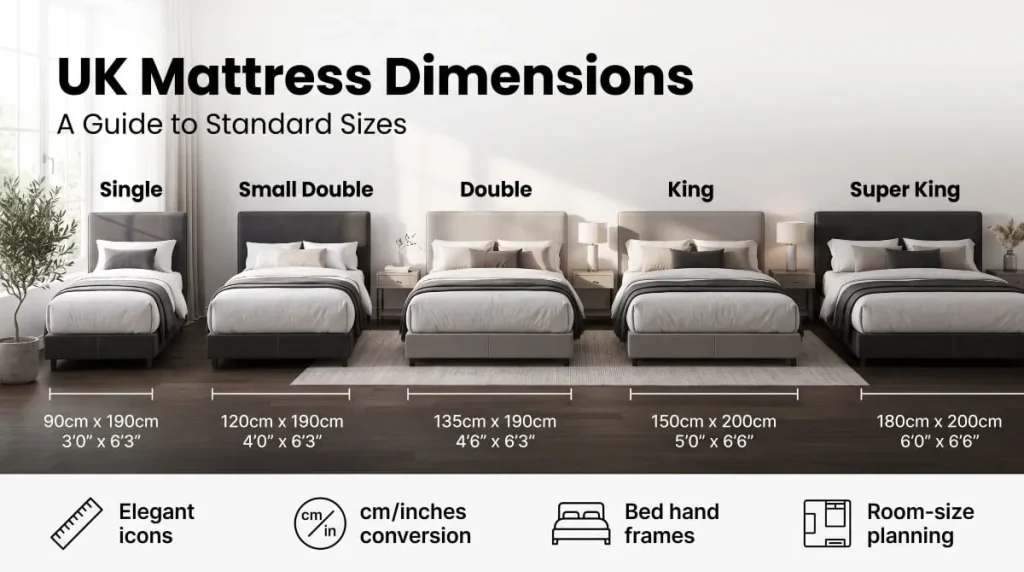
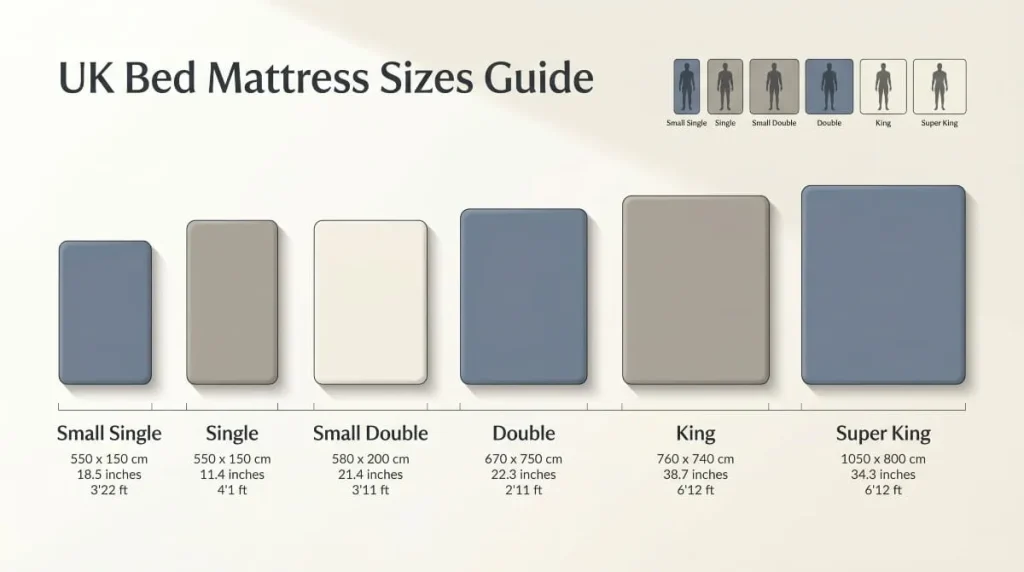
UK bed mattress sizes follow a standardised set of dimensions, from the 90 × 190 cm single up to the 180 × 200 cm super…
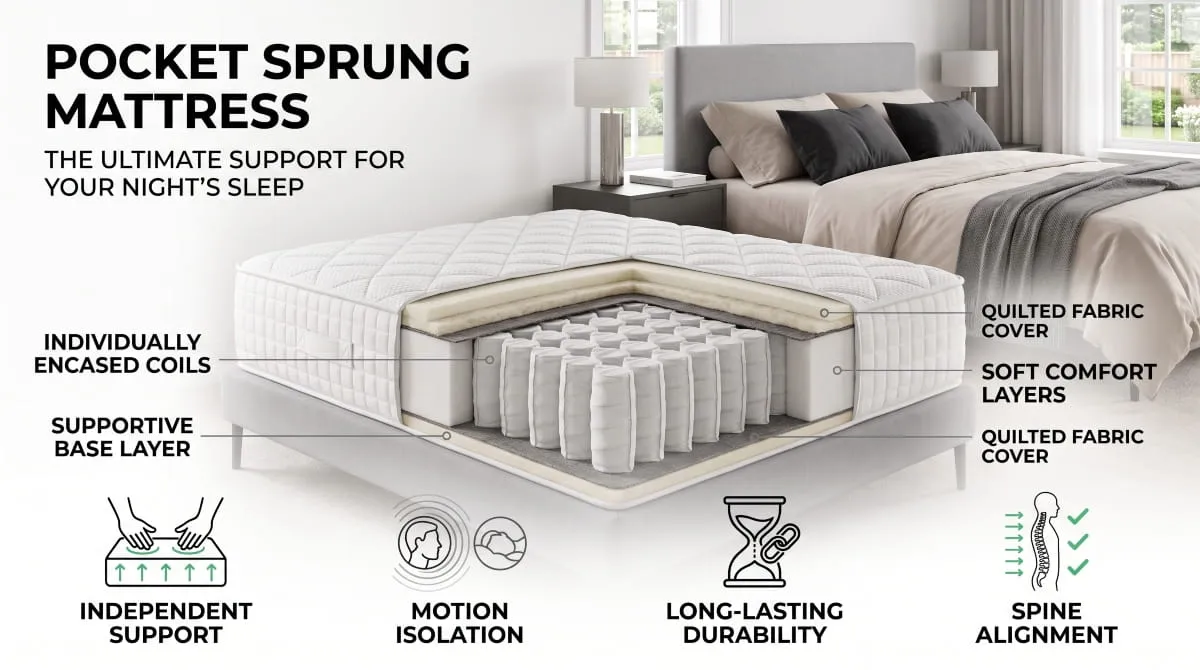
A pocket-sprung mattress is a mattress built with hundreds or thousands of individual springs, each stitched into its own fabric pocket rather than wired together as a single unit. Because every spring moves independently, the mattress responds to your body’s exact shape and weight distribution, point by point, rather than flexing as a single sheet of support.
This is the defining difference between pocket-sprung and older open-coil designs, and it’s why pocket-sprung mattresses have become the standard choice for UK shoppers who want a balance of comfort, support, and durability without paying for a fully specialist material like memory foam or latex. A quality pocket sprung mattress typically contains anywhere from 800 to over 4,000 springs, and that spring count plays a direct role in how firm, responsive, and long-lasting the mattress feels, something we’ll break down in detail below.
At Style Beds, every pocket sprung mattress is handcrafted in our Dewsbury, West Yorkshire workshop and backed by a 30-night trial, a 3-year warranty, and free UK delivery, so you can test the feel in your own bed before committing.
A pocket-sprung mattress is a mattress built from hundreds or thousands of individual coil springs, each sewn into its own fabric pocket rather than being wired together with neighboring springs. This construction allows each spring to compress and respond on its own, so the mattress molds to the specific contours of your body, shoulders, hips, and lower back, rather than flexing as a single connected surface. The result is a more precise, targeted kind of support that adapts to how you actually lie, not just your overall body weight.
Each spring in a pocket-sprung mattress is individually encased in a small fabric sleeve, and the pockets are then joined together in rows to form the mattress core. Because the springs aren’t interlinked, movement on one side of the bed- someone turning over, getting in or out- stays largely contained to that area instead of transferring across the whole mattress. This independent movement is what gives pocket-sprung mattresses their characteristic contouring feel: springs directly under heavier areas of the body compress more, while springs elsewhere remain firmer, creating support that follows your natural spinal alignment throughout the night.
Open-coil mattresses use a single length of wire twisted into interconnected springs across the entire mattress, so pressure in one spot causes neighboring springs to move as well. This connected structure makes open-coil mattresses simpler and typically less expensive to produce. Still, it also means motion transfers more easily across the bed, and that support is less responsive to individual pressure points. Pocket sprung mattresses solve both issues through their independent pocket construction, which is why they’re generally regarded as the more advanced, longer-lasting option, particularly for shared beds, where reducing motion transfer between partners is a priority.
Pocket spring count refers to the total number of individual springs inside a mattress, and it directly influences how supportive, responsive, and durable that mattress feels. As a general rule, a higher spring count means more individual points of contact supporting your body, resulting in more precise contouring and better weight distribution. Still, spring count alone doesn’t determine firmness, and it isn’t the only factor that decides whether a mattress is right for you.
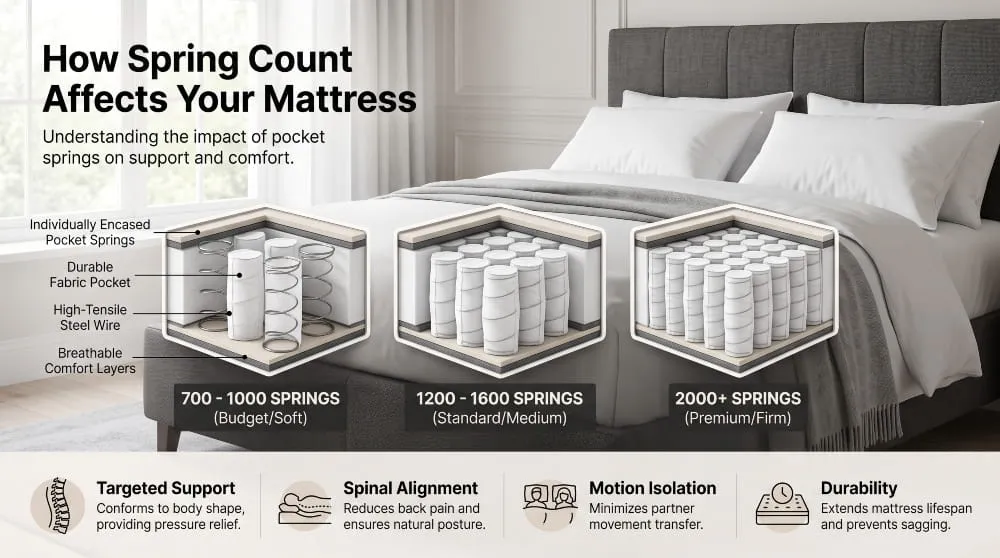
A mattress with 800 to 1000 pocket springs sits at the entry point of proper pocket sprung construction and suits people who want the benefits of independent springs without paying for a premium spec. At this count, springs are spaced further apart than in higher-count mattresses, so contouring is present but less detailed; support responds to broader areas of the body rather than fine-tuning to every curve. This range works well for lighter sleepers, guest rooms, or anyone who prioritizes value while still stepping up from a basic open-coil mattress.
Mattresses in the 1200 to 2000 spring range are the most common choice for UK main bedrooms, offering a noticeable step up in contouring accuracy and motion isolation compared to entry-level counts. With springs packed more densely, the mattress can respond to smaller changes in body shape and weight, providing more consistent support along the spine and reducing the risk of pressure points developing overnight. This range typically represents the sweet spot between comfort, support, and price for most sleepers.
At 3000 springs and above, a mattress features smaller-diameter springs packed far more tightly, allowing for highly detailed, point-by-point support across the entire sleeping surface. This density is particularly effective at isolating movement, making these mattresses a strong choice for couples with different sleep schedules or body weights. Higher spring counts also tend to correlate with a longer mattress lifespan, since the load is spread across more individual support points rather than concentrated on fewer, larger springs.
Not necessarily; spring count affects the precision and responsiveness of support. Still, firmness is determined separately by factors such as spring gauge (wire thickness), spring tension, and the comfort layers on top of the spring unit. A 2000-spring mattress can be softer than an 800-spring mattress if it uses thinner-gauge wire or a deeper pillow-top layer, so shoppers comparing spring counts should treat the number as an indicator of support quality and durability rather than a direct measure of how firm or soft the mattress will feel.
The core difference between a pocket-sprung and an open-coil mattress comes down to how the springs are connected: pocket-sprung mattresses use individually encased springs that move independently. In contrast, open-coil mattresses use a single interconnected wire structure in which springs move as a group. This structural difference shapes nearly every other aspect of how the two mattress types perform, from comfort to durability to how well they suit shared beds.
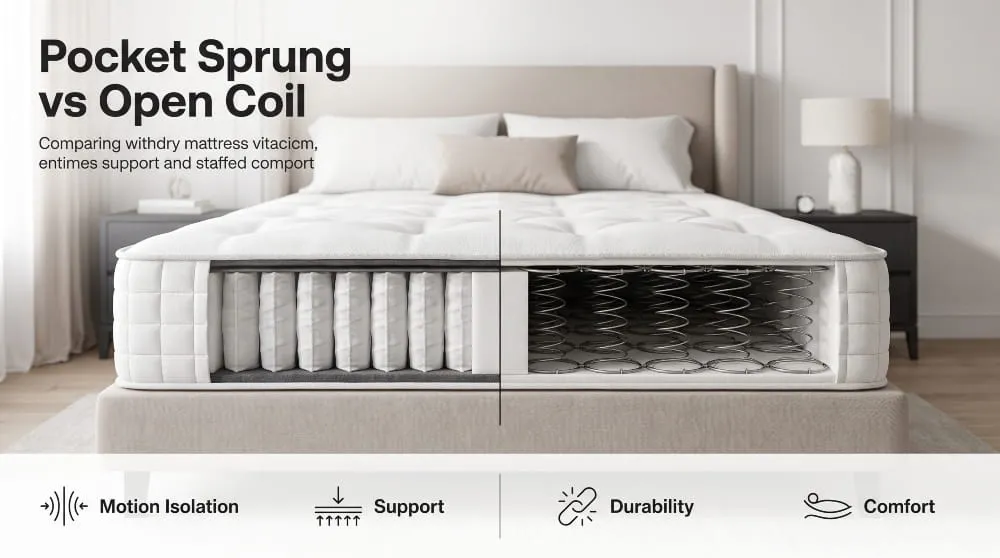
Because pocket springs compress individually, a pocket sprung mattress contours more closely to the body’s specific pressure points- shoulders, hips, lower back- while an open coil mattress flexes as a connected sheet, spreading pressure more evenly but less precisely. This independent movement also means motion isolation is far stronger in pocket sprung mattresses: when one spring compresses, it doesn’t pull on the springs around it, so movement on one side of the bed stays largely contained rather than traveling across the surface, which is why open coil mattresses tend to feel “bouncier” and transfer more movement overall.
Pocket-sprung mattresses generally offer more targeted, consistent support over time because the load is distributed across many independent springs rather than a single connected coil system, which reduces the risk of sagging in concentrated areas like the center of the mattress. Open coil mattresses, while typically more affordable, tend to wear out less evenly because the interconnected springs share stress across the entire unit, allowing weaker points to develop sooner. This is a key reason pocket sprung mattresses are usually positioned as the higher-durability, longer-term option in the UK market.
For couples, pocket-sprung mattresses are generally the stronger choice because their independent spring construction limits motion transfer, meaning that one partner turning over or getting in and out of bed is far less likely to disturb the other. This is particularly relevant for couples with different body weights, sleep schedules, or sleep positions, where an open-coil mattress’s interconnected structure would otherwise cause movement and pressure changes to ripple across the entire bed. Pocket sprung construction also allows manufacturers to build mattresses with different firmness zones across the width of the bed, giving each partner tailored support within the same mattress.
Yes, pocket-sprung mattresses are widely regarded as a high-quality choice, offering a strong balance of targeted support, durability, and motion isolation that outperforms basic open-coil designs. However, they aren’t the right fit for every sleeper or budget. Their main trade-off is cost: because each spring is individually made and encased, pocket-sprung mattresses generally sit at a higher price point than open-coil alternatives, and very high spring counts can add further cost without always delivering a proportional comfort benefit for lighter sleepers.
The primary benefit of a pocket-sprung mattress is its ability to contour precisely to the body, supporting the spine’s natural alignment while reducing pressure buildup at the shoulders and hips overnight. Independent spring movement also means significantly better motion isolation than open-coil mattresses, making pocket-sprung mattresses a strong choice for shared beds. Beyond comfort, the individual pocket construction tends to hold its shape longer, since weight is distributed across many separate support points rather than a single connected coil system. This structural advantage contributes directly to a longer mattress lifespan.
Pocket sprung mattresses suit sleepers who want responsive, body-contouring support without moving to a fully specialist material like memory foam or latex, as well as couples who need reduced motion transfer between partners. They’re also a strong fit for anyone prioritizing durability and long-term value, since the independent spring construction is built to maintain consistent support for years rather than developing early sagging. Sleepers on a tighter budget, or those who prefer a firmer, more traditional “bouncy” mattress feel, may find an open-coil mattress a more cost-effective alternative, though at the expense of the contouring and motion isolation that pocket-sprung mattresses provide.
Most sleepers get the best balance of comfort, support, and value from a mattress with 1,200 to 2,000 pocket springs, which provides enough density to deliver accurate contouring without paying a premium for spring counts beyond what most people can actually feel. The right number ultimately depends less on chasing the highest figure available and more on matching spring count to your body weight, sleeping position, and budget.
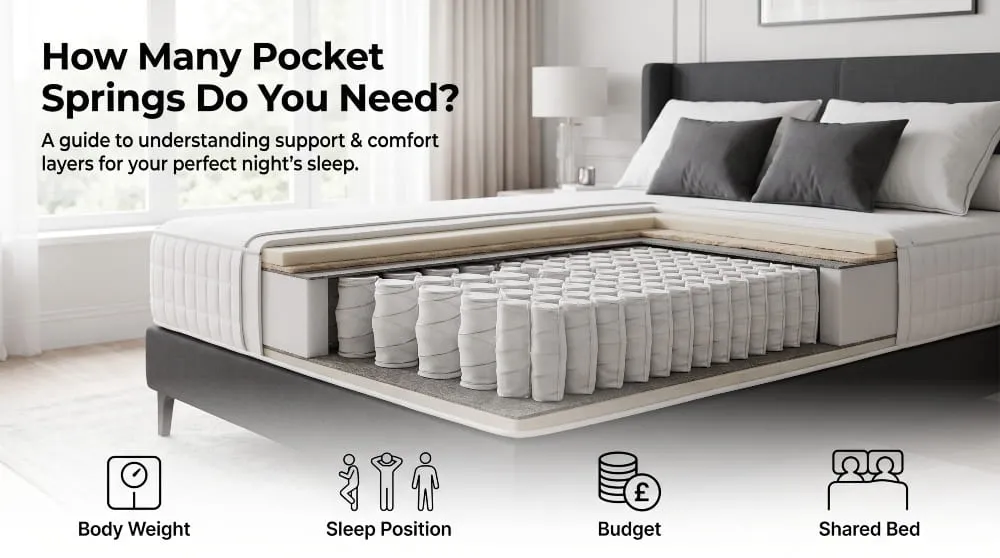
Lighter sleepers under around 12 stone often find 800–1000 springs perfectly sufficient, since less body weight is needed to engage each spring’s contouring response, making higher counts an unnecessary added cost. Average and heavier sleepers, or those who share a bed, tend to benefit more noticeably from 1,200–2,000 springs, where the denser spring layout provides more consistent support across a wider range of pressure points and body weights. Only sleepers seeking maximum motion isolation or the most detailed pressure relief, often paired with a pillow-top or hybrid comfort layer, need to look at 3,000 springs and above, since beyond this point, the comfort layers sitting on top of the spring unit tend to have a greater impact on feel than the spring count itself. As a practical guide: match spring count to your body weight and sleep position first, then treat budget as the deciding factor between two suitable ranges, rather than defaulting to the highest number available.
A pocket-sprung mattress should be rotated regularly and kept well-ventilated to maintain even support and extend the springs’ lifespan. Because the comfort layers and spring unit are designed to respond to consistent pressure patterns, simple, regular care makes a measurable difference in how long the mattress remains supportive.
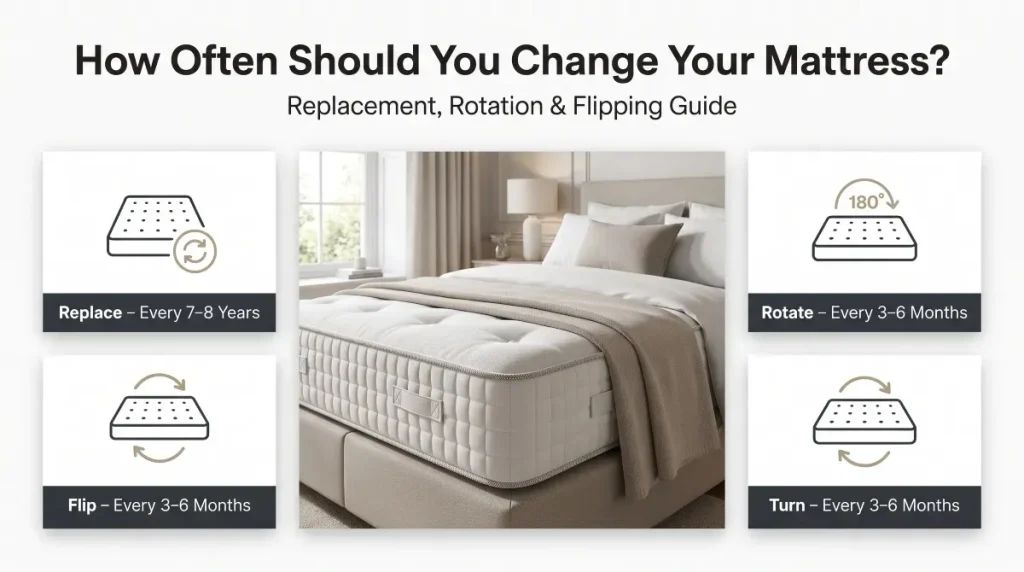
Most pocket sprung mattresses should be rotated head-to-foot every two to four weeks for the first few months, then roughly once every one to three months afterward, to prevent body impressions from forming in the same spots night after night. Many modern pocket sprung mattresses are designed as one-sided, meaning they shouldn’t be flipped over, so always check the care label first; rotating (not flipping) is the standard recommendation unless the mattress is specifically labeled as two-sided. Sticking to a regular rotation schedule during the first six months is particularly important, as the springs and comfort layers are still settling into shape.
Beyond rotation, using a fitted mattress protector helps prevent moisture, dust, and general wear from breaking down the fabric pockets and comfort layers over time. Allowing the mattress to air out regularly, pulling back bedding, and opening a window when possible reduce moisture buildup that can otherwise affect the springs and foam layers underneath. A supportive, well-fitted bed base also matters more than most people realize, since a sagging or unsupportive base can undermine even a high-quality pocket sprung mattress, causing uneven wear regardless of spring count. With consistent care, a good pocket-sprung mattress typically lasts 7 to 10 years before its support and comfort noticeably decline.
Style Beds offers a range of pocket sprung mattresses designed to combine precise, contouring support with the durability of traditional British craftsmanship, giving you a mattress built to suit your body rather than a one-size-fits-all spring count. Every mattress is made with the same attention to detail as our upholstered bed frames, so you get consistent quality whether you’re buying the mattress alone or as part of a complete bed.
Every Style Beds pocket sprung mattress is handcrafted at our workshop in Dewsbury, West Yorkshire, continuing a long-standing regional tradition of British bed and mattress manufacturing. Building mattresses in-house means closer control over spring quality, stitching, and comfort layer construction at every stage, rather than outsourcing to third-party mass production, the same standard we apply across our entire handcrafted bed frame range.
Choosing the right pocket sprung mattress often comes down to how it actually feels once you’re sleeping on it night after night, which is why every Style Beds mattress comes with a 30-night trial to test it properly in your own bedroom. Each mattress is also backed by a 3-year warranty, reflecting confidence in the spring and comfort layer construction holding up over time, and delivered free anywhere in the UK, so there’s no added cost to trying a mattress built specifically to your comfort needs.
A pocket-sprung mattress is a mattress built from individual springs, each sewn into its own fabric pocket, so it can compress and respond independently rather than moving as part of a connected coil system. This allows the mattress to contour closely to the body’s specific shape and weight distribution, offering more precise support than traditional open coil designs.
For most sleepers, yes, pocket-sprung mattresses offer better motion isolation, more accurate contouring, and generally greater durability than open-coil mattresses, since the independent springs distribute weight across many separate support points rather than a single connected unit. Open coil mattresses remain a valid, more affordable option for sleepers who prefer a firmer, bouncier feel and don’t need reduced motion transfer.
1,200 to 2,000 pocket springs are considered the sweet spot for most sleepers, offering strong contouring and support without paying for spring counts beyond what most people can feel makes a real difference. Lighter sleepers can often get sufficient support from 800–1,000 springs, while those seeking maximum motion isolation or pressure relief may look to 3,000 or more.
Yes, mattresses with 3,000 to 5,000+ pocket springs offer highly detailed, point-by-point support and strong motion isolation, making them well suited to couples or anyone prioritizing maximum pressure relief. That said, spring count alone doesn’t guarantee a better mattress; comfort layers and spring gauge also play a major role, so a very high spring count isn’t automatically necessary for every sleeper.
Most pocket sprung mattresses should be rotated head-to-foot every two to four weeks for the first few months, then every one to three months after that, to prevent uneven wear and body impressions from forming. Always check the care label first, since many modern pocket sprung mattresses are one-sided and designed to be rotated rather than flipped.