

UK Bed Mattress Sizes Guide (All Sizes in cm, Inches & Feet)
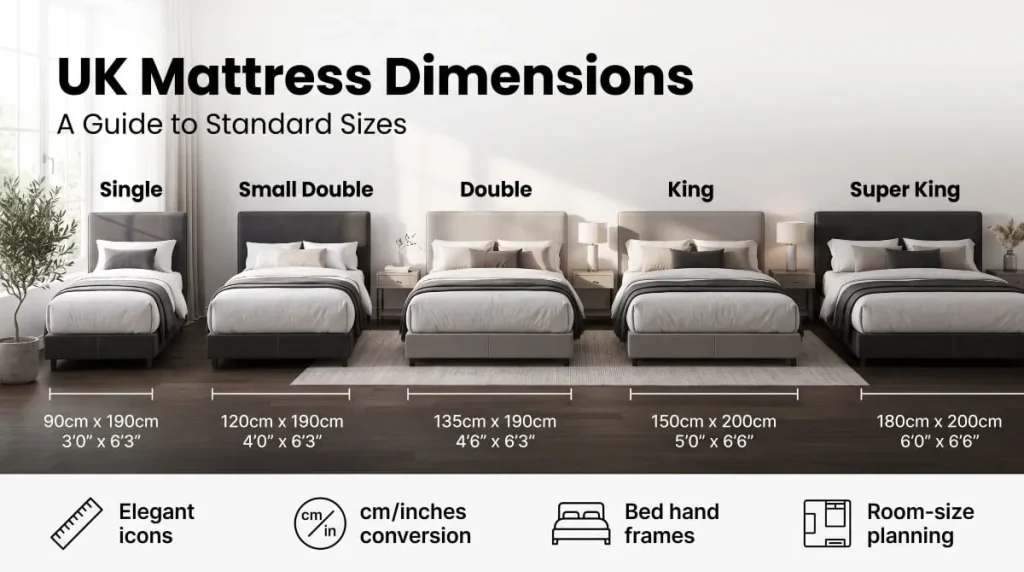
UK bed mattress sizes follow a standardised set of dimensions, from the 90 × 190 cm single up to the 180 × 200 cm super…
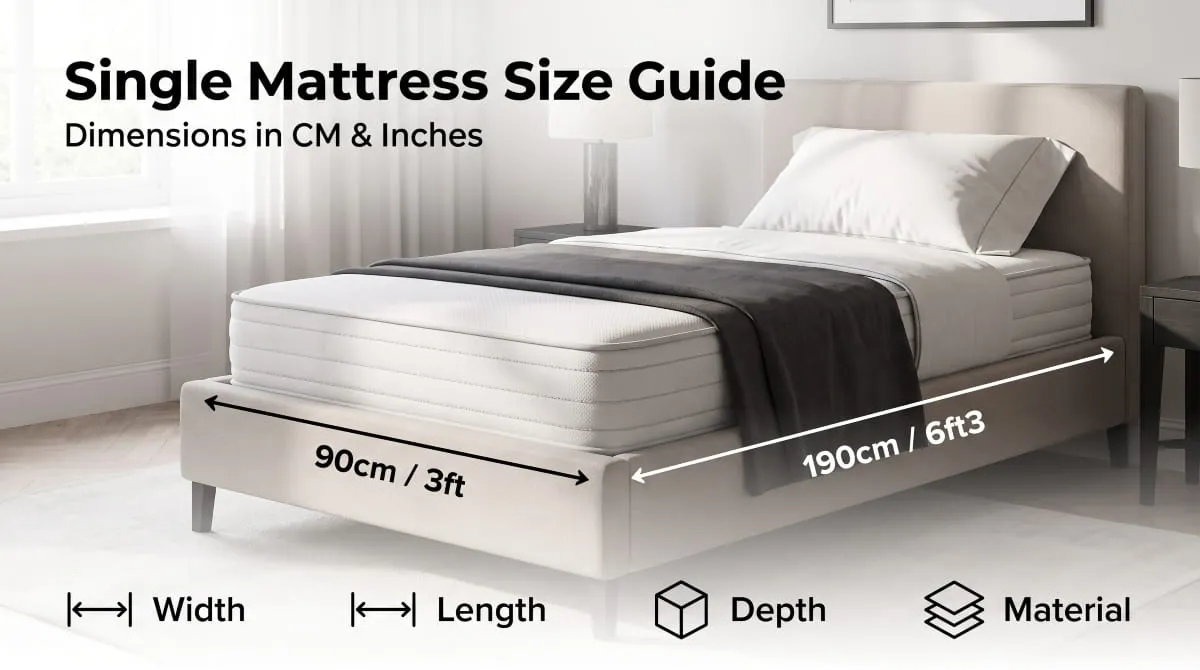
A single mattress in the UK measures 90cm x 190cm (3ft x 6 ft 3 in), making it the standard choice for children’s rooms, guest bedrooms, and single adults who want more floor space without sacrificing sleep quality. It’s the second-smallest mattress size after the small single, and the most widely stocked size across UK bed and mattress retailers.
In inches, that’s 35.5″ x 74.75″, enough length to comfortably suit most adults up to around 6ft tall, though taller sleepers often prefer the slightly longer options available in some ranges. The single mattress pairs with a matching single bed frame, and is one of four core mattress sizes sold in the UK, alongside small double, double, and super king.
Choosing the right size matters more than it might seem: a mattress that’s too short or narrow for its user is one of the most common causes of poor sleep quality in single rooms, particularly in growing children’s bedrooms where the wrong size gets outgrown within a couple of years. This guide breaks down the exact dimensions in cm and inches, the difference between a single and a small single mattress, the ideal thickness, and which type suits different rooms and budgets.
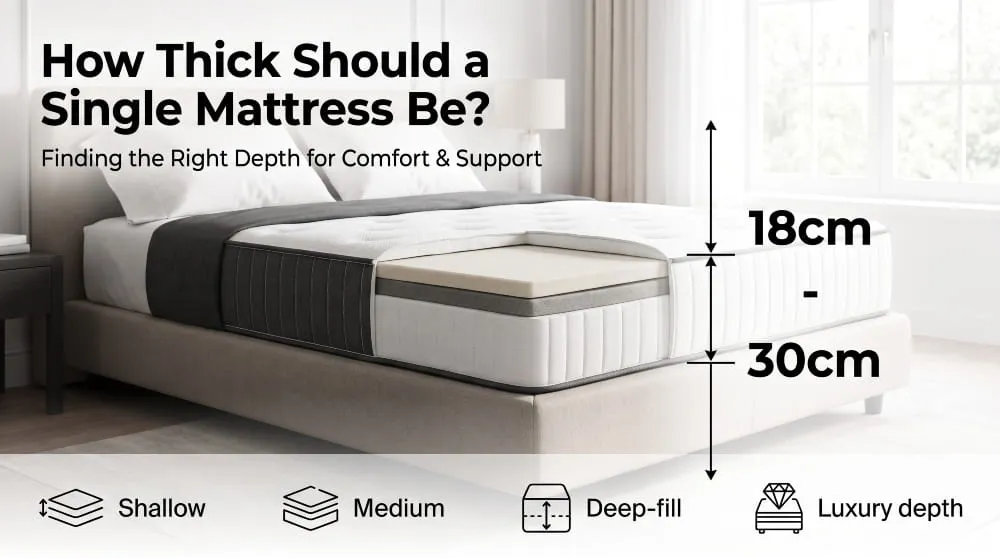
A UK single mattress measures 90cm wide by 190cm long, with depth typically ranging from 18cm to 30cm depending on the construction. These are the standard dimensions used across nearly all UK bed and mattress manufacturers, making the single one of the most consistently sized mattresses on the market.
The standard single mattress size in cm is 90cm x 190cm. Some ranges extend the length slightly to 200cm for taller sleepers, so it’s worth checking the exact spec before buying rather than assuming every “single” is identical. Depth varies more than length or width, ranging from around 18cm for budget foam options to 30cm or more for deeper pocket-sprung and hybrid builds.
In inches, a single mattress measures 35.5″ x 74.75″ (often rounded to 3ft x 6 ft 3 in retailer listings). This is the imperial conversion most commonly used when comparing UK sizing with older furniture or US mattress sizing charts, or when shopping for bedding and covers, where sizes are frequently still labelled in inches.
Length and width stay fixed at 190cm and 90cm across virtually every single mattress sold in the UK, but depth is where mattresses genuinely differ from one another. A shallow 18–20cm mattress suits children’s beds, guest rooms, or ottoman and storage beds where headboard height and lifting mechanisms need to be factored in. Deeper mattresses of 25cm and above generally offer more layers of support, pocket springs, memory foam, or hybrid comfort layers, and tend to suit single adults who use the bed as a primary sleeping space rather than an occasional one. As a rough benchmark, mattress depth is the single biggest factor in perceived comfort and support at this size, more so than length or width, since the standard frame already fixes both of those dimensions.
The main difference between a single and small single mattress is width: a small single measures 75cm wide compared to the standard single’s 90cm, while both share the same 190cm length. That 15cm gap is enough to change how a bed feels in use, and it’s a distinction that trips up many buyers who assume “small single” is just a marketing term for the same product.
A small single mattress measures 75cm x 190cm, often listed as 2’6″ x 6’3″ in imperial. It’s the narrowest mattress size sold in the UK, designed specifically for box rooms, box-room bunk beds, and spaces where a standard single frame simply won’t fit. Despite the narrower width, length stays the same as a full single, so it doesn’t compromise on sleeping space for shorter or younger users.
A standard single mattress measures 90cm x 190cm (3ft x 6ft3), giving noticeably more shoulder and elbow room than a small single while still fitting comfortably in most UK box and second bedrooms. This is the size most commonly stocked by retailers and specified as the default “single” across mattress and bed frame ranges, which is why it’s the safer default when a room’s exact dimensions aren’t yet confirmed.
The right choice comes down to available floor space and who’s using the bed. A small single suits rooms under roughly 6 ft 6 in wide, box rooms, or bunk bed setups where every centimetre counts. In contrast, a standard single is the better fit for most guest rooms, children moving up from a cot bed, and single adults who want a bit more room to move without stepping up to a small double. As a general rule, UK box rooms average around 6ft to 7ft in width, which is exactly the range where the choice between single and small single is often determined by the room itself rather than personal preference.
Yes, there is one recognised standard single mattress size in the UK: 90cm x 190cm (3ft x 6ft3). This measurement is set by the British Standards Institution and used consistently across mattress and bed frame manufacturers, which is why a single mattress bought from one retailer will almost always fit a single frame bought from another.
While 90cm x 190cm is the recognised UK standard, a small number of manufacturers produce an extended-length single at 90cm x 200cm to suit taller sleepers. Hence, it’s not universally fixed to the millimetre. This is worth checking before buying a mattress separately from a frame, since a 200cm mattress on a 190cm frame will overhang, and vice versa. Outside of that occasional length variation, single mattress sizing in the UK is far more standardised than sizes like double or king, where regional and manufacturer differences are more common.
A single bed frame is built to match the standard single mattress size of 90cm x 190cm, so the two should always be bought as a matching pair unless a frame explicitly states it accepts an extended-length mattress. The frame’s internal measurement, not its outer dimensions, is what determines mattress fit, since the outer frame includes the width of the side rails and headboard fixings. Buyers replacing a mattress on an existing frame should measure the internal base rather than relying on the frame’s product listing alone, since older frames and vintage or handmade builds can vary slightly from current standard sizing.
A single mattress should generally be between 20cm and 30cm thick, with anything below 18cm considered a budget or occasional-use depth and anything above 30cm classed as a deep-fill or luxury build. Thickness isn’t governed by a British Standard the way length and width are, so it varies far more by construction and price point than by any fixed rule.
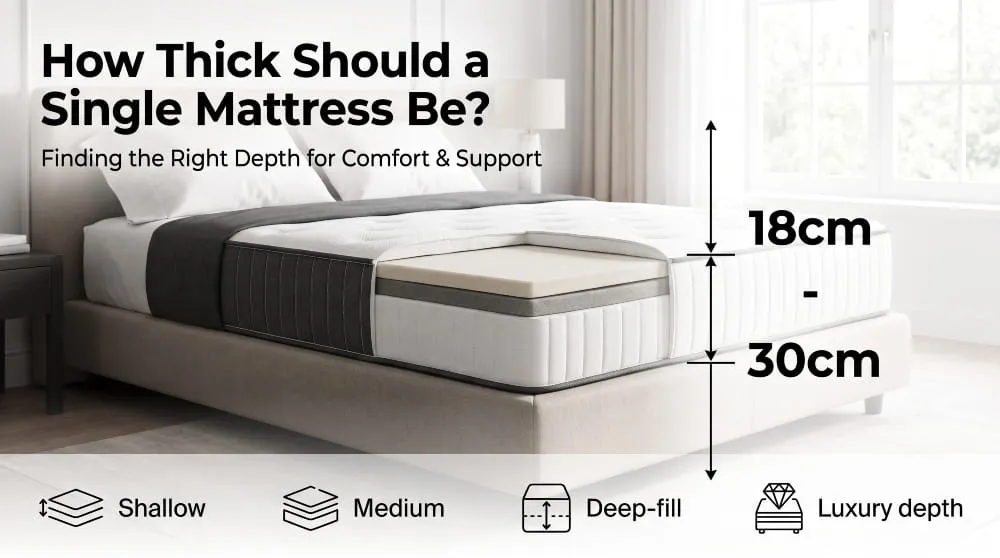
For a single mattress used as a primary bed, 22–25cm is generally the sweet spot for balancing comfort, support, and durability without adding unnecessary bulk to a smaller room. This range typically allows for a supportive base layer plus at least one comfort layer, whether that’s memory foam, pocket springs, or a hybrid combination. Mattresses below this depth can still be comfortable for lighter or younger sleepers, but tend to compress and lose support faster over time, which is one of the most common reasons a single mattress needs to be replaced sooner than expected.
Thinner mattresses, typically 15–20cm, suit children’s beds, guest rooms used occasionally, ottoman and storage beds where lift height matters, and budget-conscious buyers furnishing a second bedroom. Deep-fill mattresses of 28cm and above suit single adults who use the bed nightly, side sleepers who need more pressure relief in the hips and shoulders, and anyone upgrading from an older, worn mattress, where added support layers make a noticeable difference. As a general guide, sleep experts recommend against mattresses under 15cm deep for regular adult use, since there typically isn’t enough material to provide adequate long-term spinal support.
The main types of single mattresses available in the UK are pocket-sprung, memory foam, and orthopaedic or anti-allergy models, each suited to a different sleeper and budget. All three are available in the standard 90cm x 190cm single size, so the choice comes down to feel and support rather than fit.
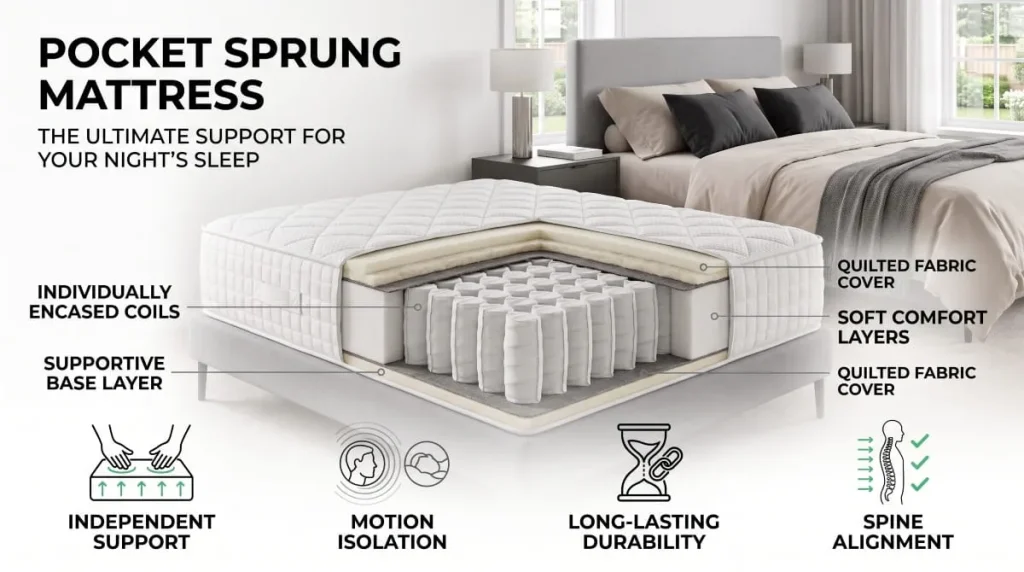
A pocket sprung single mattress uses hundreds of individually wrapped springs that move independently, contouring to the body and reducing motion transfer across the mattress surface. This construction tends to suit single adults and older children who need consistent nightly support, since the springs maintain their shape and breathability better over time than all-foam alternatives. It’s also the preferred choice for anyone prone to overheating at night, as the open spring structure allows more airflow than dense foam layers.
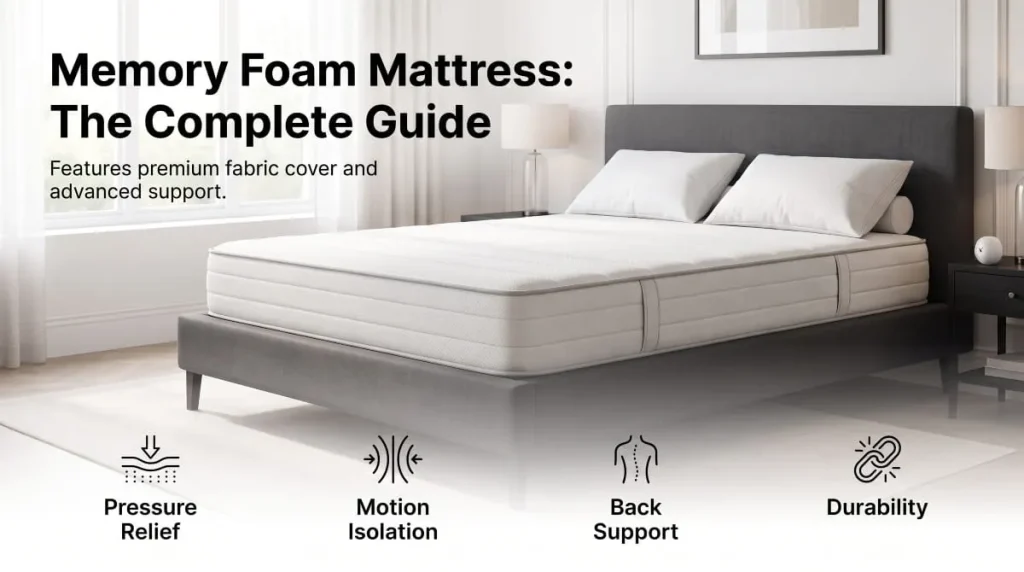
A memory foam single mattress moulds closely to the body’s shape, offering pressure relief that suits side sleepers and anyone dealing with joint or back discomfort. Because memory foam retains heat more than pocket springs, it’s better suited to cooler bedrooms or to pairing with a cooling cover in warmer rooms. This type is a popular choice for guest rooms and children’s beds too, since good-quality memory foam tends to be more affordable in the single size than an equivalent pocket-sprung build.
Orthopaedic single mattresses feature firmer support layers designed to keep the spine aligned, making them a common recommendation for back pain sufferers or older sleepers who need extra support. Anti-allergy single mattresses feature hypoallergenic covers and fillings treated to resist dust mites and bacteria, making them a sensible choice for children’s rooms and allergy-prone households. Both options are widely available at the standard single size and are frequently combined, since firmer orthopaedic support and hypoallergenic materials aren’t mutually exclusive features.
The best single mattress depends heavily on how the bed will actually be used, since a mattress built for nightly adult use isn’t always the right fit for a child’s room, a storage bed, or an occasional guest space. Matching mattress type and depth to the room’s purpose makes a bigger difference to comfort and value than chasing the highest spec available.
For children’s beds, a medium-firm mattress around 15–20cm deep offers enough support for a growing spine without the excess bulk or cost of a deep-fill adult mattress. Anti-allergy options are worth prioritising here, since children’s bedding is exposed to more spills, dust, and frequent washing than an adult’s. Because children grow quickly and bed needs change, many parents choose a mid-range mattress rather than investing in a premium build that may be replaced within a few years regardless of quality.
Ottoman and storage beds need a single mattress that’s compatible with the lifting mechanism, which usually means checking the frame’s maximum recommended depth before buying. A mattress that’s too deep or heavy can make the ottoman gas lift harder to operate and may void the frame’s warranty in some cases. Shallower mattresses around 18–22cm, ideally with a lighter pocket-sprung or foam-hybrid build, tend to work best for storage beds, balancing comfort with practical everyday lifting.
A guest room mattress needs to perform well infrequently rather than nightly, so a mid-depth mattress around 20–25cm with a pocket-sprung or hybrid build usually offers the best balance of comfort and cost. Guests staying only occasionally won’t put the same long-term wear on a mattress that a primary sleeper would, which means it’s rarely worth paying for premium depth or specialist support layers in a room used a handful of nights a year. This is also where a single frame with built-in storage, such as an ottoman or divan base, tends to add the most practical value, freeing up space in rooms that otherwise sit unused most of the time.
Once you know your ideal single mattress size and depth, the next step is to pair it with a bed frame built to match. Every Style Beds frame is handcrafted in our Dewsbury, West Yorkshire workshop to the standard single and small single dimensions covered in this guide. That means no guesswork on fit, whether you’re furnishing a box room, a child’s bedroom, or a guest space that needs to work harder for its footprint.
For the mattress itself, our pocket-sprung range offers the breathable, independently supported feel best suited to nightly adult use. At the same time, our memory foam options provide closer body contouring for pressure relief at a more accessible price point. Every mattress and frame is backed by a 3-year warranty and a 30-night trial, so there’s room to test the fit at home before committing, a reassurance particularly valuable for buyers moving between standard and small single sizing for the first time.
Free UK delivery is included as standard, and our team is on hand to talk through sizing, depth, or storage-bed compatibility before you order, whether that’s by phone or at our Dewsbury showroom.
A UK single mattress measures 90cm x 190cm (3ft x 6ft3), the standard size used across nearly all mattress and bed frame manufacturers.
A small single is 75cm x 190cm, 15cm narrower than a standard single, though both share the same length.
Most single mattresses range from 20–30cm deep, with 22–25cm offering the best balance of comfort and support for regular use.
Yes, a standard single comfortably suits adults up to around 6ft tall, though taller sleepers may prefer a longer 200 cm option.
Standard single fitted sheets are designed for a 90cm x 190cm mattress, though deeper mattresses over 25cm may need “deep fit” sheets for a secure fit.